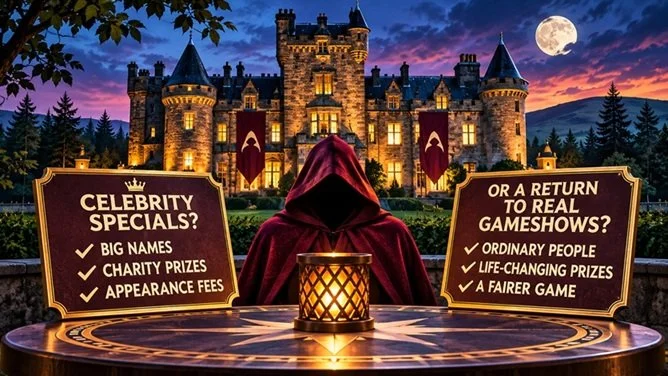
Celebrity specials or a return to gameshows featuring ordinary people? This AI-generated illustration reflects Great Park Gazette's debate over BBC's The Celebrity Traitors, celebrity appearance fees, charity prize money and whether everyday contestants deserve more opportunities to compete for life-changing cash prizes. Illustration: Great Park Gazette
OPINION | GREAT PARK GAZETTE
Two celebrity Traitors confessing their identities, reports of substantial appearance fees and an £83,000 charity prize have reignited a question about British television: when did gameshows become another opportunity for famous faces instead of ordinary people? Great Park Gazette examines the latest Celebrity Traitors series and asks whether television has lost something that made its classic gameshows so special.
For millions of British television viewers, gameshows used to offer something wonderfully simple: the opportunity to watch an ordinary member of the public walk into a television studio and potentially leave with a life-changing amount of money.
It didn't matter whether you were a shop assistant, a nurse, a factory worker, a teacher or someone living on a housing estate in Newcastle.
You could apply, get selected and, with a bit of knowledge, skill or luck, find yourself winning a prize that could genuinely transform your family's circumstances.
That was part of the magic of British gameshows.
Fast-forward to 2026, and switch on the television.
Once again, the screen is full of celebrities.
Celebrity editions of quizzes, competitions and reality programmes have become an established part of the television schedule.
The famous faces compete, the prize money goes to charity, and viewers are invited to celebrate the good causes involved.
There is nothing wrong with raising money for charity.
But there is a perfectly reasonable question that deserves asking.
Why should celebrities keep getting opportunities to compete on primetime television when ordinary people would love the chance to play those same games for themselves?
The recently concluded second series of BBC One's The Celebrity Traitors provides a particularly interesting example.
And for this writer, it also provides several reasons why the ordinary-contestant version remains the more compelling format.
The Celebrity Traitors 2026: What happened?
The second series of The Celebrity Traitors concluded on Friday 30 October 2026.
Twenty-one well-known personalities entered the castle in Scotland, competing in a game built around deception, suspicion, alliances and betrayal.
Unlike the ordinary edition, where the eventual winners keep the prize money, the celebrity contestants were playing to raise money for charities of their choice.
The prize fund eventually reached £83,000.
Faithful contestants Romesh Ranganathan and Sebastian Croft emerged victorious, with each securing £41,500 for their nominated charity.
Romesh chose the Refugee Council, while Sebastian supported Choose Love.
Those are meaningful donations, and the money will support worthwhile work.
But the series was not without controversy or moments that left some viewers questioning whether the celebrity version retains the essential spirit of the game.
Richard E Grant: A Traitor who gave himself away almost immediately
One of the central attractions of The Traitors is watching players attempt to identify people who are secretly deceiving them.
The entire format depends on Traitors concealing their identities.
They must convincingly lie, manipulate situations and survive roundtables without exposing themselves.
That is what creates tension.
Yet in the opening episode of this year's celebrity edition, actor Richard E Grant did something extraordinary.
After being selected as a Traitor, he effectively revealed his secret role to fellow contestants.
Although some initially interpreted the remark as a joke, suspicion quickly developed.
Grant was subsequently banished at the first roundtable.
For viewers hoping to watch an experienced actor expertly maintain a secret identity, the outcome was remarkable.
The premise of the game had been undermined by one of the players before it had properly developed.
Grant has since denied suggestions that he deliberately exposed himself to avoid spending longer filming the programme.
He described his slip-up as a genuine mistake and insisted he was enthusiastic about taking part.
That distinction matters. There is no established evidence that his early revelation was a calculated attempt to leave the competition.
But intentional or not, it deprived viewers of the strategic deception they had tuned in to watch.
And it was not the last time this happened.
James Acaster: Another Traitor admits the truth
Fast-forward to Thursday 29 October and the programme's semi-final.
Comedian James Acaster had successfully survived much of the competition as a Traitor.
Alongside Maya Jama and later recruit King Kenny, he had been involved in the deception central to the programme.
With the final approaching, the pressure intensified.
Actor Michael Sheen began questioning Acaster about the Traitors' activities, particularly a previous murder carried out in plain sight.
This was precisely the sort of tense confrontation that The Traitors is designed to produce.
A Traitor under pressure.
A Faithful developing a theory.
A roundtable where careful persuasion and convincing lies could determine who survived.
But rather than continue denying his involvement, Acaster admitted that he had been recruited as a Traitor.
The other contestants promptly voted him out.
To some viewers, the confession was dramatic and entertaining.
To others, it felt like another instance of a famous contestant abandoning the deception that makes the format work.
Acaster subsequently explained that he had struggled with the emotional consequences of deceiving other participants and that admitting the truth had become important to him.
His explanation suggests a genuinely difficult experience rather than an attempt to sabotage the programme.
Nevertheless, a viewer is entitled to be disappointed.
When a show is built around keeping secrets, having two Traitors reveal themselves takes away much of the challenge.
Would the same thing happen if those contestants were ordinary members of the public competing for £83,000 they could take home?
Possibly.
But that brings us to one of the biggest differences between the two versions.
Playing for charity is not the same as playing for your own future
Imagine two people entering The Traitors castle.
The first is a celebrity with an established career, television contacts and a reported appearance fee for taking part.
The second is an ordinary working person who has taken time away from their job and family to compete for a potentially life-changing cash prize.
Both might want to win.
Both might become nervous, emotional or overwhelmed.
Both might make mistakes.
But the financial stakes are fundamentally different.
For the ordinary contestant, winning could mean paying off a mortgage, clearing debts, helping children through university or creating some financial security for their family.
For the celebrity contestant, winning delivers money to a chosen charity, while their own financial arrangements for appearing on the programme are separate.
That is not to suggest celebrities do not care deeply about their charities.
Many clearly do.
Nor does it mean an ordinary contestant would automatically play more intelligently or ruthlessly.
But personal financial stakes can change how people assess risks and rewards.
For someone who might never have another opportunity to win such a significant sum, every decision can feel enormously consequential.
A badly judged accusation, an unnecessary confession or a tactical mistake could cost them money that would genuinely change their lives.
For celebrities, the absence of a personal cash jackpot removes that particular pressure.
And the Gazette believes that changes the viewing experience.
Could playing for charity change how Traitors treat one another?
One of the most compelling aspects of The Traitors is the possibility that Traitors will betray their fellow Traitors.
They might sacrifice an ally to protect themselves.
They might allow suspicion to fall on another Traitor.
They might even help banish a teammate to strengthen their chances of reaching the final.
When the eventual prize is personal money, those decisions have an obvious financial incentive.
If two Traitors reach the finish together, they may have to share the winnings. A sole surviving Traitor could potentially take the whole pot.
That creates a powerful reason to think strategically about loyalty.
In a charity edition, the incentives are different.
The contestants may be equally passionate about securing money for their chosen causes, but the desire to maximise personal winnings is absent.
Could this make some celebrity Traitors less willing to betray one another?
It is a reasonable theory, although it is not something the 2026 series proves.
Indeed, the series included examples of Traitors voting against other Traitors, and King Kenny's actions contributed to Maya Jama's elimination in the final.
There was still deception, tactical play and betrayal.
But the broader point remains: changing who receives the prize changes the incentives around which the game operates.
And the producers should not assume that a celebrity charity edition will recreate exactly the same competitive pressure as a game played for personal financial reward.
The appearance fee question: Are celebrities being paid more than the prize fund?
Another issue concerns the money reportedly paid to celebrity contestants simply for taking part.
Media reports surrounding The Celebrity Traitors have suggested appearance fees of approximately £40,000 per participant.
However, those figures should not be treated as confirmed payments to every individual.
Former England rugby player Joe Marler publicly disclosed that he received £30,000 for participating in the 2025 celebrity series.
He explained that the payment was the same whether he remained in the competition for a couple of days or several weeks.
The BBC has declined to disclose individual fees when questioned by journalists about the programme.
As a result, Great Park Gazette cannot establish exactly what Richard E Grant, James Acaster or any other participant was paid for the 2026 series.
But the reported arrangements still raise a legitimate question about value for money.
Consider the contrast.
The entire winning charity prize this year totalled £83,000.
One previously confirmed celebrity appearance fee was £30,000.
That means the publicly disclosed fee for one participant in the earlier series was equivalent to more than a third of this year's complete charity prize.
This does not establish the production's total celebrity fee bill, and it would be misleading to multiply a reported figure by every contestant and present the result as an audited expenditure.
But it does illustrate why viewers might reasonably want greater transparency.
The show may have raised £83,000 for charity, but what did it cost to secure its celebrity cast?
How much of the overall production budget was spent on appearance fees?
And could some of that money instead have funded bigger prizes for ordinary contestants?
Those are fair questions for a broadcaster primarily supported by the television licence fee.
Does the BBC receive tax relief because the prize goes to charity?
There is another claim sometimes made about celebrity charity programmes: that broadcasters benefit financially through tax relief when prize money is donated rather than paid to individual contestants.
We examined that claim.
Under HMRC rules, qualifying limited companies can generally deduct eligible charitable donations from their taxable profits.
In principle, this can reduce their Corporation Tax liability.
But that does not establish that the BBC receives a tax advantage from The Celebrity Traitors.
The BBC has a particular public-service funding structure.
Its public-service broadcasting activities are generally not subject to Corporation Tax on licence-fee income, although parts of its wider operations and commercial subsidiaries are subject to taxation.
The Celebrity Traitors is also made for the BBC by the independent production company Studio Lambert Scotland.
The financial arrangements governing the prize, any donation, the production budget and any tax treatment have not been publicly established in the sources examined by Great Park Gazette.
There is therefore no verified basis for claiming that the BBC makes celebrity charity specials specifically to obtain a tax break.
That would be speculation rather than established fact.
The stronger argument is about programming priorities, appearance fees, public funding and opportunities for ordinary contestants.
Those concerns stand on their own without relying on an unproven tax allegation.
This is licence-fee-funded television – so what should audiences expect?
The BBC is a public-service broadcaster funded principally by the television licence fee.
The annual licence fee increased to £180 from April 2026.
That means millions of households contribute to financing the programmes broadcast across the corporation's television and other services.
Great Park residents are among those households.
The BBC also earns commercial revenue, and independent production companies may be paid to make programmes for it. Publicly available information does not establish the precise funding route for each celebrity's individual fee.
But the broader principle of accountability remains.
If a public-service broadcaster commissions expensive entertainment with famous participants, viewers are entitled to question whether it represents good value and whether ordinary licence-fee payers are being properly served.
The argument is not that celebrities should work for nothing.
Performers, presenters and contributors may reasonably be paid for their time and professional commitments.
Rather, it is whether television needs so many celebrity editions in the first place.
But wasn't Celebrity Traitors a huge success?
Yes. And any fair assessment must acknowledge it.
The 2026 finale attracted an average overnight audience of approximately 11.2 million viewers, peaking at 11.6 million.
The semi-final, in which Acaster confessed, also drew an enormous audience.
The programme was plainly popular.
Many viewers loved the chaotic gameplay, the famous personalities and the unexpected confessions.
Others may have found Grant's slip-up and Acaster's admission among the most memorable moments of the series.
There is also an important charitable benefit.
The 2026 winners secured £83,000 for two charities that will put the money towards their work.
These are meaningful arguments in favour of keeping celebrity editions.
But popularity does not make a programme immune from criticism.
A television show can attract millions of viewers while still leaving some questioning whether the game itself has been compromised.
And a charity prize does not automatically settle questions about the cost of producing the programme.
The real issue is not whether Celebrity Traitors should ever exist. It is whether celebrity television should be allowed to overshadow the opportunities available to ordinary people.
Remember when ordinary people were the stars of gameshows?
For viewers who grew up watching television in the 1980s and 1990s, the difference is striking.
Think back to programmes such as Bullseye, The Generation Game, Family Fortunes, Catchphrase and The Price Is Right.
Or the excitement surrounding Who Wants to Be a Millionaire? when it launched in 1998.
These programmes created excitement around people the audience had never previously heard of.
The contestants weren't professional celebrities.
They were members of the public.
Some were brilliant.
Some were hopelessly nervous.
Some made hilarious mistakes.
And others produced remarkable performances that became memorable television moments.
Part of the attraction was that those contestants could have been your neighbour, your colleague or a member of your family.
When they won something substantial, viewers could imagine what that prize would mean to them.
When they failed, the disappointment felt genuine.
The contestants were the stars because of what happened during the game, not because they had already become famous elsewhere.
Of course, classic gameshows were not perfect.
Some offered modest prizes, some were heavily theatrical, and celebrity editions were around in earlier decades too.
But the principle of giving ordinary people a genuine chance to shine deserves greater attention today.
A chance for someone from Great Park?
Imagine a major television gameshow featuring a teacher from Newcastle Great Park.
Or an NHS worker from Gosforth.
A supermarket employee from Kingston Park.
A retired shipyard worker from Wallsend.
Perhaps a parent hoping to win enough to ease the pressure of rising household bills.
These people may have no television experience, no publicist and no established audience.
But they might be brilliant contestants.
They might be charismatic, intelligent, funny, ruthless or surprisingly good at reading other people.
That is part of the attraction of reality competition.
You do not need to be famous to be fascinating.
And with many households facing significant cost-of-living pressures, a substantial prize could make an extraordinary difference to an ordinary person's life.
To be fair, ordinary people can still apply for The Traitors
The BBC has not abandoned civilian contestants.
The regular version of The Traitors remains a major success, with further series planned.
Applications for the sixth civilian series are already open through production company Studio Lambert.
That is welcome news.
And it means the celebrity edition has not simply replaced the original format.
Nevertheless, television schedules, production budgets and commissioning opportunities are finite.
Every additional celebrity special represents time and resources that broadcasters could potentially devote to other formats.
Great Park Gazette would like to see broadcasters make ordinary-contestant gameshows the priority, rather than increasingly relying on familiar famous faces to attract attention.
Those interested in applying for the civilian edition can visit:
Studio Lambert – Apply for The Traitors UK
Time to put the public back at the heart of television
Celebrity charity specials are not inherently bad television.
They can be entertaining, raise worthwhile sums and attract audiences who might not otherwise watch a programme.
But they should remain occasional additions rather than become the default approach to filling popular television formats.
The Celebrity Traitors 2026 demonstrated both sides of that argument.
It attracted extraordinary viewing figures and delivered money to charity.
Yet it also featured two Traitors revealing their identities, raising questions for some viewers about the nature of the competition.
Meanwhile, reports of substantial celebrity appearance fees create a separate discussion about the use of broadcasting budgets.
For this writer, the solution is straightforward.
Keep celebrity editions as occasional special events. Put more ordinary contestants on television. Make the prize money meaningful. And give the public the chance to be the stars again.
The great British gameshow should not have to depend on famous faces.
Sometimes the most entertaining person on television is someone nobody has ever heard of.
And sometimes the most satisfying ending isn't watching a celebrity hand a cheque to charity.
It's watching an ordinary person realise that their life has just changed.
What do Great Park residents think?
Has British television become too dependent on celebrity specials?
Did Richard E Grant and James Acaster's confessions spoil this year's Celebrity Traitors for you, or were those moments part of the entertainment?
Would you rather see ordinary people competing for life-changing prizes?
And should the BBC publish more information about the costs of celebrity appearances on licence-fee-funded programmes?
Great Park Gazette would love to hear your views.
Email editor@greatparkgazette.co.uk or join the conversation through the Great Park Residents Group.
Published Sunday 1 November 2026.
This is an opinion article. Judgements about the quality of The Celebrity Traitors and the future of gameshows are editorial views. Financial figures, programme events and tax information have been distinguished from unverified claims.
Research and further reading

