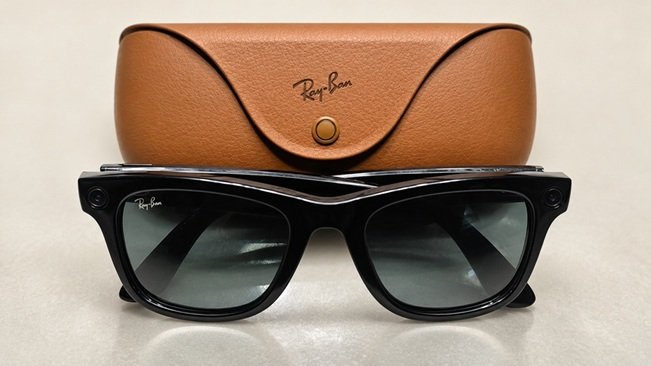
Ray-Ban Meta smart glasses feature discreet built-in cameras capable of recording photographs and videos without a handheld device. Concerns over privacy, the filming of vulnerable people and potential misuse have sparked debate in Newcastle and across the UK over whether tougher restrictions or an outright ban are needed. Illustrative image: Great Park Gazette
Smart glasses promoted by celebrities including Kylie Jenner are facing growing scrutiny over fears they could be used to secretly record unsuspecting members of the public, with Newcastle City Council already taking action against social media creators accused of exploiting vulnerable people for online views.
The increasingly popular glasses, developed by technology giant Meta, allow wearers to record photographs and videos using cameras built directly into their frames, often without the need to hold a phone or conventional camera.
Although the technology offers a range of legitimate benefits, concerns have emerged about its potential misuse, particularly when people are filmed without their knowledge and the footage is subsequently uploaded to social media platforms such as Facebook, TikTok and Instagram.
In Newcastle, the issue has become particularly controversial following the circulation of videos featuring people experiencing homelessness, intoxication and other vulnerable circumstances.
Some videos have attracted millions of views, with critics accusing content creators of turning the personal difficulties of others into entertainment.
Newcastle City Council has already issued formal warnings to two individuals over recording members of the public without informed consent, while proposals to introduce wider restrictions on harassing filming have also been considered.
Meanwhile, the technology has raised a separate and potentially more disturbing concern: could these glasses be used for sexual harassment, voyeurism or recording women and children without their knowledge?
With the UK Government now considering additional restrictions, Great Park Gazette examines the technology, the controversy in Newcastle, the laws already in place and whether stronger regulation — or even a complete ban — is necessary.
What Are Meta Smart Glasses and How Do They Work?
Meta's smart glasses look remarkably similar to ordinary prescription glasses or sunglasses.
The company has partnered with established eyewear manufacturers, including Ray-Ban and Oakley, to develop devices that incorporate cameras, microphones, speakers and artificial intelligence technology.
Depending on the model, users can take photographs, record videos, make telephone calls, listen to music, access AI assistance and receive information about their surroundings.
One of the main selling points is the ability to capture footage hands-free.
Instead of holding a smartphone in front of someone, a wearer can activate recording through controls on the glasses or supported voice commands.
This allows footage to be recorded from approximately the same viewpoint as the person wearing them.
For tourists, sports enthusiasts, people with disabilities and those who enjoy recording everyday activities, the technology can be extremely useful.
However, it also creates a significant privacy concern.
Someone wearing what appear to be ordinary glasses could potentially be recording the people around them, without those individuals realising that a camera is being used.
Unlike a smartphone, which is usually visible when pointed towards someone, recording glasses may be much harder to recognise.
And with millions of pairs already sold worldwide, the technology is becoming increasingly common.
Kylie Jenner Helps Bring Smart Glasses Into the Mainstream
Meta has invested heavily in promoting its smart glasses, including a high-profile collaboration with reality television personality and businesswoman Kylie Jenner.
The celebrity has appeared in advertising for the company's Meta Glasses by Kylie range, helping introduce the technology to a wider fashion and lifestyle audience.
For Meta, the association with a globally recognised celebrity is part of an effort to establish smart glasses as everyday accessories rather than specialist technology.
However, the growing popularity of the devices has coincided with increasing criticism about how some people are using them.
Campaigners argue that presenting camera-equipped glasses as ordinary fashion accessories risks normalising a technology that can record people without them necessarily being aware.
Supporters counter that the glasses have numerous legitimate uses and should not be judged entirely by the actions of a minority who misuse them.
The debate highlights a fundamental question about wearable technology.
Should the convenience of recording everyday life outweigh the right of other people to know when they are being filmed?
Newcastle Social Media Videos Spark Public Outrage
The controversy is particularly relevant to Newcastle, where videos recorded in public places have attracted widespread attention.
During the summer of 2026, concerns grew over content creators filming people in Newcastle city centre who appeared to be experiencing homelessness, intoxication or other personal difficulties.
Some footage showed individuals in visibly vulnerable circumstances, with the resulting videos attracting large audiences and comments that critics considered humiliating or dehumanising.
Content creators sometimes describe these recordings as documenting everyday life or raising awareness of problems on the streets.
However, campaigners have questioned whether filming somebody at a particularly difficult moment in their life, then publishing the footage to an audience of thousands or millions, can reasonably be justified without that person's informed consent.
The issue prompted a petition calling for Newcastle City Council and Northumbria Police to take action.
By August 2026, more than 5,600 people had reportedly signed the petition, which sought stronger protections against the public humiliation of vulnerable individuals for online entertainment.
The central argument was that people experiencing personal difficulties should not automatically become material for viral videos simply because they happen to be in a public place.
For many residents, the question extends beyond whether the recording itself is technically legal.
It concerns dignity, consent and the potential harm caused when footage is shared online.
Local Content Creators Named in Public Controversy
The Newcastle controversy has also involved public discussion about individual social media creators.
In July 2026, reporting by the BBC identified creators Michael Ballymore and Tin Tin as having been named in a petition calling for action against the filming of vulnerable people.
The creators disputed suggestions that their activities were intended to exploit people for entertainment.
In a joint statement, they said they aimed to operate responsibly and within the law while highlighting issues occurring on the streets.
Tin Tin also stated that the recording indicator on his smart glasses was visible and explained that he sometimes made people aware they were being recorded through gestures or verbal statements.
The creators have therefore presented their activities as a form of documenting public life rather than deliberately targeting people for humiliation.
However, critics argue that there is an important distinction between filming somebody who understands and agrees to participate and recording someone who may be intoxicated, distressed, sleeping rough or otherwise unable to make an informed decision.
Being physically present in a public space does not necessarily mean somebody understands that a video of them could subsequently be shared with a large online audience.
Equally, appearing in controversial videos does not, by itself, establish that a content creator has committed a criminal offence.
Great Park Gazette has not established that any named creator has deliberately disabled a recording light, committed a sexual offence or been convicted of unlawful filming.
These distinctions are important when examining a controversy that involves both legitimate concerns about vulnerable people and the reputations of identifiable individuals.
Newcastle City Council Issues Warnings Over Filming
In August 2026, Newcastle City Council confirmed that it had issued Community Protection Warnings to two social media creators.
The warnings instructed the individuals not to record members of the public without their informed consent in public places within Newcastle.
The action followed concerns about the filming of vulnerable people and the subsequent publication of videos on social media.
Councillor Mark Mitchell, Deputy Leader of Newcastle City Council, publicly criticised what he described as the exploitation of people experiencing difficult circumstances for online engagement.
The council's position was that deliberate, repeated and harassing filming could constitute behaviour requiring intervention.
However, there is an important distinction between these warnings and a general ban.
A Community Protection Warning is not the same as a criminal conviction, and Newcastle has not introduced a blanket ban on smart glasses or all filming in public places.
Community Protection Warnings are an initial intervention that can precede a formal Community Protection Notice.
Where the relevant legal conditions are met, a notice can impose requirements intended to stop persistent, unreasonable behaviour that has a detrimental effect on the community.
Failure to comply with a valid Community Protection Notice can lead to enforcement action and criminal penalties.
The action taken in Newcastle nevertheless represents a significant example of a local authority attempting to address the harmful use of recording technology without prohibiting ordinary photography or filming.
It also raises questions about whether councils elsewhere should adopt similar approaches.
Has Filming Vulnerable People Now Been Banned?
Not universally.
Newcastle City Council has taken action against specific individuals, while also consulting on proposals to strengthen its powers over antisocial behaviour in public spaces.
In September 2026, residents were invited to comment on plans for a Public Spaces Protection Order, commonly known as a PSPO.
Among the behaviours being considered for restriction was harassing recording of individuals.
The consultation, which closed on 25 September, was designed to help the council determine what measures would be appropriate and proportionate.
The focus was not simply on banning people from taking photographs or recording videos in public.
Instead, the proposals sought to address filming that causes harassment, alarm or distress.
The council has emphasised the importance of protecting vulnerable people while allowing legitimate activities to continue.
However, the publicly available council information checked for this article does not establish that a new PSPO specifically prohibiting harassing recording has yet come into force.
This means residents should not assume that every form of non-consensual public filming has suddenly become unlawful.
The distinction is especially important because a person being recorded without permission does not automatically mean a criminal offence has occurred under existing English law.
The circumstances, purpose and manner of the recording can be crucial.
Can You Legally Film Someone Without Their Permission?
Under current law in England, there is no general rule requiring permission before every photograph or video recording in a public place.
Members of the public can usually photograph or film streets, buildings, events and other people in public areas, provided their conduct does not breach other laws.
This is important for journalism, documentary filmmaking, public accountability and the recording of incidents that may be in the public interest.
For example, filming an accident, documenting antisocial behaviour or recording interactions with public officials may sometimes serve a legitimate purpose.
However, the legal position becomes more complicated when somebody is deliberately targeted.
Conduct involving harassment, stalking, intimidation, sexual offences or the misuse of private information may be unlawful even when it takes place in public.
Different rules and expectations can also apply inside privately controlled locations such as shops, restaurants and shopping centres.
Publishing footage online creates additional questions relating to privacy, data protection and platform policies.
The distinction is therefore not simply between recording with permission and recording without permission.
It is about the circumstances of the recording, the rights of the people involved and what subsequently happens to the footage.
Could Smart Glasses Be Used for Voyeurism or Sexual Harassment?
One of the most serious concerns surrounding smart glasses is their potential misuse for sexual purposes.
Because the cameras are built into ordinary-looking eyewear, there are fears that they could be used to record women and girls without their knowledge, including in circumstances where they would reasonably expect privacy.
The technology could also potentially facilitate stalking, unwanted monitoring, sexualised harassment and other forms of abuse.
There have been reports internationally of women discovering that interactions were filmed without their knowledge and later uploaded to social media.
Some campaigners have consequently used the controversial description "pervert glasses" when criticising camera-equipped smart eyewear.
However, that term should not be applied to everyone who owns or uses the technology.
Many people use smart glasses for entirely legitimate activities, including accessibility assistance and communication.
The concern is the potential for misuse.
Existing UK law already criminalises various forms of voyeurism, upskirting, harassment, stalking and the sharing of intimate images without consent.
Depending on the circumstances, smart glasses could be used to commit such offences.
But campaigners argue that laws designed before wearable cameras became widespread may not adequately address every form of covert or unwanted filming.
For example, an individual might secretly record a woman during an ordinary interaction, make inappropriate comments about her and post the footage online.
That behaviour could be deeply distressing without necessarily satisfying the legal requirements of a particular criminal offence.
The difficulty of proving criminal intent, identifying the person responsible and removing footage after publication creates further challenges.
The issue has now attracted attention at the highest levels of government.
Parliament Debates Smart Glasses and Women's Safety
On 4 November 2026, MPs debated smart glasses and violence against women and girls in Westminster Hall.
The debate, led by Liberal Democrat MP Anna Sabine, examined concerns that wearable recording technology could make it easier for individuals to film strangers discreetly.
MPs discussed the potential for sexual harassment, voyeurism, stalking, online abuse and the publication of footage without consent.
Some argued that existing safeguards were insufficient because victims might never know they had been recorded until a video appeared online.
Others highlighted the legitimate benefits of smart glasses, particularly for people who are blind or partially sighted.
Responding to the debate, Home Office minister Satvir Kaur confirmed that the Government was examining options to restrict smart glasses in certain settings and potentially restrict sales to certain users.
She also indicated that NHS England and the Department for Education were reviewing aspects of wearable technology use in healthcare and education.
These were proposals under consideration, not an announcement of a nationwide ban.
The debate demonstrates that concerns about smart glasses are no longer limited to social media discussions or local disputes.
They have become a national question about privacy, public safety and the responsibilities of technology manufacturers.
Can People Cover the Recording Light to Film Secretly?
Another major concern involves the small light fitted to Meta's glasses that is intended to warn people when recording takes place.
Meta refers to this as the capture LED.
When the glasses record video for the user's gallery, the light is designed to flash or pulse, providing a visual indication that the camera is active.
However, reports emerged of people attempting to obscure, remove or modify this light.
Some online discussions also described ways users had previously attempted to avoid the safeguards intended to prevent recording when the light was covered.
This raised an obvious concern.
If someone could conceal the recording indicator, how would a member of the public know they were being filmed?
Meta has acknowledged attempts to tamper with the light and introduced software updates intended to prevent the camera from operating when the indicator is obstructed or damaged.
In August 2026, the company strengthened these protections following reports of a loophole involving the light being covered after recording had already started.
Meta says its updated systems now stop recording when the capture LED is obstructed during filming.
The company has also taken action against services advertising modifications designed to defeat the indicator.
Nevertheless, questions remain over how easily the light can be noticed in different lighting conditions and whether a small visual indicator provides adequate notice to nearby people.
There are also differences between the operation of AI camera features and conventional saved video recording on some models.
A recording indicator is a safety feature, not proof that everyone nearby has understood or consented to being filmed.
It is equally important not to assume that a particular local content creator has modified their glasses simply because the possibility has been discussed online.
Such an allegation would require specific evidence.
Pubs, Theatres and Courts Introduce Restrictions
Concerns about smart glasses have already prompted restrictions in a range of locations across the UK.
Pub chain Wetherspoon has adopted a policy against filming customers and employees without their permission, including when using smart glasses.
Some restaurants and private members' venues have also restricted the use of camera-equipped eyewear over privacy concerns.
Theatre operators have taken action to prevent unauthorised recording during performances.
Courts and tribunals in England and Wales have restrictions on smart glasses, reflecting the particular importance of privacy and the integrity of legal proceedings.
Cinemas have also considered whether additional restrictions are necessary because of potential copyright infringement and unauthorised recording.
These developments suggest that organisations are already attempting to balance the benefits of wearable technology against the rights of other people.
However, individual venue restrictions are not the same as a nationwide legal prohibition.
What About Children and Other Vulnerable People?
The debate is not limited to adults.
Parents may reasonably be concerned about children being filmed in public places without their knowledge, particularly if the footage is later shared with strangers online.
There may also be concerns about recording near schools, playgrounds, leisure facilities and other locations frequented by children.
Although ordinary filming in public is not automatically illegal, circumstances involving harassment, indecent images or safeguarding risks may trigger specific legal responsibilities.
The same concerns apply to vulnerable adults.
People experiencing homelessness, severe intoxication, mental health difficulties or other personal crises may be less able to understand that a recording is taking place or appreciate the consequences of having footage published online.
A person appearing to cooperate with a camera does not necessarily establish that they have provided informed consent to widespread online distribution.
This raises an ethical question that goes beyond the minimum requirements of criminal law.
Just because somebody can legally record another person, does that necessarily mean they should?
For many critics of the current social media culture, this is the central issue.
The pursuit of views, engagement and online popularity should not come at the expense of another person's dignity.
Should Social Media Companies Be Doing More?
The controversy also raises questions about the responsibilities of social media platforms.
When footage of vulnerable people is uploaded online, it can attract substantial engagement through comments, reactions and shares.
Some of that attention may be sympathetic or intended to highlight social problems.
However, other interactions can involve mockery, humiliation or abusive comments.
Campaigners argue that social media companies should do more to prevent harmful footage from spreading and provide faster, more effective ways for affected individuals to request its removal.
Meta has said it takes action against content involving harassment and exploitation and has strengthened policies and enforcement relating to the misuse of its smart glasses.
However, taking a video down after it has been viewed or shared thousands of times cannot necessarily undo the harm.
Footage can be copied, redistributed and uploaded to other platforms.
This creates an additional problem for people who may lack the resources, confidence or technical knowledge needed to challenge the publication of videos featuring them.
The Online Safety Act and data protection laws provide some relevant protections, but not every unwanted recording automatically qualifies as illegal content.
The question is whether the protections are sufficiently accessible and effective for people who are most likely to be targeted.
Should Meta Smart Glasses Be Banned Completely?
There are arguments on both sides of the debate.
Those supporting stronger restrictions argue that camera-equipped glasses create opportunities for covert filming that are not as easily available through ordinary smartphones.
They also point to the difficulty of identifying when recording is taking place and the potential consequences for women, children and vulnerable adults.
A complete ban could prevent some forms of misuse involving these particular devices, although other concealed cameras would remain available.
Others believe that banning the technology entirely would be disproportionate.
Smart glasses can provide significant benefits to people with visual impairments, assist with navigation and communication, and allow legitimate hands-free recording.
They can also be used for journalism, sport, tourism and personal memories.
Rather than a complete ban, alternative proposals include requiring more prominent recording indicators, stronger protections against tampering, restrictions in sensitive locations and tougher action against people who deliberately harass others.
Another possibility would be clearer legal rules governing the publication of identifiable footage recorded without informed consent, particularly when it involves vulnerable people.
But any new legislation would need to consider freedom of expression, legitimate journalism and the practical difficulties of distinguishing harmful filming from ordinary everyday recording.
The Government is now considering some restrictions, but no blanket national ban has been announced.
What Would This Mean for Newcastle Great Park?
Although the recent controversy has focused heavily on Newcastle city centre, the wider issues are relevant to communities such as Newcastle Great Park.
Residents regularly spend time in local shops, cafés, parks, community facilities and other public spaces.
Smart glasses could be used responsibly in those locations, just as smartphones and other cameras are used every day.
However, some residents may feel uncomfortable with the possibility that someone wearing ordinary-looking glasses could be recording them without their knowledge.
Parents may be particularly concerned about children being filmed, while other residents may worry about footage being published online without their agreement.
Local businesses and community organisations may also need to consider whether their existing photography and filming policies adequately cover wearable devices.
The question is how to protect privacy and personal dignity without unnecessarily restricting technology that can provide genuine benefits.
Newcastle's response to concerns about the filming of vulnerable people suggests that authorities are already attempting to address misuse through existing powers.
Whether those measures prove sufficient remains to be seen.
Are Current Rules Strong Enough?
The emergence of smart glasses has exposed a difficult issue within modern society.
The law generally allows people to photograph and film in public, and there are legitimate reasons why that freedom exists.
However, modern technology makes it easier than ever to capture someone's image, upload it to the internet and potentially expose them to widespread attention.
The consequences can extend far beyond the original recording.
People can be recognised, embarrassed, harassed or subjected to unwanted contact.
Those already experiencing personal difficulties may be particularly vulnerable to the consequences.
At the same time, introducing laws that are too broad could interfere with legitimate photography, journalism and personal freedoms.
There is no simple answer.
What is clear is that the public debate over smart glasses is no longer only about technological innovation. It is increasingly about consent, accountability, safeguarding and how society treats people whose private difficulties become public entertainment.
For Newcastle, the controversy has already resulted in formal warnings, public consultation and demands for stronger protection.
Nationally, the issue has reached Parliament, where ministers are now examining whether additional restrictions are appropriate.
The next question is whether the existing combination of criminal law, council enforcement, manufacturer safeguards and social media policies provides enough protection.
Or whether the technology has developed faster than the rules intended to govern its use.
Have Your Say
Do you think Meta smart glasses should be banned from recording people in public without their permission?
Should there be a complete ban on camera-equipped glasses, or would that unfairly penalise people using them responsibly?
Are the small recording lights sufficient to protect privacy?
Should tougher penalties be introduced for deliberately filming vulnerable people and posting the footage online for views?
And would you feel comfortable knowing that someone standing near you in a shop, pub or public space could potentially be recording through their glasses?
We would like to hear your views on an issue that is already causing controversy across Newcastle and beyond.
Join the discussion in the Great Park Residents Group on Facebook and let us know where you think the boundaries should be drawn.
Great Park Gazette will continue to follow developments involving smart glasses, local authority enforcement and any changes to the law affecting privacy and public filming.
Further Information and Official Sources
Meta – Official Smart Glasses Privacy and Recording Safeguards
UK Parliament – Smart Glasses and Violence Against Women and Girls Debate, 4 November 2026
House of Commons Library – Smart Glasses and Violence Against Women and Girls
UK Parliament – Government Response on Wearable Cameras and Public Privacy
The Big Issue – Smart Glasses and the Exploitation of Homeless People

