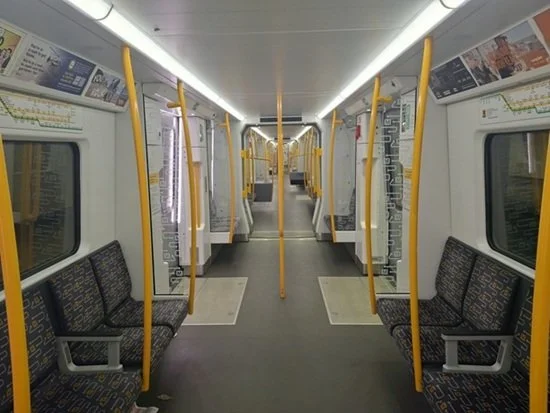
Tyne and Wear Metro. Photo: AlecCoates / Wikimedia Commons
Metro passengers warned they could be removed from trains for playing loud music
Tyne and Wear Metro bosses have warned passengers that playing loud music or videos without headphones is unacceptable and could result in them being removed from trains, following a new government campaign targeting anti-social behaviour on public transport.
Passengers across Newcastle, Gateshead, North Tyneside, South Tyneside and Sunderland are being reminded to show consideration for fellow travellers after the government announced new measures to tackle people who play music, videos and other audio aloud during journeys.
The announcement, made on Monday 19 October 2026, is part of a wider national initiative aimed at tackling nuisance behaviour on buses and trains.
The campaign includes warnings that passengers on national rail services could face fines of up to £1,000 if they refuse to comply with existing rules, while local transport authorities in England are being encouraged to introduce penalties of up to £100 for certain forms of anti-social behaviour on buses.
However, Nexus has clarified that the Tyne and Wear Metro operates under its own byelaws, meaning the national rail penalties do not automatically apply to the local network.
Nevertheless, the message from Metro bosses is clear: passengers who persistently disturb others by playing loud audio risk being removed from the train.
Nexus issues warning to Metro passengers
Kevin Storey, Operations Director at Nexus, has welcomed the government's efforts to discourage anti-social behaviour on public transport.
Speaking to Chronicle Live, he explained that Metro is governed by its own rules, which already cover a range of unacceptable behaviour.
These include fare evasion, littering, vaping, alcohol consumption and anti-social behaviour.
Mr Storey confirmed that playing loud music is not permitted and that Metro customer service teams and Travel Safe Officers can remove passengers who engage in the behaviour.
He also explained that Nexus would examine the government's latest announcement to establish whether any changes might be appropriate for the Tyne and Wear network.
The operator has indicated that passengers will be informed if any amendments to Metro's rules are introduced.
The announcement reinforces the expectation that passengers should respect those around them and avoid creating unnecessary disturbances during journeys.
What is 'loudcasting'?
The government's latest campaign focuses on a practice increasingly referred to as loudcasting.
This describes playing audio through mobile phone speakers or other devices in shared public spaces, without using headphones.
Examples include listening to music at high volume, watching TikTok or YouTube videos with the sound turned up, or playing other audio that can be heard by surrounding passengers.
Although using a mobile phone on public transport is entirely normal, problems can arise when other passengers are forced to listen to somebody else's entertainment.
For commuters, families, older passengers and people who may be sensitive to noise, persistent loud audio can make an otherwise ordinary journey unpleasant or stressful.
The national campaign aims to encourage people to use headphones and consider the comfort of others.
It is based on a straightforward principle: passengers should be able to enjoy their journeys without unnecessary disruption.
Could Metro passengers face a £1,000 fine?
One of the most significant aspects of the government's announcement is the publicity surrounding potential fines of up to £1,000.
However, there is an important distinction between the rules applying to national railway services and those governing the Tyne and Wear Metro.
National rail services
Under existing railway rules, passengers who refuse to stop playing disruptive audio when instructed by authorised staff can be removed from trains and may face prosecution, with fines of up to £1,000.
The new national campaign is designed to raise awareness of those existing enforcement powers.
Tyne and Wear Metro
Metro is a locally operated light rail network with its own byelaws.
Nexus has confirmed that passengers playing loud music can already be removed from its trains by customer service teams or Travel Safe Officers.
However, there has been no announcement that the national rail system's £1,000 penalty will automatically apply to Metro passengers.
Nexus says it will review the government's announcement before communicating any potential changes.
For now, passengers should understand that playing loud music can result in enforcement action on Metro, but should not assume the national railway fine has been introduced locally.
New £100 penalties could also affect bus passengers
The government's announcement extends beyond railway travel.
New guidance published by the Department for Transport on 19 October supports powers allowing local transport authorities in England to introduce byelaws addressing nuisance behaviour on buses.
The issues covered include:
Playing loud music or videos without headphones.
Vaping on buses.
Littering.
Threatening or intimidating behaviour.
Other forms of disruptive conduct.
Where the appropriate local byelaws have been introduced and approved, offenders could face fixed penalties of up to £100.
However, these powers do not mean that every bus passenger across England is automatically subject to a new £100 fine from 19 October.
Individual transport authorities must put the relevant local rules in place before they can be enforced.
The government has also emphasised that bus drivers will not be expected to take responsibility for issuing penalties.
Instead, authorised officers, including transport safety officers and police officers, would deal with enforcement.
The guidance encourages officers to engage with individuals, explain the rules and take further action where necessary.
For Great Park residents travelling on local bus services, the changes could eventually provide additional ways of addressing nuisance behaviour, depending on the measures introduced by the relevant transport authorities.
North East Mayor welcomes tougher approach
North East Mayor Kim McGuinness has welcomed the government's efforts to address noisy and disruptive behaviour on public transport.
Speaking following the announcement, she expressed frustration at passengers who play unwanted music and videos without considering those travelling alongside them.
She said she hoped the crackdown would discourage people from disrupting journeys and improve the experience for passengers across the region.
The announcement reflects wider concerns about anti-social behaviour on public transport and the importance of making journeys more comfortable for everyone.
However, not everyone believes the measures go far enough.
Unite general secretary Sharon Graham has argued that the government's proposals do not adequately address the more serious issues of abuse and violence experienced by public transport workers.
Her comments highlight the distinction between tackling everyday nuisance behaviour and ensuring that drivers, customer service workers and other transport employees are properly protected.
Why consideration matters on public transport
For many people across the North East, public transport is an essential part of daily life.
Metro services help connect residential neighbourhoods with workplaces, schools, universities, hospitals, shopping centres and leisure destinations.
The network is also used by Great Park residents making journeys elsewhere across Tyne and Wear, often alongside other forms of public transport.
While the vast majority of passengers travel without causing any difficulties, a small number of inconsiderate individuals can affect the experience of an entire carriage.
Unwanted noise can be particularly challenging for passengers with sensory sensitivities, anxiety or other conditions that make busy environments difficult.
The issue is therefore about more than whether somebody enjoys a particular type of music.
It is about recognising that buses and trains are shared spaces, used by people with different needs and expectations.
Using headphones, keeping conversations at a reasonable volume and treating fellow passengers with respect are simple ways to make public transport more welcoming.
How to report anti-social behaviour on the Metro
Nexus operates a discreet reporting service for passengers who experience or witness low-level anti-social behaviour on its network.
The service, known as Report It, allows passengers to alert Metro staff without having to confront the person responsible.
Passengers can report nuisance behaviour using WhatsApp or SMS.
Metro Report It service: 07345 222 710
This can be particularly helpful when dealing with disruptive conduct that does not require an immediate police response.
Passengers should provide useful information where possible, such as the train's location, direction of travel and a description of the behaviour.
Anyone experiencing immediate danger or witnessing a serious incident requiring an emergency police response should call 999.
Passengers are not expected to challenge potentially confrontational individuals themselves.
Further information about the Metro's rules, conditions of carriage and reporting arrangements is available through Nexus and Travel North East.
A more comfortable journey for everyone
The latest government announcement has brought renewed attention to behaviour that many public transport users will have encountered at some point.
For Tyne and Wear Metro passengers, the key message is that existing rules already allow Nexus staff to intervene when loud music or similar nuisance behaviour causes problems.
Although the national campaign may eventually lead to further changes locally, Nexus has not yet announced any additional financial penalties specifically for loudcasting on Metro services.
The wider discussion also raises important questions about how public transport operators can improve passenger comfort while ensuring frontline staff are protected from confrontation and abuse.
Ultimately, the principle behind the announcement is simple.
Everyone should be able to travel without having somebody else's music or videos forced upon them.
And for passengers who want to listen to their favourite songs, podcasts or videos during a journey, the solution is equally straightforward: use headphones.
Sources and further information
Department for Transport – Government launches measures to prevent noise and anti-social behaviour on transport, 19 October 2026
Department for Transport – Using bus byelaws to tackle nuisance behaviour
https://www.gov.uk/government/publications/using-bus-byelaws-to-tackle-nuisance-behaviour
Travel North East – Metro anti-social behaviour reporting
https://travelnortheast.uk/ways-to-travel/metro/anti-social-behaviour-report-it-to-sort-it/
Travel North East – Metro conditions of carriage and byelaws

