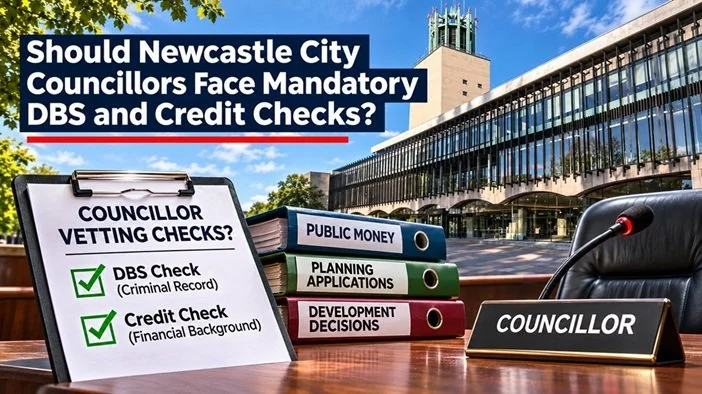
Should Newcastle City Council introduce mandatory DBS criminal record checks and consider financial background screening for councillors? As neighbouring North Tyneside Council reviews its approach to elected-member vetting, questions are being raised about transparency, accountability and safeguards surrounding public money and major planning decisions. Illustration based on a photograph of Newcastle Civic Centre. Image: Great Park Gazette.
Newcastle City Council is facing fresh questions about whether its elected councillors should undergo criminal record checks and, where appropriate, financial background screening, as neighbouring North Tyneside Council seeks specialist legal advice on introducing Disclosure and Barring Service (DBS) checks for elected representatives.
The development has prompted a wider debate about the standards expected of people entrusted with making decisions affecting public money, vulnerable residents, major housing developments and essential council services.
While employees working in many sensitive roles are required to undergo background checks, there is currently no universal legal requirement for elected councillors in England to undergo even a basic DBS check before taking office.
This means that somebody can be elected to a local authority without necessarily having undergone the criminal-record screening that many employees must complete before starting their jobs.
The situation raises an important question for Newcastle residents.
If private-sector employers routinely carry out checks on staff entrusted with sensitive financial responsibilities, should elected representatives involved in decisions affecting millions of pounds of public money face comparable scrutiny?
And should financial background checks also be considered for councillors holding particularly sensitive positions, where conflicts of interest or improper financial influence could pose risks to public confidence?
For Newcastle Great Park residents, the debate is particularly relevant given longstanding concerns about housing development, planning decisions, infrastructure and accountability.
North Tyneside Council Seeks Specialist Advice on DBS Checks
North Tyneside Council is examining whether it can introduce compulsory criminal-record checks for its elected councillors.
The matter was considered by the authority's Standards Committee on 5 November 2026, following calls for stronger safeguards.
Council officers had approached the Disclosure and Barring Service seeking clarification on how mandatory checks could operate for elected members.
However, the response did not fully resolve the legal questions.
The council's Head of Law and Governance has consequently sought specialist advice to help determine what arrangements might be lawful and practical.
Further findings are expected to be reported to the Standards Committee.
The review follows a request from North Tyneside's elected mayor for the council's legal and standards officers to examine the available options.
The council has explained that national legislation governs who is eligible for different levels of DBS checking, particularly enhanced checks.
This means a local authority cannot simply introduce the highest level of criminal-record screening for every councillor without considering the legal requirements.
Nevertheless, the review represents a significant attempt to examine whether additional safeguards could strengthen public confidence in local government.
The question now is whether Newcastle City Council should undertake a similar review of its own elected representatives.
Are Newcastle City Councillors Required to Have DBS Checks?
Newcastle City Council has 78 elected councillors, representing 26 wards across the city.
They are responsible for representing residents, scrutinising council decisions, establishing policy and participating in committees dealing with matters including planning, finance, children's services and adult social care.
However, there is no publicly confirmed requirement for every Newcastle councillor to undergo a basic or enhanced DBS check.
The council publishes information about its Code of Conduct, declarations of interests and governance arrangements, but this does not establish whether all elected members are routinely subject to criminal-record screening.
Importantly, the absence of a published universal requirement does not mean that no Newcastle councillors have undergone checks.
Some may have been checked because of their individual responsibilities or other professional roles.
The uncertainty concerns whether the council has a consistent policy covering elected members and how it determines which positions require additional scrutiny.
On 8 June 2026, the UK Government confirmed in a parliamentary response that criminal-record checking procedures for councillors are generally determined by individual local authorities.
The Government explained that all local government members are eligible for basic DBS checks.
It also confirmed that councillors in relevant upper-tier and unitary authorities who are being considered for appointment to committees involved in decisions about children's services or services for vulnerable adults can be eligible for enhanced checks.
However, there is no blanket national requirement for every councillor to undergo either type of screening.
That leaves an important question.
Should residents have to rely entirely on individual councils deciding whether their elected representatives require criminal-record checks?
What Is the Difference Between Basic and Enhanced DBS Checks?
A Disclosure and Barring Service check provides information about certain criminal convictions and cautions.
There are different levels of screening, each governed by specific rules.
Basic DBS check
A basic check reveals unspent criminal convictions and conditional cautions.
Anyone aged 16 or over can generally apply for one.
This is the least intrusive form of DBS screening and can be requested for a wide range of employment and voluntary positions.
Standard DBS check
A standard check provides more detailed criminal-record information, subject to filtering rules.
It can only be obtained for legally eligible positions.
Enhanced DBS check
An enhanced check can include relevant information held by local police forces, alongside the criminal-record information disclosed through standard checks.
These checks are available only where the specific legal eligibility requirements are satisfied.
Enhanced DBS with barred-list checks
For certain eligible roles, additional checks can establish whether someone is legally barred from undertaking specified work with children or vulnerable adults.
The level of checking permitted depends on the responsibilities involved.
An elected councillor does not automatically become eligible for the highest level of screening simply because they hold public office.
However, the Government has confirmed that councillors being considered for certain safeguarding-related committee positions may qualify for enhanced checks.
This creates scope for councils to examine whether their existing procedures adequately reflect the responsibilities assigned to individual members.
Private-Sector Employees Often Face More Extensive Checks
One of the arguments for reviewing councillor vetting arrangements concerns the comparison with private-sector employment.
In many industries, employees undergo criminal-record screening before being appointed to positions involving sensitive information, vulnerable individuals or financial responsibilities.
Within financial services, some regulated roles are also subject to assessments of honesty, integrity, competence and financial soundness.
The Financial Conduct Authority requires firms to assess whether certain senior managers and other relevant employees are fit and proper to perform their duties.
This can involve examining relevant disciplinary matters, criminal history and aspects of financial conduct.
Not every employee working in finance undergoes identical checks, and credit screening is not required for every financial-sector position.
Nevertheless, the principle is clear.
The greater the responsibilities and potential risks associated with a role, the stronger the case for appropriate safeguards.
An employee handling sensitive financial information may face background checks before being trusted with that responsibility.
Yet an elected councillor can participate in decisions concerning public expenditure and major developments without there necessarily being a universal criminal-record screening requirement.
Councillors and employees have different legal responsibilities, and elected office cannot simply be treated as ordinary employment.
However, the comparison raises a legitimate question about consistency and public confidence.
What if a Councillor Has Previously Been Convicted of Fraud?
An important concern is whether someone with a previous conviction for dishonesty or financial wrongdoing could legally become an elected councillor.
The answer is yes, in some circumstances.
Having a criminal record does not automatically prevent somebody from standing for election.
English electoral law establishes specific grounds for disqualification.
These include certain custodial sentences, restrictions relating to registered sex offenders and particular electoral offences.
For example, a person who has received a prison sentence of three months or more, including a suspended sentence, during the relevant preceding five-year period may be disqualified, subject to the statutory conditions.
However, not every criminal conviction results in disqualification.
A previous fraud conviction that did not lead to a disqualifying sentence or another applicable legal restriction would not necessarily prevent someone from becoming a councillor.
There are also legal protections concerning spent convictions.
A basic DBS check does not disclose every conviction a person has ever received.
This means that being legally eligible to become a councillor is not necessarily the same as having undergone a comprehensive assessment of suitability for every sensitive responsibility within the council.
However, screening must not be used to impose additional unlawful barriers to elected office.
Simply discovering a conviction would not automatically give a council the legal power to remove a democratically elected representative.
Any additional restrictions would need to comply with existing legislation or be introduced through changes to the law.
Should Councillors Also Undergo Financial Background Checks?
Beyond criminal-record screening, another question deserves consideration.
Should councillors appointed to particularly sensitive financial or decision-making roles undergo proportionate financial background checks?
Some private-sector organisations assess employees' financial circumstances where the nature of their work creates identifiable risks.
This can include reviewing relevant insolvency records, outstanding judgments or other evidence that may be significant for a particular regulated position.
The purpose is not necessarily to exclude individuals experiencing financial difficulties.
Instead, employers may use appropriate checks to assess risks and determine whether additional safeguards are needed.
Local councillors can hold responsibilities involving substantial budgets, procurement decisions, grants, major regeneration schemes and oversight of public services.
They may also participate in decisions that have major financial implications for private businesses and developers.
This raises the question of whether similar risk-based assessments should be considered within local government.
However, financial vetting is much more intrusive than a basic criminal-record check.
The Information Commissioner's Office advises that credit checks should not be undertaken routinely or without justification.
The organisation carrying out the checks must be able to demonstrate that they are necessary, proportionate and supported by an appropriate lawful basis.
The Financial Conduct Authority also makes clear that having limited financial means does not, by itself, make somebody unsuitable for a regulated role.
Any proposal to introduce financial checks for councillors would therefore need strong legal safeguards, clear eligibility criteria and protection against unfair discrimination.
Could Financial Pressures Increase the Risk of Improper Influence?
One hypothetical concern is whether an elected representative facing serious financial pressures could become vulnerable to improper influence from someone seeking to benefit from a council decision.
For example, imagine a councillor involved in decisions affecting a major development.
A developer or other interested party attempts to offer the councillor a financial advantage in exchange for improperly influencing the outcome.
Such conduct could amount to bribery and would be a serious criminal matter.
The Bribery Act 2010 already criminalises relevant forms of offering, requesting or accepting improper financial advantages.
Councillors are also required to comply with rules governing conflicts of interest, gifts and hospitality.
However, preventing corruption involves more than simply making it illegal.
It also requires clear procedures, independent scrutiny and effective mechanisms for identifying inappropriate relationships.
Financial screening is sometimes suggested as one possible additional safeguard.
But there are important limitations.
Being in debt, having a poor credit history or experiencing financial hardship does not mean someone is dishonest or likely to accept a bribe.
Many people experience financial difficulties for reasons entirely unrelated to their integrity.
Equally, a wealthy individual with an excellent credit history could still engage in corruption.
A credit check cannot reliably predict whether someone will act dishonestly.
The more relevant question may be whether councils have robust systems to identify actual conflicts of interest, unexplained benefits and improper attempts to influence decisions.
Why This Matters to Newcastle Great Park
For Newcastle Great Park residents, the issue of elected-member accountability has become increasingly prominent.
Great Park Gazette has previously examined concerns about local councillor attendance, housing development and the delivery of infrastructure promised to residents.
These include longstanding questions about road adoption, estate management arrangements, healthcare provision and the continued expansion of residential development.
In October 2026, Newcastle City Council's Planning Committee supported proposals for another 155 homes north of Brunton Lane, subject to the completion of a legal agreement and relevant planning conditions.
A further application proposes up to 320 homes at the former Sage headquarters.
Together, these schemes involve proposals for up to 475 additional homes, although their planning statuses differ.
Such applications can have significant financial implications for developers, landowners and the wider community.
Planning decisions must be determined according to relevant planning law, adopted policies and material considerations.
Councillors involved in those decisions are expected to act impartially, declare relevant interests and comply with the council's Code of Conduct.
That makes transparency particularly important.
With major developments continuing across Newcastle Great Park, what safeguards should residents expect to be in place to ensure councillors are held to the highest standards of integrity and accountability?
Existing safeguards already address many of these concerns.
Newcastle City Council requires members to declare relevant financial interests, while councillors with certain interests may be restricted from participating in particular decisions.
There is no suggestion that any councillor involved in Great Park planning decisions has acted improperly, and the development applications mentioned above are included solely to illustrate the significance of decisions made by elected representatives.
Nevertheless, residents are entitled to ask whether the council's existing safeguards are sufficient and whether additional checks could strengthen public confidence.
The question is not whether wrongdoing has occurred, but whether Newcastle City Council should review its procedures to ensure the strongest possible protections are in place before concerns ever arise.
The issue should be considered across all political parties, not directed at individual councillors without evidence..
What Safeguards Does Newcastle City Council Already Have?
Newcastle City Council already operates a framework intended to promote ethical conduct and prevent improper influence.
Councillors must comply with the authority's Code of Conduct.
They are required to register relevant financial and other interests and declare conflicts when participating in council business.
The council also maintains a register of gifts and hospitality.
Its Standards Committee is responsible for promoting high standards of conduct, while the Monitoring Officer has responsibilities relating to lawful and ethical governance.
Other protections include financial oversight, internal audit, external audit, procurement procedures and the statutory responsibilities of the council's chief finance officer.
These safeguards are important because elected councillors do not simply have unrestricted personal access to council funds.
Financial decisions take place within an established system of legal responsibilities, delegated authority and officer oversight.
The Local Government Association's Fighting Fraud and Corruption Locally 2026 strategy also identifies planning, procurement, housing and major regeneration as areas where corruption risks must be actively managed.
It recommends clear standards, effective conflict-of-interest procedures and appropriate systems for detecting fraud.
Any proposal for additional vetting should therefore be considered alongside these existing arrangements.
The question is whether there are identifiable gaps that new checks would help address.
Would Mandatory Credit Checks Be Fair?
There are also serious arguments against applying compulsory credit checks to every elected councillor.
Financial records are personal information.
A blanket requirement could potentially discourage people from standing for public office, particularly those from lower-income backgrounds.
It could also create unfair assumptions about people who have experienced unemployment, illness, divorce, financial hardship or other difficult circumstances.
These experiences do not make someone less honest or less capable of representing their community.
There is a further constitutional issue.
Councillors are elected by voters rather than recruited through an ordinary employment process.
Any system allowing financial records to influence eligibility for elected office would require particularly careful scrutiny.
A more proportionate approach might involve examining specific sensitive appointments, improving conflict-of-interest procedures or requiring additional declarations where a genuine risk has been identified.
However, even targeted checks would need to be lawful, justified and accompanied by appropriate privacy protections.
The aim should be to prevent corruption, not to exclude people simply because they are experiencing financial difficulties.
Could Newcastle Follow North Tyneside's Example?
North Tyneside Council's current review provides an opportunity for Newcastle to examine its own arrangements.
Rather than immediately introducing additional requirements, the council could ask its Standards Committee and Monitoring Officer to assess what checks are already undertaken and whether changes are necessary.
Such a review could examine the benefits and limitations of basic DBS checks for all elected members.
It could also establish whether enhanced checks are consistently undertaken for eligible safeguarding-related appointments.
Any consideration of financial background screening would require a separate examination of legality, proportionality, data protection and the specific risks associated with sensitive positions.
The council could also review how it identifies potential conflicts involving developers, contractors and organisations seeking public funding.
This would allow the debate to be based on evidence rather than assumptions.
Importantly, North Tyneside has not yet introduced the universal mandatory system being discussed.
It is seeking specialist advice to establish what is legally possible.
Newcastle could undertake a similar evidence-based review without prejudging its outcome.
Questions Newcastle City Council Should Answer
There are several questions that could help establish whether the authority's current procedures provide sufficient reassurance to residents.
1. Are all elected councillors required to undergo basic DBS checks?
If not, has the council considered introducing a consistent procedure, and what are the legal or practical obstacles?
2. Which elected positions qualify for enhanced DBS checks?
Are checks undertaken for eligible councillors appointed to committees involving children's services or vulnerable adults?
3. Does the council have a written DBS policy specifically covering elected members?
If so, is that policy publicly available?
4. Are any financial background checks undertaken for councillors holding sensitive responsibilities?
If not, has the council assessed whether such checks would be lawful, necessary and proportionate for particular appointments?
5. What protections exist against improper financial influence?
How does the council identify and manage conflicts involving developers, contractors and organisations seeking public funding?
6. How are gifts, hospitality and potential conflicts independently scrutinised?
Are existing arrangements regularly reviewed to ensure that they remain effective?
7. Will Newcastle City Council ask its Standards Committee to undertake a review similar to North Tyneside's?
A published review could help residents understand what safeguards already exist, where improvements may be necessary and which proposals would require changes to national legislation.
Protecting Public Money Without Undermining Democracy
The debate over councillor vetting raises important questions about the balance between accountability and democratic representation.
On one hand, councillors are entrusted with significant public responsibilities.
They help make decisions that affect residents' lives, local services, public spending and major developments.
It is reasonable for the public to expect high standards of integrity.
On the other hand, additional background checks must be lawful, proportionate and consistent with the rights of democratically elected representatives.
A criminal record does not always prevent someone from holding public office.
A poor credit history does not establish dishonesty.
And no background-screening system can guarantee that corruption will never occur.
Effective governance requires a combination of transparent decision-making, strong conflict-of-interest rules, independent oversight and appropriate enforcement.
Criminal-record checks may provide useful additional information in some circumstances.
Financial checks could potentially identify particular risks in carefully defined situations.
But neither should be treated as a substitute for the wider safeguards already required in local government.
Should Newcastle City Council Review Its Vetting Procedures?
The decision by North Tyneside Council to seek specialist advice demonstrates that questions about elected-member screening are being taken seriously within the region.
It also highlights the absence of a single national approach.
Some councils have introduced their own procedures, while others continue to rely on existing legal disqualification rules, declarations of interest and standards arrangements.
For Newcastle City Council, a review could provide clarity about whether its existing policies remain appropriate.
For residents, the benefits would include a better understanding of how elected representatives are assessed for sensitive responsibilities and what safeguards protect public decisions.
The central question is not whether councillors should be treated with suspicion simply because they hold public office. It is whether the checks and safeguards surrounding that office are sufficient for the responsibilities they undertake.
At a time when councils face substantial financial pressures and residents are being asked to contribute more through council tax, transparency and accountability are increasingly important.
Newcastle City Council has an opportunity to explain its current position and consider whether any improvements are necessary.
Have Your Say
Great Park Gazette would like to hear residents' views on whether additional checks should be introduced for elected councillors.
Should every Newcastle City Council councillor undergo a basic DBS check after being elected?
Should enhanced checks be required for those appointed to eligible safeguarding-related roles?
Would carefully targeted financial background checks provide greater reassurance for sensitive positions, or would they represent an unnecessary intrusion into councillors' private lives?
And should Newcastle City Council follow North Tyneside by commissioning an independent review of the legal and practical options?
Do you believe councillors should face similar background checks to employees holding comparable positions of trust?
Or are the existing safeguards already sufficient?
Join the discussion in the Great Park Residents Group on Facebook and share your views.
Great Park Gazette will continue examining standards, transparency and accountability in local government, including the safeguards surrounding decisions that affect Newcastle Great Park.
Further Information and Official Sources
North Tyneside Council – Standards Committee, 5 November 2026
UK Parliament – Government Answer on Councillor DBS Checks, 8 June 2026
Newcastle City Council – Local Councillors and Registers of Interests
Information Commissioner's Office – Pre-employment Vetting and Financial Checks
Local Government Association – Fighting Fraud and Corruption Locally 2026
Electoral Commission – Disqualification Rules for Local Councillors

