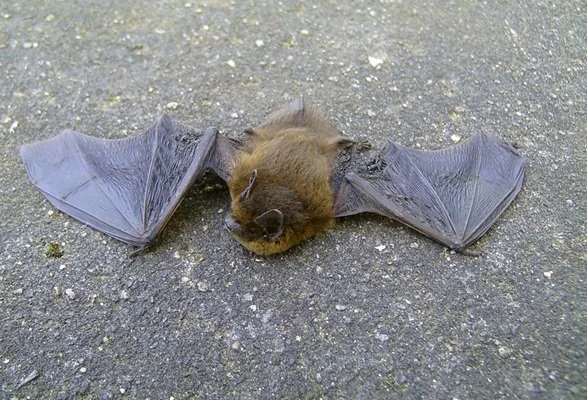
A common pipistrelle bat, one of the species recorded in Newcastle Great Park. As autumn progresses, bats become less visible while preparing for winter. Photograph: Dumi / Wikimedia Commons
Residents who have noticed fewer bats flying around Newcastle Great Park this autumn might wonder where they have disappeared to. But as local wildlife enthusiast Jules Robinson has highlighted, Britain's bats lead a fascinating hidden life as winter approaches — and some gather in remarkable nocturnal swarms before hibernation.
As the evenings grow colder and darkness falls earlier across Newcastle Great Park, one of our most elusive wild neighbours can become increasingly difficult to spot.
During the warmer months, bats may be seen darting through the evening sky, hunting insects near trees, hedgerows, wetlands and other green spaces.
But by late October, those familiar silhouettes can appear to have vanished.
So where have Great Park's bats gone?
The answer is more interesting than many residents might expect.
They're not necessarily gone at all. Many are simply changing their behaviour as they prepare for winter.
The subject was recently highlighted by Jules Robinson, who shared an informative post in the Great Park Wildlife Facebook group explaining a remarkable behaviour known as autumn swarming.
Her post offers a fascinating insight into a part of the natural world that most of us never see.
And with bats already recorded in Newcastle Great Park, it's a particularly relevant subject for our community.
Bats really have been recorded in Great Park
Before exploring what happens to bats in autumn, there's some encouraging news for local wildlife enthusiasts.
Bats are not simply a theoretical possibility in Newcastle Great Park.
They have been recorded here during organised wildlife activity.
The Natural History Society of Northumbria documented bat sightings at Great Park during its first Big Bat BioBlitz, an event involving wildlife specialists and volunteers surveying locations along the Ouse Burn.
During the Great Park survey, participants recorded three species:
Common pipistrelles – Small, fast-flying bats that are among Britain's most familiar species.
Soprano pipistrelles – Another small species, often associated with habitats where insects are plentiful.
Noctules – Larger bats that often fly higher above trees and open areas.
The group observed common pipistrelles moving between hedgerows, noctules flying above the trees and soprano pipistrelles feeding on insects.
It's an important reminder that even within a growing residential development, wildlife continues to make use of suitable habitats.
However, these summer records do not establish how many bats are present across Great Park in autumn or winter.
Nor do they identify where the bats spend the colder months.
Jules Robinson highlights a remarkable autumn ritual
Jules Robinson recently drew attention to the subject through a post in the Great Park Wildlife Facebook group, describing how certain British bats gather around underground spaces during autumn.
The behaviour is known as autumn swarming.
To someone who happened to witness it, the spectacle could appear extraordinary.
Imagine standing near an old tunnel or cave entrance after dark.
A bat flies past.
Then another.
Soon, several bats are swooping, circling and repeatedly approaching the entrance.
It might seem as though something has disturbed them.
In reality, the gathering may be part of an important stage in their annual life cycle.
Scientists believe autumn swarming has a significant social and mating function, although researchers are still studying its full purpose.
Jules's post helps explain why some bats become especially active around particular underground sites before winter — even while becoming harder to see in the places where they spent the summer.
Thank you to Jules Robinson for highlighting this fascinating aspect of British wildlife and helping raise awareness among Great Park residents.
Residents interested in local wildlife observations, photographs and discussions can visit the Great Park Wildlife Facebook group:
https://www.facebook.com/share/g/1CP6kuugNS/
The Great Park Residents Group also provides a place for neighbours to share their wildlife experiences and discuss the natural environment around the estate.
What exactly is autumn swarming?
Autumn swarming is a behaviour observed in certain bat species, particularly members of the Myotis group.
These include Daubenton's bats and Natterer's bats.
During the late summer and autumn, bats may gather around caves, abandoned mines, tunnels and other suitable underground structures.
Individuals can travel from different areas to visit these locations.
The gatherings are usually nocturnal, with bats repeatedly approaching or entering the site before moving away again.
The activity can be particularly noticeable during August, September and October.
Historic England identifies September and October as important months for mating, storing fat reserves and autumn swarming.
The National Trust has also documented swarming involving eight bat species at Cliveden in Buckinghamshire.
Researchers believe mating is one of the main reasons for these gatherings.
The bats may also use them to explore or become familiar with potential winter roosting sites.
However, not every British bat species takes part in the same type of swarming behaviour, and not every gathering of flying bats is an autumn swarming event.
It is also important to emphasise that there is currently no independently confirmed autumn swarming site identified in the information available to the Gazette for Newcastle Great Park.
The behaviour described in Jules's post is a recognised natural phenomenon, rather than evidence of a particular gathering taking place locally.
One of nature's most extraordinary survival strategies
Perhaps the most surprising aspect of Britain's bat biology is what can happen after mating.
In many British bat species, mating takes place during autumn, but pregnancy does not immediately follow.
Instead, females can store sperm through the winter, with fertilisation occurring in spring.
This allows the birth of their young to coincide with more favourable conditions.
By late spring and early summer, warmer temperatures generally mean more flying insects are available.
That matters because Britain's native bats are insect-eating mammals.
A female bat needs substantial energy to support pregnancy and, later, to feed her young.
Delaying fertilisation helps align the reproductive cycle with the time of year when food is more plentiful.
It's a remarkable adaptation that allows such small mammals to survive and reproduce in Britain's changing seasons.
So why can't we see as many bats around Great Park now?
There are several reasons why bats become less visible as autumn progresses.
1. There are fewer flying insects
British bats depend on insects for food.
As temperatures fall, the number of flying insects generally decreases.
With less food available, bats may reduce the amount of time they spend flying and hunting.
This is one reason sightings can decline around gardens, paths and open green spaces.
2. Bats are beginning to conserve energy
Bats can enter a state called torpor.
During torpor, their body temperature falls and their metabolism slows, helping them conserve energy.
As winter approaches, these periods of inactivity can become longer.
Many British bats eventually spend much of winter hibernating, although they may wake naturally from time to time.
A bat that isn't actively feeding or travelling will be much less noticeable to residents watching the evening sky.
3. Some bats move to different roosting sites
The places bats use in summer are not necessarily the same places they use in winter.
A summer roost might be in a building, roof space or tree.
A winter roost may be in a sheltered crevice, cavity, underground structure or another location offering suitable conditions.
Different species have different preferences.
Some bats travel between seasonal roosts, and certain species undertake longer-distance movements.
So while bats may seem to disappear from a familiar summer feeding area, that doesn't automatically mean they have left the wider region.
4. Colder and wetter evenings make sightings less likely
Bats are often easiest to observe on relatively warm, dry, calm evenings when insects are active.
Cold temperatures, heavy rain and strong winds can reduce the conditions suitable for feeding.
By late October, there may be far fewer opportunities to see them flying.
5. They are naturally difficult to detect
Even when bats are present, they're easy to miss.
Most are small, fast-moving and active in low light.
Their high-frequency echolocation calls are usually beyond the range of human hearing.
Without specialist equipment, a resident could be standing near feeding bats and barely realise they are there.
For that reason, not seeing bats does not mean there are no bats nearby.
Where might bats find food around Newcastle Great Park?
Great Park is fortunate to have a range of green spaces that can support insects and other wildlife.
The Newcastle Great Park Consortium's official nature guide identifies several habitats across the development, including the River Ouseburn, wetlands, meadows, hedgerows and woodland.
These are the kinds of environments that can be valuable to bats.
The River Ouseburn
The River Ouseburn runs through the southern part of Great Park.
Waterways can attract insects, providing feeding opportunities for bats.
Some species, such as Daubenton's bats, specialise in hunting insects close to the surface of water.
The presence of the river therefore makes the surrounding habitat potentially valuable.
However, a suitable habitat does not by itself confirm the presence of a particular species.
Great Park's wetlands and ponds
The estate's Sustainable Drainage Systems, often called SuDS, include areas of open water, reeds and wetland vegetation.
These environments can support insects, making them potentially useful feeding areas for bats.
Warkworth Woods
Established woodland can offer sheltered routes for travelling bats and provide feeding opportunities around trees and woodland edges.
Natural cavities and crevices in suitable trees can also provide potential roosting opportunities.
Hedgerows and the Wagonway
The former Wagonway running through Great Park is bordered by hedgerows and other vegetation.
Such linear green corridors can help some bat species move between feeding areas while remaining relatively sheltered.
These features illustrate why protecting connected green spaces matters, even in an urban environment.
Does street lighting affect bats?
Artificial lighting can influence where bats choose to feed and travel.
Some species avoid brightly illuminated areas, particularly where lights shine onto roost entrances or otherwise dark routes.
Other species may sometimes hunt insects attracted to artificial lights.
The effects therefore vary between species and locations.
The Bat Conservation Trust advises that unnecessary lighting near bat roosts, feeding habitats and commuting routes should be avoided.
For Great Park residents, simple measures such as avoiding unnecessary garden lighting throughout the night can help preserve darker areas for wildlife.
This is especially relevant where gardens back onto woodland, hedgerows or other green spaces.
However, residents should not assume that lighting is the reason bats have become less visible in any particular part of Great Park.
Seasonal changes in temperature, insect availability and roosting behaviour are important explanations in their own right.
Do bats hibernate throughout the entire winter?
Not continuously.
Many British bats spend much of winter in a state of hibernation or prolonged torpor, conserving the energy stored in their body fat.
However, they can wake naturally during winter.
On milder evenings, some may emerge to feed if enough insects are flying.
They may also wake to drink or move between roosting locations.
This means it is still possible to see a bat during November, December or even January.
An occasional winter sighting is not automatically evidence that something is wrong.
The Bat Conservation Trust explains that winter activity can be normal under suitable conditions.
However, a bat found on the ground, exposed and unable to fly, or apparently injured may need specialist help.
When is the best time to look for bats in Great Park?
For residents hoping to see bats, the best opportunities are generally during the warmer months.
The National Trust recommends May to September as the main period for watching bats.
The first half-hour after sunset can be particularly rewarding.
In Great Park, residents might keep an eye on the sky while enjoying an ordinary evening walk along established public paths near suitable habitats.
Areas around hedgerows, woodland edges and water can be worth observing from a respectful distance.
A bat detector can make the experience even more interesting by translating ultrasonic echolocation calls into sounds people can hear.
But there's no need to approach roosts, explore tunnels or enter restricted areas.
Watching wildlife should never involve disturbing the animals or putting yourself at risk.
For anyone particularly interested in bats, joining an organised walk led by knowledgeable wildlife volunteers may offer a better opportunity to learn about the different species.
Why protecting bats matters
Bats are an important part of Britain's natural environment.
They feed on flying insects and contribute to the ecological balance of the habitats they occupy.
But they are also vulnerable.
Habitat loss, changes to roosting places, disturbance and inappropriate artificial lighting can all create difficulties for different species.
In England, all bat species and their roosts are protected by law.
It can be an offence to deliberately disturb bats, injure them or damage their breeding sites and resting places.
These protections also apply in circumstances where bats are temporarily absent from a protected roost.
For residents, the most important advice is straightforward:
Give bats space, leave potential roosts undisturbed and seek expert guidance before carrying out work that could affect them.
If you discover bats using a building, roof space, tree cavity or another structure, avoid interfering with the location.
Specialist advice is available through the Bat Conservation Trust.
What should you do if you find a bat on the ground?
A bat found on the ground may be injured, exhausted or otherwise in difficulty.
It should not simply be thrown into the air or released without appropriate advice.
The RSPCA recommends contacting the Bat Conservation Trust for guidance.
National Bat Helpline: 0345 1300 228
Avoid handling bats with bare hands.
If there is an immediate risk to the animal, follow the Bat Conservation Trust's instructions for keeping it safe while specialist assistance is arranged.
Never attempt to feed, treat or release an injured bat without appropriate advice.
A thank you to Jules Robinson and Great Park's wildlife enthusiasts
Stories like this are a reminder of the value of community wildlife groups.
We would like to thank Jules Robinson for sharing her informative post about autumn swarming through the Great Park Wildlife Facebook group and helping to bring attention to a fascinating part of British wildlife.
The original post provides a wonderful starting point for anyone who has ever wondered where bats go as the colder weather arrives.
Local nature enthusiasts also share their observations and questions through the Great Park Residents Group, helping neighbours appreciate the variety of wildlife living around the estate.
As Great Park continues to develop, these discussions can play a valuable part in increasing awareness of our natural surroundings.
Residents interested in wildlife photographs, observations and seasonal nature information are encouraged to visit Jules's community:
Great Park Wildlife Facebook Group
https://www.facebook.com/share/g/1CP6kuugNS/
Whether you're interested in bats, birds, hedgehogs, foxes or the other animals sharing our neighbourhood, the group provides a place for residents to learn more about local wildlife.
Great Park's bats haven't necessarily disappeared
The next time you walk through Newcastle Great Park on a chilly autumn evening and notice an absence of bats, remember that there's likely more happening than meets the eye.
Some bats will be conserving energy.
Others may be moving between seasonal roosting sites.
And certain species elsewhere in Britain may be taking part in the extraordinary autumn swarming gatherings highlighted by Jules Robinson.
These gatherings, their mating behaviour and their ability to survive months with little insect food demonstrate just how remarkable these animals are.
Most importantly, we know that bats have been recorded at Great Park.
Their reduced visibility in autumn does not mean that they have disappeared from the area.
Much of their life takes place beyond our sight, in dark and sheltered places where they can survive until warmer weather returns.
For Great Park's bats, autumn isn't necessarily a goodbye. It's the beginning of another remarkable chapter.
Have you spotted bats in Newcastle Great Park?
We'd love to hear from residents.
Have you seen bats flying around your garden, over the River Ouseburn or near Great Park's woodland areas?
Have you noticed fewer sightings now that autumn has arrived?
Or have you ever attended a bat walk or used a bat detector?
Share your observations through the Great Park Residents Group or the Great Park Wildlife Facebook group.
Please avoid publicly identifying sensitive roost locations, entering restricted structures or disturbing animals to obtain photographs.
Residents who would like their wildlife observations to contribute to scientific recording can also submit sightings to Northumberland Wildlife Trust's Nature Counts programme.
Sources and further information
Great Park Wildlife Facebook Group – Jules Robinson's wildlife community
https://www.facebook.com/share/g/1CP6kuugNS/
Natural History Society of Northumbria – Bats of the Burn: Big Bat BioBlitz
https://www.nhsn.org.uk/big-bat-bioblitz/
Newcastle Great Park – Nature and wildlife habitats
https://www.newcastlegreatpark.com/nature/
Bat Conservation Trust – A year in the life of a bat
https://www.bats.org.uk/about-bats/a-year-in-the-life-of-a-bat
Bat Conservation Trust – Hibernation roosts
https://www.bats.org.uk/about-bats/where-do-bats-live/bat-roosts/hibernation-roosts
Historic England – British bats and their life cycles
National Trust – Protecting bats
https://www.nationaltrust.org.uk/our-cause/nature-climate/nature-conservation/protecting-bats
Bat Conservation Trust – Lighting and bats
https://www.bats.org.uk/about-bats/threats-to-bats/lighting
Northumberland Wildlife Trust – Record a wildlife sighting
https://www.nwt.org.uk/wildlife/record-sighting
Bat Conservation Trust – National Bat Helpline
https://www.bats.org.uk/our-work/national-bat-helpline
Published October 2026. The seasonal behaviour described in this article is based on established information about British bats. The presence of three species at Great Park has been documented during a local wildlife event, but no specific autumn swarming or winter hibernation site within Great Park has been independently confirmed for this article.

