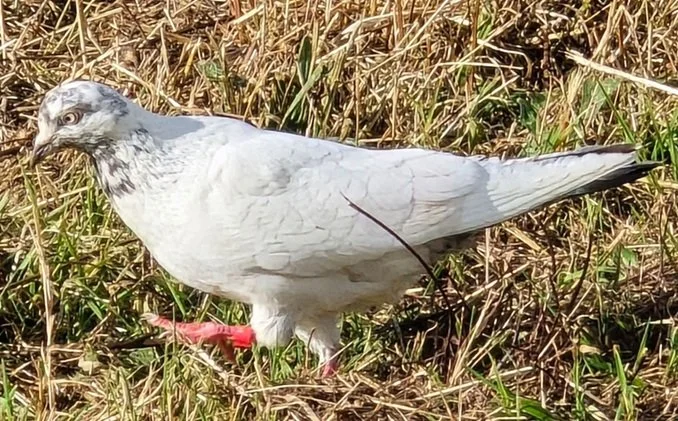
Meet Marshall, the much-loved white and grey pigeon who has become a familiar sight across Newcastle Great Park. With his distinctive red leg ring and unusual red and green markings beneath his wings, Marshall has captured the hearts of local residents, who regularly share sightings of his adventures. His origins remain a mystery, although he is believed to be a domesticated high-flyer pigeon. Photo: Supplied to Great Park Gazette
A distinctive white and grey pigeon with colourful markings beneath his wings and a bright red leg ring has captured the hearts of residents across Newcastle Great Park, becoming something of a local celebrity as neighbours share sightings, photographs and concerns about his wellbeing.
Affectionately known as Marshall, the unusual bird has been spotted wandering around residential streets, exploring gardens, resting on fences and searching for food in grassy areas across the estate.
Unlike the pigeons normally seen around Newcastle, Marshall is instantly recognisable thanks to his predominantly white feathers, grey markings around his head and neck, and unusual splashes of red and green beneath his wings.
He also appears to have a red identification ring around one leg, suggesting that he may originally have belonged to someone who kept pigeons.
But where did Marshall come from? Is he a lost racing pigeon, a specialist high-flyer, or simply a domesticated bird who has decided that Newcastle Great Park is now his home?
Nobody has yet been able to establish his origins with certainty.
What is clear, however, is that Marshall has become a much-loved character in the Great Park community, with residents keeping an eye out for him and sharing updates whenever he makes another appearance.
A Familiar Face Around Osprey Walk, Lynemouth Way and Melbury
Marshall's appearances have been generating discussion in the Great Park Wildlife Facebook group for several months.
On 13 August 2026, a resident shared photographs of an unusual pigeon he had spotted on more than one occasion.
The resident noticed something particularly distinctive about the bird.
He wrote:
"Seems to have red paint under one wing and green under the other."
The photographs showed a pale pigeon flying across one of Great Park's open grassy areas behind Osprey Walk, with a bright red marking clearly visible beneath one wing.
The unusual colouring immediately prompted questions about whether the bird was a racing pigeon, a high-flyer or another variety of domesticated pigeon.
As other residents joined the discussion, it became apparent that the bird was already familiar to people living elsewhere on the estate.
A resident reported seeing him regularly around Lynemouth Way.
They explained that he had disappeared for a while, leaving them wondering whether he had found another home, before later sightings reassured them that he was still around.
Another resident reported that the pigeon had been visiting Lynemouth Way for approximately two months when they commented.
Other sightings followed, including around the Melbury side of Newcastle Great Park.
The bird's distinctive appearance has made him relatively easy to recognise, and what began as a question about an unusual pigeon gradually developed into an affectionate community discussion.
How Marshall Became a Local Celebrity
For many residents, Marshall is now far more than just another pigeon.
His travels have become a regular talking point in the Great Park Wildlife Facebook group, where members share sightings and ask whether anyone has seen him recently.
When one photograph was posted, a resident was delighted to recognise the familiar bird.
"Yes!! That's Marshall...Glad to know that he is well...."
Great Park Wildlife administrator Jules Robinson also recognised him and responded warmly to the sighting.
The discussions suggest that Marshall has become a familiar visitor to several parts of the estate.
A resident described him as a sociable bird that is frequently out exploring.
Others have recounted encounters in their gardens, on fences and around nearby green spaces.
One particularly amusing contribution came from a resident, who explained that Marshall had apparently taken a liking to their garden fence.
According to the resident, he had been sleeping on the fence between neighbouring houses for a while, before eventually being encouraged to move along because of the mess he was leaving behind.
It seems that even Great Park's feathered celebrities are not entirely without their faults!
Despite his occasionally untidy habits, the comments make clear that Marshall has developed a loyal following.
Residents have been pleased to see him return after periods when he has apparently gone missing, and some have even made preparations to provide him with food when he next appears.
Has Marshall Really Been Living on Great Park for More Than a Year?
One of the most interesting details to emerge from the Facebook discussions concerns how long Marshall may have been living locally.
While some residents reported first noticing him during the summer of 2026, one resident suggested that he had already been living around Great Park for considerably longer.
In response to concerns about whether the pigeon was lost, the resident commented:
"He's been living on GP over a year now."
That claim has not been independently verified, but it suggests Marshall may be far more established in the neighbourhood than initially thought.
Other residents expressed surprise that he could have been around for so long without everyone noticing him.
His reported movements between different streets and neighbourhoods may help explain why residents sometimes go weeks without seeing him.
One day he might be searching for food around Lynemouth Way; another day he could be exploring the grasslands near Melbury.
And because he does not appear to remain in one location permanently, different residents may encounter him at different times.
It is entirely possible that Marshall has become a familiar part of the local environment while remaining a mystery to many of the people who see him.
Is Marshall a Racing Pigeon or a High-Flyer?
One of the biggest questions surrounding Marshall is his identity.
His red leg ring and coloured wing markings initially led several residents to speculate that he might be a racing pigeon.
Racing pigeons are domesticated birds selectively bred for their ability to navigate back to their home lofts over considerable distances.
They usually carry numbered identification rings that can help trace their original owners.
However, another explanation has emerged from the Great Park Wildlife discussions.
Two contributors suggested that Marshall is actually a high-flyer pigeon.
In one exchange, a commenter told group administrator Jules Robinson:
"It not a racing pigeon it a high flyer the ring has no numbers it's just a red id ring."
This is an important distinction.
High-flyers are domesticated pigeons bred for their flying performance, particularly their ability to reach considerable heights and remain airborne for extended periods.
Unlike conventional racing pigeons, which are generally released away from home and timed on their return, high-flying pigeons are often flown in the vicinity of their home loft.
Depending on the breed, they may be trained for endurance, altitude or particular flying characteristics.
Some specialist high-flying pigeons can remain airborne for many hours, although individual performance varies considerably.
Marshall's predominantly white colouring and grey markings are compatible with the wide range of appearances seen in domesticated pigeons.
His red leg ring also supports the possibility that he was previously kept or bred by a pigeon enthusiast.
However, his exact breed cannot be confirmed from the photographs alone.
The claim that his ring has no identification numbers also needs to be confirmed through a clear, close-up view.
For now, describing Marshall as a likely domesticated high-flyer is more appropriate than definitively identifying him as a racing pigeon.
Why Does Marshall Have Red and Green Markings Under His Wings?
Perhaps the most unusual feature of Marshall's appearance is the coloured marking beneath each wing.
Residents have reported red beneath one wing and green beneath the other.
The red colouring is visible in a photograph shared in the Great Park Wildlife group, showing Marshall in flight.
These markings do not appear to be part of the bird's natural feather pattern.
One possibility is that the colours were deliberately applied by a previous keeper.
Pigeon enthusiasts sometimes use artificial markings to distinguish birds or identify their ownership.
In the Great Park Wildlife discussion, one contributor suggested that such markings could help owners recognise their pigeons while flying.
However, there is not enough evidence to establish whether Marshall's colours were applied for that reason.
It is also unclear whether the markings were intended to identify a particular loft, distinguish him from other birds or serve another purpose.
The red and green markings remain one of the biggest clues to Marshall's past.
If a local pigeon keeper recognises the combination of colours, they may be able to provide valuable information about where he came from.
What Does the Red Ring Around His Leg Mean?
Marshall's red leg ring has been another major subject of discussion.
A photograph examined by Great Park Wildlife administrator Jules Robinson appeared to confirm the presence of the ring.
Jules hoped that identifying any letters or numbers on it could help trace Marshall's original owner.
She contacted a representative associated with pigeon homing in the North East to ask what could be done.
However, identifying a registered racing pigeon generally requires the details printed on its official leg ring.
The Royal Pigeon Racing Association explains that racing pigeons normally carry numbered rings, often beginning with the letters GB.
The RSPCA similarly advises that rings can help distinguish racing pigeons from other domesticated varieties.
However, a plain coloured ring without an identification number may have been fitted for a different purpose.
If the commenter's observation is correct and Marshall's red ring has no numbers, it may be a simple identification band rather than a conventional racing registration ring.
That would make tracing his original owner through the usual racing pigeon registration system more difficult.
It could also support the suggestion that Marshall belongs to a specialist high-flying or other domesticated pigeon variety.
For now, the identity of the person who originally kept him remains unknown.
Residents Have Been Concerned About Marshall's Safety
Although Marshall's appearances have brought plenty of smiles, they have also prompted genuine concern.
In October, Jules Robinson shared another update after spotting him around the Melbury side of Great Park.
She explained that she had contacted a regional homing pigeon representative but had been unable to progress an identification enquiry without a ring number.
Jules was also worried about how Marshall would cope as winter approached.
In her post, she said she had been warned that he might struggle to survive the colder months without appropriate care.
Other residents shared similar concerns.
One commenter reported that Marshall appeared to struggle to gain height while flying, although another resident described seeing him feeding on grass before flying away without any apparent difficulty.
These observations do not establish that Marshall is ill, injured or unable to fly.
His continued appearances over many months are encouraging, but they do not guarantee that he will remain safe indefinitely.
The concerns highlight how attached residents have become to the bird.
For many, Marshall is no longer simply an unidentified pigeon.
He is an animal they have come to recognise and care about.
Neighbours Have Been Looking Out for Him
The Great Park Wildlife comments also reveal the kindness of residents who have been checking on Marshall.
One resident described how he had returned to Lynemouth Way and how residents had been feeding him during his visits.
When he disappeared again, they asked whether anyone had seen him.
Following confirmation of another sighting, they explained that they had food ready for him should their paths cross again.
Other residents have continued sharing photographs, comparing sightings and providing reassurance whenever Marshall is spotted.
These contributions have created an informal community watch for a bird whose origins remain a mystery.
And while Marshall may have no idea how much attention he is receiving, his adventures have helped bring together people who share an interest in the wildlife and animals around Newcastle Great Park.
What Should You Do if You See Marshall?
Residents who encounter Marshall are encouraged to observe him calmly and avoid frightening or chasing him.
If he appears healthy, is walking normally and is capable of flying, there may be no immediate need to intervene.
The RSPCA advises that healthy racing pigeons sometimes stop to rest and feed before continuing their journeys.
Although Marshall may not be a conventional racing pigeon, the general principle of avoiding unnecessary disturbance remains sensible.
If residents wish to help, they can provide clean water in a safe location.
Suitable bird seed may also be offered if advice from a pigeon welfare specialist indicates that feeding is appropriate.
Bread should be avoided.
Anyone who can obtain a clear photograph of Marshall's leg ring without handling or distressing him may also be able to help establish whether it contains identifying information.
However, residents should not attempt to chase or capture Marshall simply to examine his ring.
If he appears injured, unable to fly, unusually weak or in obvious distress, advice should be sought from a veterinary professional, the RSPCA or an experienced pigeon rescue organisation.
People should also follow current guidance on avian influenza and avoid handling birds showing symptoms of illness.
The Royal Pigeon Racing Association provides advice about identifying and reporting stray racing pigeons.
Where a bird has no numbered racing ring, a specialist pigeon keeper or rescue organisation may be better placed to advise.
Useful contacts:
Royal Pigeon Racing Association – Stray Pigeon Advice
RSPCA – What to Do if You Find an Injured or Lost Pigeon
National Pigeon Association – Advice on Found Pigeons
Could Marshall Have Made Great Park His Permanent Home?
One of the more heartwarming possibilities is that Marshall has simply become accustomed to life around Newcastle Great Park.
If he really has been present for more than a year, as one resident suggests, he may have established familiar feeding places and resting locations.
Domesticated pigeons can become accustomed to people, particularly in areas where they regularly encounter humans.
Marshall's apparent willingness to wander around gardens and residential streets suggests he is relatively comfortable in the presence of people.
However, that does not necessarily mean he was abandoned or that he has chosen to remain permanently.
Without knowing his original circumstances, it is impossible to say whether he escaped from a loft, became separated from his keeper or has some other explanation for living around the estate.
It is also unknown whether he has somewhere sheltered to roost or whether somebody locally is still caring for him.
These are questions that residents may eventually be able to answer with the help of someone experienced in keeping high-flying pigeons.
A Little Character Bringing the Community Together
Newcastle Great Park is home to a remarkable variety of wildlife, from garden birds and squirrels to deer, foxes and other animals regularly spotted around its green spaces.
Yet few individual birds have attracted quite the same affection as Marshall.
His unusual appearance, apparent confidence around people and unpredictable movements have made him a recognisable character.
The Great Park Wildlife Facebook group has played an important role in bringing his story together, allowing residents to share sightings that might otherwise have remained isolated encounters.
What began as a simple question about an unusually coloured pigeon has developed into an ongoing community conversation.
Residents have worried about his safety, laughed about his untidy habits, celebrated his return and continued looking out for him.
Whether Marshall is a high-flyer, a former racing pigeon or another type of domesticated bird, he has undoubtedly found a place in the hearts of many Great Park residents.
And perhaps that is what makes his story so special.
In a growing community where neighbours do not always know one another, a small white pigeon has given people something to talk about, look out for and enjoy together.
Have You Seen Marshall?
Great Park Gazette would love to hear from residents who have encountered Marshall around Newcastle Great Park.
Have you seen him on Osprey Walk, Lynemouth Way, around Melbury or somewhere completely different?
Does he regularly visit your garden?
Have you managed to photograph the red or green markings beneath his wings?
And, perhaps most importantly, does anyone with experience of keeping high-flying pigeons recognise Marshall or know where he originally came from?
If you have photographs, sightings or information that could help establish his history, please share them with the community.
You can join the discussion in the Great Park Wildlife Facebook group, where residents have been following his adventures, or share your experiences through the Great Park Residents Group.
Let's continue looking out for Marshall and help ensure that Great Park's feathered celebrity remains safe and well.
Further Information
This article is based on photographs, posts and comments shared in the Great Park Wildlife Facebook group between August and October 2026. Marshall's precise breed, ownership history and current condition have not been independently confirmed.

