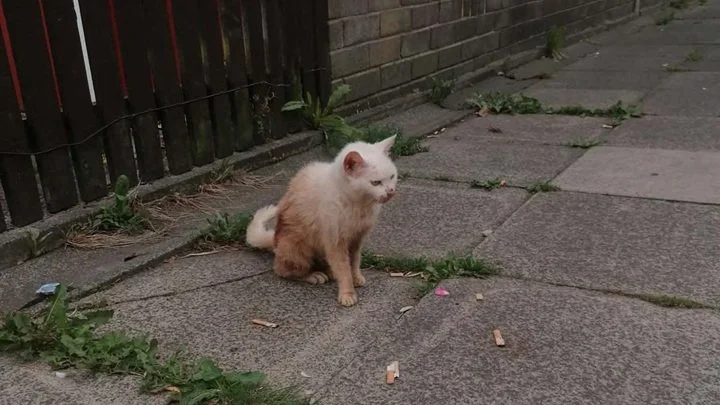
A cat identified by a volunteer as Bailey, pictured in Benwell. The RSPCA said it had closed the case, and the volunteer says those who raised concerns still don’t know what happened to him. Photo supplied to Great Park Gazette
Members of the public raised concerns about a cat in Benwell with both the RSPCA and the police, according to a person who followed the case and brought a group together to try to help. They say people contacted the RSPCA on six dates. Months later, those who raised the alarm still don’t know whether the cat received veterinary treatment, was taken into care or what ultimately happened to him.
A member of the public gave the cat the name Bailey because they felt he deserved a name. The person who organised the group contacted Great Park Gazette after our report on the pressures facing cat rescues across Newcastle and North Tyneside. They say a charity that asks the public to fund its rescue work should explain what action it took when people reported an animal in distress. For donors, the case raises a wider question about what their money funds and how they can see the results locally. Read our original report on the local cat rescue crisis.
Six reported contacts with the RSPCA and a report to police
In an email shared with the Gazette, the person who organised the group said Bailey’s welfare was first reported to the RSPCA on 29 August 2026. They listed further contacts on 31 August and 1, 2, 7 and 21 September. They said they had made a report themselves and that photographs and videos had been provided to the charity.
They said the police were also contacted and that they have a police incident reference. The Gazette has yet to establish what action, if any, police took.
How the appeal spread across two Facebook groups
Screenshots supplied to the Gazette show that an appeal about Bailey was posted in Cats North East: (The 9 Lives Foundation) Lost & Found on 29 August. It urged readers to contact the RSPCA and said people trying to help were waiting for an update.
On 31 August, the appeal was shared in Missing, Found, and Deceased Cats North East England, where the post displayed photographs and video of the cat. The person who organised the group said more than ten people were involved in trying to help Bailey.
Why people were worried about Bailey
The source described Bailey repeatedly scratching and biting at his skin. People who saw the footage suspected a severe flea infestation and feared his condition was worsening. They believed he needed urgent veterinary attention.
Brown staining is visible on parts of Bailey’s white fur in a photograph supplied to the Gazette. Some of those who raised concerns wondered whether it came from injuries caused by scratching and biting. The Gazette has no veterinary confirmation of the cause of the staining or the suspected flea infestation.
The source said members of the public offered to help pay for veterinary treatment and understood that the offer was declined. According to the source, the owner expressed worries about treatment because of previous experiences. The Gazette has yet to independently verify that account.
What did the RSPCA tell the people who raised concerns?
In the email, the source said nearly a month had passed since the first report and that, as far as those involved knew at the time, the RSPCA had yet to see Bailey or take him into care. The Gazette has yet to establish when the charity first logged the report or whether an officer saw Bailey.
The source shared an RSPCA email circulated on 9 October which they understood to relate to the report about Bailey. RSPCA Operations said an officer had assessed and dealt with the situation, that “the appropriate action has been taken” and that the incident had been closed. The email does not name Bailey or describe what action was taken. Whether he was examined by a vet, received treatment or was taken into care remains unknown.
Suspected neglect was also reported at a second Benwell property
The source described a separate welfare report involving several cats at another Benwell property. They said litter trays were full of faeces and described cats losing fur and covered in fleas. They said photographs and videos relating to those concerns were also sent to the RSPCA.
In a separate email dated 29 September, RSPCA Operations said it had logged the concerns and would pass them on for assessment. It said it could give no timescale for further action because its officers were extremely busy.
According to the source, a member of the public learned about the case on Facebook, picked up one of the cats from the street and took it to a vet. The source said that cat later went into another charity’s care. The Gazette has yet to independently verify that account or establish what happened to the other cats.
What does the RSPCA say donations pay for?
The RSPCA says that for every £1 donated, 80p goes to rescue and care, 19p to fundraising and marketing, and 1p to governance and support. Its 2025 accounts record £151.6 million in donations and legacies and £48.3 million in spending on its inspectorate. The charity says its cruelty helpline received 933,000 calls that year. RSPCA donations page · 2025 annual report and accounts · 2025 annual review
The accounts show what the RSPCA spends nationally. Donors in Newcastle and North Tyneside may also want to know how quickly officers attend urgent reports in the North East, how many reports lead to a visit, and what help animals receive. Does the charity publish those figures for this region?
What should people be told when a case closes?
The RSPCA says it assesses reports by severity and urgency. Its officers have no statutory power to enter private property without permission or to seize animals. Its privacy notice says it uses callers’ details to provide brief updates about investigations if requested. RSPCA reporting guidance · RSPCA investigation guidance · RSPCA reporting privacy notice
The person who brought the group together acknowledged that investigations can take time and that there are limits on what the charity can share during an active case. They said they could provide records of the reports and that others could give their own accounts. They want to know what the RSPCA can now tell them about Bailey.
Could the charity routinely tell the person who reported a concern whether an officer attended, whether the animal received a welfare assessment and what outcome it can share? Where it has to withhold details, could it explain why?
Have your say
If you’ve reported an animal welfare concern, what did you hear back? If you donate to an animal welfare charity, what would you like it to publish about its work in your area? Share your experience in the Great Park Residents Group on Facebook, keeping names and addresses private.