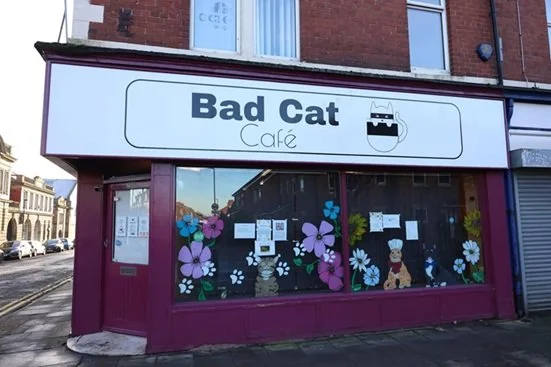
Bad Cat Café in Wallsend is among the local rescue organisations highlighting the growing pressure on cat welfare services across Newcastle and North Tyneside, as volunteers struggle with rising veterinary costs, limited space and increasing numbers of stray, abandoned and unwanted cats needing help
A growing animal welfare crisis is placing enormous pressure on cat rescue organisations across Newcastle and North Tyneside, with volunteers warning that they are struggling to cope with increasing requests to help stray, abandoned, unneutered and unwanted cats.
New evidence shared with Great Park Residents Group by Wallsend-based BAD Cat Café & Rescue reveals the difficult decisions facing those attempting to care for vulnerable animals, including mounting veterinary bills, limited foster capacity and cases where rescuers have no space to take in cats desperately needing assistance.
In one particularly concerning case, the organisation has received a request for help involving 12 cats whose owner is reportedly facing eviction on Wednesday 4 November.
Meanwhile, other cats remain outdoors awaiting rescue, with volunteers concerned about deteriorating weather conditions and the approaching Bonfire Night celebrations.
The situation has prompted calls for Newcastle City Council and North Tyneside Council to work with rescue organisations to investigate the scale of the problem and explore practical solutions, including affordable neutering, microchipping, education and preventative animal welfare programmes.
The concerns extend well beyond Wallsend, with reports involving cats across Newcastle, North Tyneside and surrounding communities.
"I'm starting to dread my phone ringing"
For the volunteers dealing with the situation every day, the pressure is becoming increasingly difficult to manage.
Tasmin, from BAD Cat Café & Rescue in Wallsend, has shared a candid account of the challenges facing the organisation.
The rescue currently has 38 cats in its care, including animals living at the café and others being looked after by foster carers.
Despite this considerable commitment, requests for help continue to arrive.
Tasmin explained:
"I'm starting to dread Sundays because people contact me when they can't get through anywhere else."
She also described the emotional impact of repeatedly receiving calls about animals needing assistance when the organisation is already struggling to accommodate those in its care.
"I'm starting to dread my phone ringing."
"I'm starting to dread vet appointments."
Perhaps one of the most difficult aspects is knowing that some animals cannot be helped immediately, despite volunteers wanting to assist.
"There's nowhere to refer people to. Sometimes there's just nothing I can say that will help the situation."
These comments illustrate the emotional burden falling on individuals who are attempting to deal with a much wider animal welfare problem.
Twelve cats facing an uncertain future following an eviction
One of the most urgent cases reported to the rescue involves a person who is facing eviction on Wednesday 4 November.
According to the information provided, the individual needs to find alternative arrangements for 12 cats, including both adults and kittens.
Such circumstances highlight how quickly a housing emergency can become an animal welfare emergency.
Finding accommodation for one cat can be difficult when local rescues are already full.
Finding suitable accommodation for 12 animals at very short notice presents an even greater challenge.
The cats may have different needs, ages, personalities and veterinary requirements, while any organisation accepting them would need sufficient space, resources and appropriately experienced carers.
The full circumstances of this individual case have not been independently established, and it is not yet known what arrangements can be made for the animals.
However, it provides a particularly stark example of the difficulties facing both pet owners and the organisations they turn to for help.
It also raises broader questions about what support exists when people are forced to give up their homes and cannot take their pets with them.
Cats left outdoors because rescues have no room
The crisis is not limited to pets being surrendered by their owners.
Volunteers have also described situations involving stray cats that remain outside because rescue organisations simply cannot accommodate them.
Tasmin reported that one cat is living outdoors close to the café but cannot currently be brought into care.
The difficulty is not simply finding a space.
Accepting responsibility for the animal would also mean paying for neutering, microchipping, vaccinations and any additional veterinary treatment it might require.
These are costs that already stretched rescue organisations cannot always absorb.
Another case has been reported in the NE5 area of Newcastle, where a nervous cat is living outdoors and awaiting assistance.
Those involved are concerned about the animal's welfare as Bonfire Night approaches, particularly because it is reportedly frightened by loud noises.
The cat has been placed on a list for assistance but cannot easily be approached and may require humane trapping by experienced rescuers.
While outdoor cats are not necessarily stray or abandoned, and some may have owners, these situations demonstrate why identifying ownership and arranging appropriate help can be complicated.
For genuinely stray, sick or vulnerable animals, a shortage of rescue places can mean a prolonged wait for assistance.
Five kittens rescued, but friendly adult cats could not be taken in
In another recent incident, BAD Cat Café & Rescue worked alongside independent rescuers to take in five kittens.
However, the organisation reported that adult cats at the same location, described as friendly and comfortable with human contact, could not be accommodated.
The rescuers believed the adults might have been suitable for rehoming if places had been available.
Instead, they reported that the only intervention they could provide was trap-neuter-return, commonly known as TNR.
TNR involves humanely trapping cats, arranging neutering and returning them to an appropriate outdoor environment.
It is an established approach for managing feral cat populations, although the suitability of returning an individual animal depends on its circumstances and welfare needs.
Friendly, socialised cats may have different needs from genuinely feral animals, and individual welfare assessments remain important.
For the rescuers involved, the experience was particularly upsetting.
Tasmin explained that it was the first time they had found themselves in such a position, with the lack of available space preventing them from offering the adult cats an opportunity for rehoming.
The incident raises a difficult question.
What happens when an animal could potentially be rehomed, but every available rescue space is already occupied?
Veterinary bills and everyday costs are mounting
Caring for rescued cats involves considerably more than providing food and shelter.
Many arrive requiring neutering, vaccinations, flea and worm treatment, microchipping, dental work or other veterinary care.
Some need ongoing treatment for illnesses or injuries, while others require specialist attention before they can be safely rehomed.
BAD Cat Café & Rescue has provided a snapshot of the financial pressure involved.
The organisation expects to have spent approximately £750 on veterinary treatment across just two days, by Tuesday evening.
It has also scheduled approximately £470 worth of veterinary appointments, although it has not been established whether that amount overlaps with the two-day expenditure.
These figures are separate from many of the routine costs involved in caring for cats.
Last month alone, the organisation spent approximately £400 on cat litter across the café and its foster homes.
Food, cleaning products, transport, vaccinations, medication and other everyday essentials add further costs.
Unlike larger organisations with extensive infrastructure, many local rescues rely heavily on fundraising, donations, volunteers and small networks of foster carers.
Even when additional people are willing to foster, rescues must consider whether they can afford the animals' care and provide appropriate supervision and support.
BAD Cat Café & Rescue says it cannot currently afford to expand its foster network or take responsibility for supervising additional carers.
The organisation also reports having eight cats that are already considered particularly difficult to rehome, potentially requiring longer-term support.
These pressures mean that increasing the number of animals in care is not necessarily a viable solution without additional resources.
The figures from one rescue tell an important story
The latest accounts follow earlier information provided by the same organisation about the number of cats it has dealt with over recent years.
These figures have been shared with Great Park Residents Group as part of efforts to establish the scale of the problem.
Cats recorded by BAD Cat Café & Rescue
2022 and 2023 combined
Cats arriving from shelters: 21
Stray cats: 2
Owner surrenders: 43
Total: 66 cats
2024
Cats arriving from shelters: 33
Stray cats: 5
Owner surrenders: 17
Total: 55 cats
2025
Cats arriving from shelters: 36
Stray cats: 20
Owner surrenders: 28
Total: 84 cats
2026 – figures provided to date
Cats arriving from shelters: 15
Stray cats: 13
Owner surrenders: 19
Total: 47 cats
Across these periods, the organisation has recorded 252 cats through these categories.
It has also reported that 95 cats arrived unneutered and subsequently had to be neutered through the organisation's own arrangements.
The rescue explained that many animals transferred from other shelters had already been neutered.
The figures therefore raise particular concerns about the numbers of animals arriving without having received this important preventative treatment.
What do these figures actually show?
It is important to interpret the information carefully.
These figures come from one organisation and should not be presented as a comprehensive count of stray, abandoned or unwanted cats across Newcastle and North Tyneside.
The figures for 2022 and 2023 are combined, while those for 2026 cover only part of the year.
The different categories also include transfers from other shelters, meaning they do not exclusively represent cats originating from the immediate area.
Nevertheless, they provide evidence of the substantial workload being managed by one relatively small rescue organisation.
The reported increase in stray cats handled between 2024 and 2025 is particularly notable, rising from five to 20.
Further information from other rescues would help determine whether this reflects a wider regional pattern.
The wider problem of unneutered cats
One of the central concerns raised by rescuers is the number of cats that remain unneutered.
Cats can become capable of reproducing at a relatively young age, and an unneutered female may produce multiple litters over time.
Without effective preventative measures, unwanted breeding can contribute to further pressure on rescue organisations.
Once kittens are born, volunteers may find themselves caring not only for the kittens but also for their mothers, with additional veterinary and rehoming costs.
Neutering can help prevent unwanted litters and reduce certain health risks.
Cats Protection recommends neutering pet cats at around four months of age, subject to veterinary advice.
Its 2026 Cats and Their Stats report estimates that around 2.1 million owned cats across the UK are not neutered, illustrating why preventative animal welfare work remains an important national issue.
Cost can also be a barrier for some owners.
Programmes offering subsidised neutering can therefore have an important role in helping households care responsibly for their pets before an unwanted litter occurs.
Microchipping is already a legal requirement
Another issue raised by rescuers is the importance of microchipping.
Since 10 June 2024, owned cats in England have generally been legally required to be microchipped by the age of 20 weeks.
Owners must also ensure that the registration details associated with the microchip remain up to date.
The requirement applies to indoor cats as well as those allowed outdoors, although certain free-living cats, including feral cats, are exempt.
Owners who fail to comply with the regulations can face enforcement action and a fine of up to £500.
Microchipping does not prevent a cat from becoming lost or abandoned.
However, it can make it considerably easier for veterinary professionals and rescue organisations to identify an owner and reunite a missing animal with its family.
Where cats are not microchipped, rescuers can face additional difficulties establishing whether the animal is genuinely abandoned, has become lost or is simply roaming away from its home.
Why are councils being asked to become involved?
The concerns have already been formally raised with Newcastle City Council and North Tyneside Council.
Following discussions involving residents, rescuers and volunteers, correspondence was sent to senior council representatives, relevant departments and elected councillors.
The intention was to bring the issue directly to the attention of those who may be able to investigate what is happening and help coordinate a response.
The correspondence was not intended to suggest that any individual councillor, council or department had caused the problem.
Instead, it asked whether the two authorities could work with animal welfare organisations to establish the scale of the issue and explore practical interventions.
The problem crosses council boundaries.
A cat found in Wallsend may have originated elsewhere in North Tyneside or Newcastle, while rescue organisations frequently accept animals from much wider areas.
This means that addressing the situation purely within individual wards may not reflect how local rescue services actually operate.
What have the councils been asked to consider?
The formal request included seven key areas:
1. Investigating the scale of the problem
Gathering evidence from local rescues about stray cats, abandoned animals, owner surrenders, unneutered cats and animals they have been unable to accommodate.
2. Reviewing existing provision
Establishing what support currently exists for stray and unowned cats and identifying potential gaps.
3. Bringing rescue organisations together
Arranging discussions with those involved in animal welfare to understand the pressures they are experiencing.
4. Developing preventative programmes
Exploring neutering, microchipping, responsible ownership and early intervention.
5. Learning from existing schemes
Considering whether approaches developed elsewhere in the North East, including proposals associated with Pawz for Thought in Sunderland, could offer useful ideas.
6. Considering practical support
Examining whether funding, facilities, training, insurance arrangements or other forms of assistance could help reputable local organisations.
7. Improving education
Exploring opportunities to promote responsible pet ownership through schools, community groups and other local initiatives.
The objective is to establish what is practical, affordable and achievable rather than assuming that either council can resolve the situation independently.
Why are stray cats treated differently from stray dogs?
One issue repeatedly raised during discussions is the difference between the arrangements for stray dogs and those for cats.
Local authorities in England have a statutory responsibility to deal with stray dogs under the relevant legislation.
The legal position for stray cats is different.
There is no equivalent general statutory duty requiring councils to collect every roaming or unowned cat.
This does not mean that cats lack legal protection.
Animal welfare legislation still applies, and local authorities have certain enforcement powers, including in relation to compulsory microchipping.
Nevertheless, the difference in arrangements can leave voluntary charities playing a particularly important role in providing practical help for cats.
A dog found wandering without its owner is generally recognised as a matter requiring formal intervention.
By contrast, a cat living outdoors may initially be assumed to belong to someone nearby.
It can be difficult to establish whether the animal is lost, abandoned, feral or simply roaming.
For some cats, this uncertainty can delay identification and appropriate assistance.
That is one reason campaigners believe greater cooperation between local authorities, veterinary professionals and rescue organisations is worth exploring.
This is not just a Wallsend problem
Although BAD Cat Café & Rescue is based in Wallsend, the concerns being raised are not confined to one town.
Volunteers and residents have described difficulties involving animals across Newcastle and North Tyneside, including parts of the NE5 postcode area.
Rescues may also receive requests from neighbouring communities when other organisations are full.
Newcastle Great Park, Gosforth, Wideopen, Kingston Park, North Shields, Wallsend, Killingworth, Longbenton and other surrounding areas are all part of a wider region where animal welfare organisations and residents may encounter similar difficulties.
The scale of the problem in each individual area has not yet been formally established.
That is precisely why campaigners are asking for better evidence gathering and closer cooperation.
A coordinated approach could provide a clearer picture of where the greatest pressures exist, what support is already available and where additional help might be most effective.
Could prevention reduce pressure on rescue organisations?
The people raising these concerns are not simply asking for more places to accommodate cats.
They are also questioning whether more could be done to prevent animals from needing rescue in the first place.
A stronger preventative approach could involve more accessible neutering services, community microchipping events, information for new owners and early support for people struggling to keep their pets.
Education could also help people understand the financial responsibilities involved in owning a cat, including veterinary care, vaccinations, neutering and ongoing treatment.
Supporting owners before they reach crisis point may help prevent some animals from being surrendered.
It could also reduce pressure on voluntary organisations that are already caring for cats with complex health and behavioural needs.
However, any local scheme would require discussions about funding, trained personnel, veterinary involvement, safeguarding and the appropriate division of responsibilities.
No new council-funded programme has been confirmed as a result of the correspondence described in this article.
National petition calls for action on the cat rescue crisis
The concerns being raised locally reflect a wider national debate about cat welfare and the pressures facing rescue organisations.
A UK Parliament petition titled "Introduce a national strategy to tackle the cat overpopulation and rescue crisis" is calling for greater government action.
The petition, created by Bradley Shaw, asks for measures including:
Expanded access to affordable neutering.
Additional support for overwhelmed rescue centres.
Better education about responsible cat ownership.
Measures to address irresponsible breeding and abandonment.
A coordinated approach to improving cat welfare.
The petition has already exceeded 21,000 signatures and received a formal government response.
In its response, the Department for Environment, Food and Rural Affairs outlined work relating to responsible pet ownership, cat breeding and engagement with animal welfare organisations.
The petition remains open until 19 February 2027.
READ AND SIGN THE UK PARLIAMENT PETITION:
https://petition.parliament.uk/petitions/777945
The petition concerns national policy, but its aims closely reflect the preventative measures and practical support being discussed by local volunteers.
How can residents help?
Residents across Newcastle and North Tyneside can help support animal welfare organisations in several ways.
Consider adopting rather than buying
Rescue organisations frequently have cats and kittens looking for suitable homes. Some animals may require additional patience or specialist care.
Support local rescues
Donations, fundraising and practical supplies can help organisations meet veterinary and everyday care costs.
Before donating items, contact the organisation to establish what it currently needs.
Neuter and microchip your cats
Responsible ownership can prevent unwanted litters and make it easier to reunite lost pets with their families.
Seek advice early if you are struggling
If you are facing financial difficulties, housing problems or circumstances that could affect your ability to care for a pet, contact appropriate welfare organisations as early as possible.
Share information about the situation
Local rescue organisations may hold records of cats taken into care, animals awaiting assistance, veterinary costs and requests they have been unable to accommodate.
With their agreement, anonymised statistics could contribute to a clearer regional picture.
Support the petition
Residents who agree with the proposals can read and sign the parliamentary petition calling for a national strategy.
What if you find a stray cat?
Not every unfamiliar cat is homeless.
Cats may wander considerable distances from their homes, and some may be mistaken for strays.
If you find a cat that appears lost, contact a local veterinary practice or animal welfare organisation for advice about checking for a microchip and tracing an owner.
If an animal is sick, injured or in immediate danger, seek urgent veterinary or appropriate animal welfare assistance.
Do not attempt to trap a frightened or feral cat without suitable experience and advice.
Cats Protection Northumbria provides information about lost and found cats, rehoming and neutering assistance across Newcastle, North Tyneside and surrounding communities.
Further information is available at:
https://www.cats.org.uk/northumbria
What happens next?
The immediate priority for campaigners is to raise awareness and encourage constructive engagement between councils, local rescue organisations and residents.
Evidence has already been provided to Newcastle City Council and North Tyneside Council through formal correspondence.
The latest information from BAD Cat Café & Rescue adds further detail about the capacity limitations, financial pressures and difficult welfare decisions facing those on the front line.
There are still important questions to answer.
How many cats are currently awaiting rescue across Newcastle and North Tyneside?
How many requests for help are being turned away because organisations are full?
What are the total veterinary costs being absorbed by local rescues?
Could preventative programmes reduce the number of animals needing emergency assistance?
And what practical support could realistically be provided through cooperation between public bodies, charities, veterinary professionals and local communities?
The intention is not to place blame but to bring the relevant people together and investigate what can be done.
A crisis that cannot be solved by volunteers alone
The latest accounts from BAD Cat Café & Rescue offer a sobering insight into the difficulties facing people who dedicate their time to helping vulnerable animals.
Behind the statistics are cats living outdoors, owners facing desperate circumstances, foster carers managing increasingly demanding responsibilities and volunteers making decisions they never expected to face.
For some, the most distressing part is not the work itself but knowing that another animal needs help and having no means of providing it.
The situation cannot be understood simply by counting the number of cats entering rescue.
It must also take account of the animals that cannot be accepted, the people desperately seeking assistance and the emotional and financial costs borne by those doing the work.
Whatever solutions eventually emerge, those directly involved in rescue and welfare work have made one thing increasingly clear.
Without sufficient capacity, effective prevention and coordinated support, the pressure on voluntary rescuers is unlikely to ease.
Have your say – and help us build the evidence
Great Park Gazette and Great Park Residents Group would welcome information from rescue organisations, foster carers and residents across Newcastle, North Tyneside and surrounding communities.
If you are involved in animal rescue and have figures relating to stray cats, owner surrenders, unneutered animals, veterinary expenditure, waiting lists or requests for assistance that could not be accommodated, that evidence could be particularly valuable.
We would also welcome constructive suggestions about preventative schemes, education and practical assistance.
Please avoid sharing identifying details of vulnerable individuals or the precise locations of cats at risk in public comments.
The purpose of gathering this information is to understand the problem properly and help identify workable solutions.
The more reliable evidence available, the more informed the discussion can become.
Research and further reading
UK Parliament – Petition calling for a national strategy on cat overpopulation and rescue pressures
Cats Protection Northumbria – Local assistance and information
UK Government – Local authority responsibilities for stray dogs
Editorial note: The figures and first-hand accounts attributed to BAD Cat Café & Rescue were supplied directly to Great Park Residents Group with permission to publish. They have not been independently audited and should not be interpreted as comprehensive figures for Newcastle or North Tyneside. The council correspondence and requests for investigation have been described using information provided by the group. Individual cases involving animals and people in vulnerable circumstances have been anonymised where appropriate.

