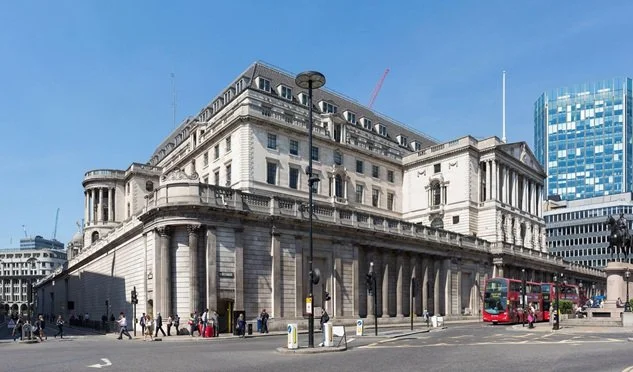
The Bank of England's headquarters in London. The central bank raised its base interest rate from 3.75% to 4% on Thursday 5 November 2026, with implications for mortgages, savings and household finances across Newcastle Great Park and the wider UK. Photograph: David Iliff / Wikimedia Commons
The Bank of England has increased the UK's base interest rate from 3.75% to 4%, delivering another financial challenge for households already facing rising energy bills and pressure on everyday living costs.
The decision, announced on Thursday 5 November 2026, represents an increase of 0.25 percentage points and is the first rise in Bank Rate since August 2023.
For homeowners across Newcastle Great Park, Gosforth, Kingston Park, Wideopen and the wider North East, the announcement raises an immediate question: will mortgage repayments now increase?
The answer depends largely on the type of mortgage a household has.
People with tracker mortgages are generally expected to see their interest rates increase, while those with existing fixed-rate deals should see no immediate change to their contractual monthly repayments.
And despite the Bank of England's decision to raise rates, some major mortgage lenders have actually been reducing selected fixed-rate deals this week.
Great Park-based mortgage adviser Leston Mortgages has highlighted this important distinction, explaining that fixed mortgage rates are influenced by financial markets and do not automatically move in the same direction as the Bank of England's base rate.
Great Park Gazette examines today's announcement, the reasons behind the increase and what it could mean for local homeowners, first-time buyers, savers and families managing household budgets.
Bank of England confirms first interest rate increase since 2023
The Bank of England's Monetary Policy Committee voted to increase the base rate from 3.75% to 4% following its latest meeting, which concluded on Wednesday 4 November.
The decision was publicly announced at midday on Thursday 5 November.
All nine members of the committee supported increasing interest rates.
Eight members voted for a rise of 0.25 percentage points, while one member, Catherine Mann, preferred a larger increase of 0.5 percentage points, which would have taken the rate to 4.25%.
The majority therefore agreed on the smaller increase.
The decision was widely anticipated by financial markets after months of concern about inflation and rising global energy prices.
The base rate had remained at 3.75% since December 2025.
The latest increase brings it back to 4%, a level last seen before the December reduction.
What is the base rate?
The Bank of England's base rate, also known as Bank Rate, is the interest rate paid on reserves held by commercial banks at the central bank.
It influences the wider cost of borrowing and saving throughout the UK economy.
When the base rate increases, borrowing can become more expensive.
This can affect mortgages, loans and certain other forms of credit.
Higher interest rates can also encourage saving, although banks and building societies do not always pass on increases to their customers.
The Bank of England uses interest rates as one of its main tools for controlling inflation.
Its official target is to maintain inflation at 2%.
Why have interest rates gone up?
The Bank of England says continuing instability in the Middle East has contributed to higher global energy prices, increasing the risk of sustained inflation.
The conflict involving Iran and its wider consequences for energy supplies have added significant uncertainty to the economic outlook.
Higher oil prices can increase the cost of petrol, diesel, transport and manufacturing.
Rising natural gas prices can also affect household energy bills and business operating costs.
When businesses face higher expenses, some may eventually pass those costs on to customers through increased prices.
This can create additional inflationary pressure throughout the economy.
The Bank has warned that inflation could rise further over the coming months.
UK consumer price inflation reached 3.5% in September 2026, already above the official 2% target.
Its latest forecast suggests inflation could reach approximately 5% by the middle of 2027.
That figure is a forecast rather than a guaranteed outcome.
Much will depend on what happens to energy prices, international events and the wider economy.
What has Andrew Bailey said?
Bank of England governor Andrew Bailey explained that the continued rise in energy costs had created sufficient inflationary pressure to justify an increase in interest rates.
However, he also cautioned against assuming that Thursday's decision marks the beginning of an unavoidable series of increases.
The Bank will assess conditions at each future meeting.
If inflationary pressures ease, the outlook for interest rates could change.
If energy costs remain elevated and begin feeding more widely into wages and prices, further increases may become necessary.
For households, this means there is still considerable uncertainty about the direction of borrowing costs during 2027.
What does the increase mean for Great Park homeowners?
Newcastle Great Park is home to a mixture of established homeowners, families who have moved into recently built properties and people purchasing their first homes.
Many residents have mortgages, with monthly repayments representing one of their largest household expenses.
The impact of today's announcement will differ depending on whether a borrower has a tracker, fixed-rate or other variable-rate mortgage.
Some households will experience an increase in their payments.
Others may see no immediate difference at all.
The important thing is to understand how a particular mortgage works rather than assuming that every homeowner will automatically pay more because the Bank of England has raised its rate.
Tracker mortgages: Payments are likely to rise
Homeowners on tracker mortgages are among those most directly affected.
A tracker mortgage follows an external interest rate, usually the Bank of England base rate, with an additional margin set by the lender.
For example, someone with a tracker charging one percentage point above Bank Rate would previously have paid interest at 4.75%.
Following Thursday's announcement, that rate would normally increase to 5%.
The precise timing of the change depends on the mortgage agreement and the lender's procedures.
Some lenders will implement changes relatively quickly, while others operate specific review dates.
How much extra could a tracker mortgage cost?
The financial impact depends on the outstanding mortgage balance, the remaining repayment term and whether the borrower has a repayment or interest-only mortgage.
Consider an illustrative £200,000 repayment mortgage with 25 years remaining.
At an interest rate of 4.75%, the monthly repayment would be approximately £1,140.
If the rate increased to 5%, the monthly repayment would rise to approximately £1,169.
That represents an increase of around £29 per month, or approximately £348 over a full year if the higher payment applied for all 12 months.
For a £300,000 mortgage over the same remaining term, the equivalent increase would be approximately £43 per month.
These are illustrative repayment calculations, not quotations from a mortgage lender.
Actual changes will depend on individual circumstances, mortgage terms and the way the lender calculates payments.
What about interest-only mortgages?
For interest-only borrowing, the immediate effect can be easier to illustrate.
A 0.25 percentage-point increase on a £200,000 interest-only mortgage adds approximately £41.67 per month in interest.
On a £300,000 interest-only balance, the additional interest would be approximately £62.50 per month.
Those calculations assume the full rate increase is passed through and the outstanding balance remains unchanged.
Interest-only borrowers also remain responsible for repaying the original mortgage capital at the end of the term.
Fixed-rate mortgages: No automatic increase today
There is better news for homeowners currently on fixed-rate mortgage deals.
If a borrower has secured a fixed interest rate for two, three, five or more years, their agreed rate normally remains unchanged until that fixed period ends.
This means someone paying a fixed rate of 4.5% should not suddenly see their mortgage rate rise to 4.75% because of today's Bank of England decision.
The contractual fixed rate remains in place.
However, the situation changes when the fixed-rate period comes to an end.
At that point, the homeowner must choose whether to arrange another deal with their existing lender, remortgage elsewhere or move onto their lender's standard variable rate.
It is the rate available when the new arrangement begins that determines future payments.
This is particularly important for residents whose existing mortgage deals expire during late 2026 or 2027.
Leston Mortgages: Fixed rates do not necessarily rise when Bank Rate increases
Great Park-based Leston Mortgages, which works with residents in the local community, has provided a useful explanation of why today's announcement does not necessarily mean all mortgage deals will become more expensive.
In information shared with Great Park residents following the Bank of England's decision, the business highlighted three important points.
1. The interest rate rise was already widely expected
Leston Mortgages explained that the increase had largely been anticipated by financial markets.
Fixed mortgage rates are influenced significantly by interest-rate swap markets, which reflect expectations about future borrowing costs.
As a result, lenders often adjust their fixed-rate pricing before the Bank of England makes an official announcement.
When a rate increase has already been widely anticipated, the actual announcement may have relatively little immediate effect on newly advertised fixed-rate products.
2. Tracker mortgage holders are likely to see increases
The firm also warned that borrowers with tracker mortgages will generally see their mortgage interest rates rise by the same 0.25 percentage-point increase, where their products directly follow Bank Rate.
This could result in higher monthly payments.
The exact increase will depend on the outstanding mortgage balance and terms of the agreement.
3. Some major lenders have actually reduced fixed mortgage rates
Leston Mortgages pointed out that several major lenders had reduced selected fixed-rate mortgage products this week, despite the anticipated base rate increase.
The business highlighted Halifax, Nationwide and Santander in its local update.
The distinction is important because the Bank of England's rate and the fixed mortgage rates offered by individual lenders are not directly interchangeable.
Lenders also consider competition, funding costs, expected future rates and the type of borrowers they want to attract.
Nationwide confirms cuts to fixed mortgage products
Nationwide announced on Tuesday 3 November that it was reducing selected fixed mortgage rates by up to 0.15 percentage points, with the changes taking effect on Wednesday 4 November.
Its announcement covered products for first-time buyers, home movers and people remortgaging.
The building society said its lowest advertised rate for qualifying home movers would become 4.89%, although that offer carries specific eligibility requirements, including deposit or equity conditions and a product fee.
Other rates and arrangements apply to different borrowers.
Halifax also announced reductions to selected fixed-rate mortgage deals this week.
These developments support the point raised by Leston Mortgages: a rise in Bank Rate does not automatically mean every new fixed mortgage deal becomes more expensive on the same day.
However, this should not be interpreted as a guarantee that fixed rates will continue falling.
Mortgage pricing can change rapidly, and a lender's lowest advertised rate may not be available to every applicant.
Why can fixed mortgage rates fall when the base rate rises?
The explanation lies partly in how banks and building societies finance their mortgage lending.
Fixed mortgage pricing is heavily influenced by wholesale financial markets, including interest-rate swaps.
These markets reflect expectations of what interest rates may do over the coming years.
If lenders and investors have already anticipated a Bank of England increase, that expectation may already be reflected in the cost of fixed-rate borrowing.
Some lenders may then decide to reduce their advertised mortgage rates to remain competitive.
For example, a lender seeking more remortgage customers might cut selected two-year or five-year fixed deals even while Bank Rate is increasing.
This does not mean the Bank of England's decision is irrelevant.
Its decisions and economic forecasts influence the wider market.
But there is no rule requiring a lender to increase every fixed mortgage rate by exactly the same amount as the central bank's latest change.
It is therefore sensible to compare actual mortgage offers rather than relying solely on headlines about Bank Rate.
What about homeowners on standard variable rates?
Borrowers on a lender's standard variable rate, commonly known as an SVR, could also face higher mortgage payments.
Unlike a tracker, an SVR is set by the individual lender.
The lender can decide whether to increase or reduce it, subject to the mortgage agreement and applicable rules.
Some lenders may pass on the full 0.25 percentage-point increase.
Others may make a different adjustment or leave their rate unchanged.
Standard variable rates are often higher than the rates available through fixed or tracker mortgage products.
Many homeowners move onto an SVR automatically when an introductory mortgage deal ends, unless they arrange an alternative.
For anyone currently paying an SVR, Thursday's announcement is a reason to review the available options.
However, switching mortgages can involve fees and other considerations, so the lowest advertised interest rate is not always the cheapest overall deal.
First-time buyers: Will getting a mortgage become harder?
For people hoping to buy their first home in Newcastle Great Park or nearby communities, the increase adds another factor to consider.
Mortgage lenders assess whether applicants can afford their repayments, taking account of income, existing financial commitments, credit history and the size of their deposit.
Higher mortgage rates can reduce the amount some households are able to borrow.
They can also increase monthly repayments on a given mortgage amount.
However, the exact effect depends on the deals available when an application is made.
The fact that some lenders have reduced selected fixed rates this week demonstrates that advertised mortgage products may move differently from the base rate.
First-time buyers should therefore compare products carefully, including:
The initial interest rate.
Monthly repayments.
Arrangement and product fees.
The length of the fixed-rate period.
Deposit and loan-to-value requirements.
Early repayment charges.
What happens when the introductory deal ends.
A low headline rate may be accompanied by a substantial product fee.
For someone borrowing a relatively small amount, a slightly higher rate with a lower fee could sometimes represent better value.
The appropriate choice depends on the full cost of the mortgage and the borrower's individual circumstances.
What if your mortgage deal ends in 2027?
Residents approaching the end of a fixed-rate deal should consider reviewing their options well before the final payment date.
MoneyHelper, the government-backed financial guidance service, recommends starting to explore remortgaging options up to six months before an existing deal expires.
That provides time to compare lenders and understand the costs involved.
It may also allow borrowers to secure a future deal without immediately leaving their existing mortgage.
Depending on the lender and the product, it may be possible to change to a more competitive offer before the new mortgage begins.
However, this is not guaranteed.
Some lenders may charge fees, and not every arrangement allows customers to switch freely.
Residents should also be aware of early repayment charges if they are considering ending a fixed-rate agreement before its scheduled expiry.
The important point is that homeowners do not necessarily need to wait until the final week of their mortgage deal to start exploring their options.
Could savings accounts pay more interest?
While higher interest rates can be difficult for borrowers, savers may benefit.
Banks and building societies can respond to an increase in Bank Rate by offering higher interest on certain savings products.
However, they are not required to pass on the full increase.
For example, someone holding £10,000 in a savings account would earn an additional £25 in annual interest if their savings provider increased the account's rate by the full 0.25 percentage points and the balance remained unchanged.
That is an illustration, not a prediction that all savings accounts will increase by that amount.
The actual benefit depends on the account's terms.
Fixed-rate savings products generally continue paying their agreed rate for the duration of the fixed term.
Variable-rate savings accounts may change, but the timing and size of any adjustment are determined by the provider.
Residents should compare the Annual Equivalent Rate (AER), withdrawal restrictions and other account conditions before moving their savings.
What happens to credit cards and personal loans?
The Bank of England's decision can also affect borrowing beyond mortgages.
Some credit products have variable interest rates, meaning lenders may adjust the amount customers pay.
However, credit card interest rates do not necessarily change directly in line with Bank Rate.
Personal loan agreements may also have fixed interest rates, which normally remain unchanged throughout the agreed repayment period.
New loans could become more expensive if lenders increase their rates.
Anyone carrying substantial credit card balances should pay particular attention to the interest being charged, the minimum payment and the time it may take to repay the debt.
Households struggling with unsecured borrowing can seek free, independent debt advice rather than relying on further expensive credit.
Rising energy bills create another concern for household budgets
The interest rate announcement comes during a period of renewed pressure on energy costs.
The Bank of England has warned that higher oil and gas prices are expected to contribute significantly to inflation during the coming months.
That could affect household electricity and gas bills, as well as transport and shopping costs.
For families managing mortgage repayments, council tax, utilities, childcare and other expenses, the combination of rising borrowing costs and inflation may be difficult.
The Bank of England's latest forecast suggests inflation could approach 5% in the middle of 2027.
If that happens, prices would be rising considerably faster than the Bank's 2% target.
However, the forecast is dependent on future energy prices and other economic developments.
A sustained reduction in wholesale energy costs could ease some of the pressure.
It is not yet possible to know precisely how energy bills and inflation will develop over the next year.
What should Great Park residents do now?
For homeowners, the most useful response is to understand their current mortgage arrangements.
Residents should check whether they are on a fixed, tracker, standard variable or discounted-rate product.
They should also identify when their existing deal ends and whether the lender has issued any notice of an upcoming rate change.
Those with tracker mortgages may want to review their budgets to account for a possible increase in repayments.
Homeowners approaching the end of a fixed-rate deal can compare available offers and explore whether a product transfer or remortgage would be appropriate.
Anyone experiencing difficulty meeting repayments should contact their lender as early as possible.
Lenders may be able to discuss temporary arrangements or other options depending on the circumstances.
Independent guidance is also available through MoneyHelper.
MoneyHelper – Mortgage and financial guidance:
https://www.moneyhelper.org.uk/
The Financial Conduct Authority also provides information on choosing mortgage products and checking whether firms are authorised.
FCA Financial Services Register:
Looking for local mortgage advice? Leston Mortgages supports Great Park residents
Residents who would like to explore their mortgage options may wish to seek advice from a suitably qualified mortgage adviser.
Leston Mortgages is based in Newcastle Great Park and provides mortgage advice to customers across Newcastle, Gosforth, the wider North East and other parts of the UK.
The business has shared guidance with the Great Park community following today's Bank of England announcement, helping explain the difference between the central bank's base rate and the fixed mortgage rates advertised by lenders.
Its local update emphasises that borrowers should not automatically assume every mortgage deal will become more expensive because of Thursday's decision.
The company advises on mortgages for first-time buyers, home movers and homeowners considering remortgaging, subject to individual circumstances.
Find Leston Mortgages in the Great Park Gazette Business Ads section
Anyone interested in finding out more about Leston Mortgages and the services it offers can visit the Business Ads section of the Great Park Gazette website, where the business will be advertised, or alternatively they can can click on the below link:
Residents should remember that mortgage advice may involve fees and that the suitability of any mortgage product depends on individual financial circumstances.
Great Park Gazette includes the business's comments as a local perspective on the interest rate announcement. This does not constitute an endorsement of a particular lender or mortgage product.
Will the Bank of England raise rates again in December?
The next scheduled Monetary Policy Committee decision is due on Thursday 17 December 2026.
The Bank has not committed to raising rates again.
Governor Andrew Bailey has made clear that future decisions will depend on the economic evidence available at the time.
Particular attention will be paid to inflation, energy prices, wage growth and the wider economy.
If energy costs remain high and inflationary pressure continues to build, further action may be considered.
If conditions improve, the Bank may take a different approach.
Financial markets can change their expectations quickly in response to new information.
This is another reason why households should be cautious about assuming that current mortgage offers will remain available indefinitely or that rates are certain to move in one direction.
The bottom line for Newcastle Great Park households
The Bank of England's decision to increase the base rate to 4% is a significant development for household finances.
But it does not mean that every mortgage holder in Great Park will immediately pay more.
Tracker mortgage customers are likely to experience higher interest charges.
Those on standard variable rates may also see increases, depending on decisions made by their lenders.
Existing fixed-rate customers should continue paying their agreed rates until their deals end.
Meanwhile, some major lenders have reduced selected new fixed-rate mortgage products despite the increase in Bank Rate.
The contrasting developments highlight why it is important to distinguish central bank decisions from the mortgage offers available to individual borrowers.
For homeowners, first-time buyers and residents approaching a remortgage, careful planning and an understanding of the available options will be especially important.
With inflation forecast to rise further during 2027, households will also need to consider the wider pressure on energy bills, transport and everyday spending.
The message for Great Park residents is straightforward: understand your mortgage, check when your deal expires, compare the full costs of available options and seek appropriate advice before making major financial decisions.
Have your say
Are you concerned about the Bank of England's decision to raise interest rates?
Have your mortgage repayments already increased, or are you approaching the end of a fixed-rate deal?
Have you noticed mortgage lenders reducing their advertised fixed rates despite Thursday's announcement?
And how are rising energy bills and other household costs affecting your budget?
Great Park Gazette welcomes residents' experiences and views on the latest interest rate decision and its impact across Newcastle Great Park and surrounding communities.
Please avoid sharing confidential financial information or personal account details in public comments.
Sources and further reading
Bank of England
Official November 2026 Monetary Policy Committee decision:
https://www.bankofengland.co.uk/monetary-policy-summary-and-minutes/2026/november-2026Understanding Bank Rate and interest rate decisions:
https://www.bankofengland.co.uk/monetary-policy/the-interest-rate-bank-rateMonetary Policy Committee meeting dates:
https://www.bankofengland.co.uk/monetary-policy/upcoming-mpc-dates
Mortgage lenders
Nationwide – Fixed mortgage rate reductions announced 3 November 2026:
https://www.nationwide.co.uk/media/news/nationwide-cuts-fixed-mortgage-rates-for-first-time-buyers-home-movers-and-people-remortgaging
MoneyHelper
How interest rates affect mortgages:
https://www.moneyhelper.org.uk/en/blog/buy-or-rent-a-home/how-will-interest-rates-affect-my-mortgageRemortgaging to get a better deal:
https://www.moneyhelper.org.uk/en/homes/buying-a-home/remortgaging-to-cut-costsPreparing for interest rate changes:
https://www.moneyhelper.org.uk/en/homes/buying-a-home/how-to-prepare-for-an-interest-rate-rise
Local business perspective
Leston Mortgages – Mortgage guidance published for the Great Park community, 5 November 2026.
Great Park Gazette – Business Ads section: https://www.greatparkgazette.co.uk/business-ads
Editorial note: The Bank of England's increase to 4% was confirmed on 5 November 2026. Information provided by Leston Mortgages is attributed to the local business. Nationwide's announced rate reductions have been independently checked, and Halifax's reductions have been reported in mortgage-industry coverage. Mortgage offers, rates and fees can change without notice. Repayment figures in this article are illustrative only and do not constitute personalised financial advice.

