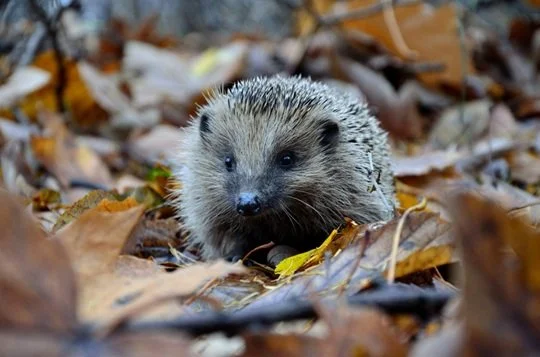
A hedgehog sheltering among fallen leaves. Northumberland Wildlife Trust is urging Great Park residents to check bonfires carefully before lighting them, as hedgehogs may be hiding among logs, branches and garden waste while preparing for winter. Photograph: Matteo.Valerio / Wikimedia Commons
Residents across Newcastle Great Park and the wider North East are being urged to take extra care this Bonfire Night, as Northumberland Wildlife Trust warns that hedgehogs searching for somewhere to spend the winter could be hiding inside unlit bonfires.
The wildlife charity has issued a fresh appeal ahead of Thursday 5 November, reminding people that piles of logs, leaves, branches and garden waste can look like ideal winter shelters to small animals preparing for hibernation.
For a hedgehog, a carefully assembled bonfire can provide exactly the kind of sheltered space it is searching for as temperatures fall.
But what appears to be a safe home can become a deadly trap if the pile is set alight without being checked.
The warning is particularly relevant to residential communities such as Newcastle Great Park, Gosforth, Kingston Park, Wideopen and surrounding areas, where gardens, hedgerows and green spaces can provide valuable habitats for hedgehogs and other wildlife.
Northumberland Wildlife Trust is urging anybody planning a bonfire to inspect it thoroughly before lighting it, preferably moving and rebuilding the entire pile on the day.
The advice is straightforward, but following it could prevent an animal from suffering serious injury or death.
Why bonfires are so dangerous for hedgehogs
As autumn progresses and temperatures begin to fall, hedgehogs search for dry, sheltered places where they can spend periods of the winter in hibernation.
Suitable locations can include dense hedges, sheltered corners of gardens, leaf piles, log stacks and areas beneath sheds or other structures.
An unlit bonfire often contains exactly the same materials.
The spaces between stacked wood and branches can provide shelter, while the surrounding leaves offer insulation from cold weather.
This makes bonfire piles particularly attractive to animals looking for somewhere to rest.
Unfortunately, hedgehogs have no way of knowing that the pile could soon be set alight.
They may settle deep inside the material, particularly around the base, making them difficult to see during a quick visual inspection.
If a fire is lit while an animal remains hidden, it may be unable to escape.
Hedgehogs' natural response to danger can make the situation even worse.
Rather than immediately running away, they often curl into a tight ball, relying on their spines for protection.
That defence may work against some predators, but it offers no protection against flames or intense heat.
Northumberland Wildlife Trust issues urgent advice
Northumberland Wildlife Trust published its latest Bonfire Night warning on Monday 2 November 2026.
The charity is encouraging households and event organisers to make checking for wildlife an essential part of their preparations.
Geoff Dobbins, Estates Manager at Northumberland Wildlife Trust, explained that a bonfire pile can be especially attractive to a hedgehog searching for a winter home.
He warned that a bonfire can resemble a ready-made shelter and urged people to take the time to inspect and rebuild piles before lighting them.
The charity stresses that these precautions are relatively simple and could save lives.
Mr Dobbins also highlighted the importance of hedgehogs in gardens, where they feed on a range of invertebrates and contribute to the natural balance of the environment.
With hedgehog populations under pressure, preventing avoidable injuries has become an important part of wider conservation efforts.
The Trust's message is that enjoying Bonfire Night and protecting wildlife do not have to be incompatible.
However, preventing harm requires people to think about animals before the celebrations begin.
The three essential steps: Stop, Move, Check
The British Hedgehog Preservation Society has issued its own guidance for Bonfire Night 2026.
Its campaign encourages people to follow three important steps.
1. STOP – Consider whether you need a bonfire
Before building a fire, consider whether an organised community event or a different form of celebration might be a safer alternative.
Fewer individual bonfires can mean fewer opportunities for wildlife to become trapped in combustible material.
Attending an organised event may also reduce the risks associated with inexperienced people lighting fires close to homes, gardens and other structures.
2. MOVE – Rebuild the bonfire on the day
If you decide to have a bonfire, gather the materials separately and move them to a new, clear site immediately before lighting.
Building a pile several days in advance gives hedgehogs and other animals time to move inside.
Even a bonfire assembled earlier on the same day can become attractive to wildlife.
Moving the material and rebuilding the fire provides an opportunity to identify any animals sheltering among the branches and leaves.
Importantly, the entire pile should be checked, including the lower layers.
3. CHECK – Inspect carefully before lighting
The British Hedgehog Preservation Society recommends using a torch and gently lifting the material with a broom handle or pole.
Look carefully through the pile, especially around the base and centre.
Listen for unusual noises, including the huffing sound a disturbed hedgehog may make.
Never use a garden fork or spade to probe the pile, as sharp tools can seriously injure animals hiding inside.
If the bonfire is completely clear, light it from one side only, allowing an escape route for any animal that may have been missed.
This final precaution should never replace a thorough inspection.
What should you do if you find a hedgehog?
Anyone discovering a hedgehog inside an unlit bonfire should stop preparing the fire until the animal is safely protected.
The British Hedgehog Preservation Society recommends carefully collecting the animal together with as much of its original nest material as possible.
Use gardening gloves or a folded towel to protect both the hedgehog and the person handling it.
The hedgehog can be temporarily placed in a secure, high-sided box containing suitable nesting material, with ventilation holes and a firmly secured lid.
Keep the box somewhere quiet, sheltered and well away from the bonfire, such as a suitable shed or garage.
Fresh water and a small amount of meaty cat or dog food can be offered.
The charity advises that a healthy hedgehog temporarily moved for bonfire safety can be returned near where it was found once the fire has been fully extinguished, the embers are completely cold and the area is safe.
It should be released with its original nesting material in suitable shelter.
However, if the animal appears injured, weak, ill, unusually cold or distressed, it should receive advice from a specialist rather than simply being released.
Anyone concerned about a hedgehog should contact the British Hedgehog Preservation Society for guidance.
British Hedgehog Preservation Society helpline: 01584 890 801
Further information:
https://www.britishhedgehogs.org.uk/found-a-hedgehog/
Why the warning matters to Newcastle Great Park
Newcastle Great Park is a developing residential community with a network of gardens, green spaces, trees, hedgerows and landscaped areas.
Such environments can offer opportunities for wildlife to feed, shelter and move between habitats.
For hedgehogs in particular, access to connected gardens can be valuable.
These animals are mainly active at night and may travel considerable distances while searching for food, mates and suitable places to nest.
Their routes can take them through residential gardens, beneath hedges, alongside fences and across roads.
That means an animal sheltering in an otherwise ordinary garden may have travelled through several neighbouring properties.
Residents do not necessarily need to have seen a hedgehog to have one using their garden.
The animals are naturally secretive, and much of their activity takes place after dark.
This is why the advice to check bonfires is relevant even to households that have never previously encountered one.
Great Park's mixture of housing and green space provides a particularly good reason to consider how gardening activities can affect small wildlife.
Great Park Gazette is not suggesting that a specific number of hedgehogs are currently living in the development, or that any local bonfire has caused an injury.
The warning is a preventative measure based on well-established wildlife behaviour and the risks associated with bonfires.
Hedgehogs are under pressure across Britain
Hedgehogs are among Britain's most recognisable wild mammals, yet their conservation status has become a source of considerable concern.
The species was classified as vulnerable to extinction in Great Britain in 2020.
Habitat loss, road traffic, changes in land management and barriers between suitable habitats are among the pressures affecting populations.
The national picture is not identical everywhere.
Research has identified substantial long-term declines in rural hedgehog populations, particularly in agricultural landscapes.
Evidence from some urban monitoring schemes is more encouraging, suggesting that populations in towns and cities may be stabilising or recovering in certain areas.
This makes gardens, parks and connected green spaces especially important.
For communities such as Great Park, relatively small actions by individual households could help create better conditions for hedgehogs.
A garden does not need to be large to provide food, water or shelter.
And neighbouring gardens may become particularly valuable when hedgehogs can move safely between them.
An untidy garden can be a good thing for wildlife
Northumberland Wildlife Trust is encouraging residents to consider leaving small areas of their gardens relatively undisturbed during autumn and winter.
A neatly cleared garden may look attractive to people, but piles of leaves, logs and twigs can provide important habitats for wildlife.
An area of longer grass or a sheltered corner beneath a hedge can offer additional protection.
As Geoff Dobbins explained in the Trust's latest appeal, creating alternative shelters can help hedgehogs avoid choosing dangerous locations such as bonfires.
Residents can help by keeping a quiet corner of the garden available for wildlife rather than removing every fallen leaf or branch.
Where suitable, a purpose-built hedgehog house can also provide a sheltered nesting space.
These structures should be positioned somewhere quiet, protected from disturbance and away from places where fires, garden machinery or other hazards may be present.
A small amount of considerate wildlife gardening can benefit hedgehogs throughout the year.
Five simple ways Great Park residents can help hedgehogs
Protecting hedgehogs does not have to involve expensive equipment or specialist conservation work.
There are several practical steps households can take.
1. Leave a sheltered corner of the garden
Piles of leaves, small logs and branches can provide places for hedgehogs to rest and shelter, provided they are left undisturbed and are not intended for burning.
2. Provide fresh water
A shallow dish of clean water can be useful for hedgehogs and other wildlife.
During dry periods or cold weather, access to safe drinking water may become particularly important.
3. Avoid unnecessary pesticides and slug pellets
Hedgehogs feed on insects and other invertebrates.
Reducing the use of garden chemicals can help protect their food sources and reduce potential harm.
4. Check before using garden machinery
Long grass, hedgerows and overgrown garden corners can conceal sleeping or nesting animals.
Always check carefully before strimming, mowing or cutting back vegetation.
5. Make space for a Hedgehog Highway
If appropriate, residents can create a small opening at the base of a garden fence to allow hedgehogs to travel between neighbouring properties.
The Hedgehog Street conservation project recommends a gap approximately 13cm by 13cm.
Such an opening is generally large enough for hedgehogs to pass through while remaining too small for most household pets.
Residents should obtain permission where needed and consider any implications for pets, shared boundaries or property arrangements.
More information:
https://www.hedgehogstreet.org/
Why garden fences can be a problem
One of the challenges hedgehogs face in modern residential developments is that gardens are often separated by solid fences, walls and other barriers.
While these boundaries provide privacy and security for residents, they can make it difficult for wildlife to move between areas.
Hedgehogs need access to relatively large areas to find enough food and suitable nesting opportunities.
When gardens are completely enclosed, an animal may be forced to travel along roads or across other potentially hazardous areas.
The Hedgehog Street project encourages households to work with their neighbours to create connected routes.
These small openings are known as Hedgehog Highways.
A network of connected gardens can allow animals to travel through residential areas without encountering as many barriers.
For Great Park residents interested in supporting wildlife, discussing suitable fence openings with neighbours could be a simple but effective starting point.
However, any opening should be created safely and with the agreement of those responsible for the boundary.
What about fireworks and other wildlife?
Bonfires are not the only concern during the November celebrations.
Fireworks can also disturb animals.
Sudden loud noises and flashes of light may cause distress to pets and wildlife, particularly when displays take place close to residential areas and natural habitats.
Dogs and cats may become frightened, while wild animals can be startled from their resting places.
Residents using fireworks should follow the relevant safety rules and be considerate of neighbours and animals.
It is also sensible to clear up firework debris after celebrations, once it is safe to do so.
Discarded packaging and other materials can create hazards for animals.
Anyone who chooses to attend an organised display should follow the guidance provided by event organisers.
A responsible celebration considers not only the safety of spectators but also the impact on nearby homes and wildlife.
Bonfire safety is also a concern for human life
The warning about hedgehogs comes alongside the wider need to prevent injuries and property damage during Bonfire Night.
Tyne and Wear Fire and Rescue Service advises people to attend organised events where possible rather than taking unnecessary risks with private bonfires.
For those who do choose to light a bonfire, the service recommends substantial separation from buildings, trees and fences.
Its guidance advises keeping bonfires at least 18 metres away from those structures and ensuring that spectators remain at a safe distance.
The fire service also warns against using flammable liquids to start fires.
It recommends having water available, never leaving a bonfire unattended and ensuring the fire is fully extinguished before leaving the area.
This is particularly relevant in residential communities where gardens may be relatively close to neighbouring properties.
If a garden cannot accommodate a bonfire at a safe distance from buildings and other hazards, an organised event may be the more appropriate choice.
A responsible Bonfire Night means protecting people, property, pets and wildlife.
Official fire-safety guidance:
https://www.twfire.gov.uk/celebrations/
What if you find a sick or injured hedgehog?
Not every hedgehog encountered in a garden needs rescuing.
Healthy hedgehogs are generally active at night and should normally be left undisturbed.
However, an animal that is injured, weak, struggling to walk or lying exposed may need urgent assistance.
A hedgehog seen during daylight hours can also require attention, particularly if it appears lethargic or unwell, although there are circumstances in which healthy hedgehogs may briefly be active during the day.
The British Hedgehog Preservation Society recommends placing an injured or seriously unwell animal somewhere warm, quiet and secure while seeking specialist advice.
Use gardening gloves or a folded towel when handling it.
The charity can provide guidance and help identify appropriate independent wildlife rehabilitators.
For hedgehog emergencies or welfare advice:
Telephone: 01584 890 801
Website: https://www.britishhedgehogs.org.uk/
A hedgehog in obvious pain or requiring urgent treatment should be taken to a veterinary professional as soon as possible.
Residents should not attempt to administer medication or undertake specialist treatment themselves.
A simple message for this Bonfire Night
As families across Newcastle Great Park and the wider North East prepare for Bonfire Night, Northumberland Wildlife Trust's warning is a timely reminder that wildlife can be affected by activities taking place in our gardens.
A pile of leaves and branches might look like nothing more than fuel for a fire.
But to a hedgehog looking for protection from the cold, it could appear to be the perfect winter home.
Taking a little extra time to move and inspect a bonfire before lighting it could prevent an entirely avoidable tragedy.
And the opportunity to help does not end when Bonfire Night is over.
Leaving a quiet corner of the garden undisturbed, providing water, reducing the use of harmful chemicals and creating safe routes between neighbouring properties can all make a difference.
For a community with extensive green spaces and a growing interest in protecting local wildlife, these are practical actions residents can consider throughout the year.
Before you light a bonfire, remember the three words that could save a hedgehog's life: Stop, Move, Check.
Have your say
Have you spotted a hedgehog in your garden or around Newcastle Great Park?
Do you provide a hedgehog house, feeding station or wildlife-friendly area in your garden?
Have you ever discovered a hedgehog sheltering among leaves, logs or garden waste?
Great Park Gazette would love to hear about local sightings and the steps residents are taking to protect wildlife.
If you have photographs of hedgehogs visiting your garden, we would also welcome the opportunity to share them, with your permission.
Please avoid disturbing nesting or hibernating animals simply to take photographs.
Sources and further reading
Northumberland Wildlife Trust – Give hedgehogs a chance this Bonfire Night (2 November 2026)
https://www.nwt.org.uk/news/give-hedgehogs-chance-bonfire-night
British Hedgehog Preservation Society – Stop, Move, Check: Protect Hedgehogs This Bonfire Season (21 September 2026)
https://www.britishhedgehogs.org.uk/stop-move-check-protect-hedgehogs-this-bonfire-season
British Hedgehog Preservation Society – Hedgehog first aid advice
https://www.britishhedgehogs.org.uk/found-a-hedgehog/
Northumberland Wildlife Trust – Wildlife advice
https://www.nwt.org.uk/wildlife/wildlife-advice/frequently-asked-questions/questions-about-wildlife
Hedgehog Street – Helping hedgehogs move between gardens
https://www.hedgehogstreet.org/
Tyne and Wear Fire and Rescue Service – Bonfire and celebration safety
https://www.twfire.gov.uk/celebrations/
Editorial note: This article is based on guidance published by Northumberland Wildlife Trust, the British Hedgehog Preservation Society and Tyne and Wear Fire and Rescue Service. It is intended to raise awareness of preventative safety measures and does not suggest that any specific bonfire incident involving hedgehogs has occurred in Newcastle Great Park.

