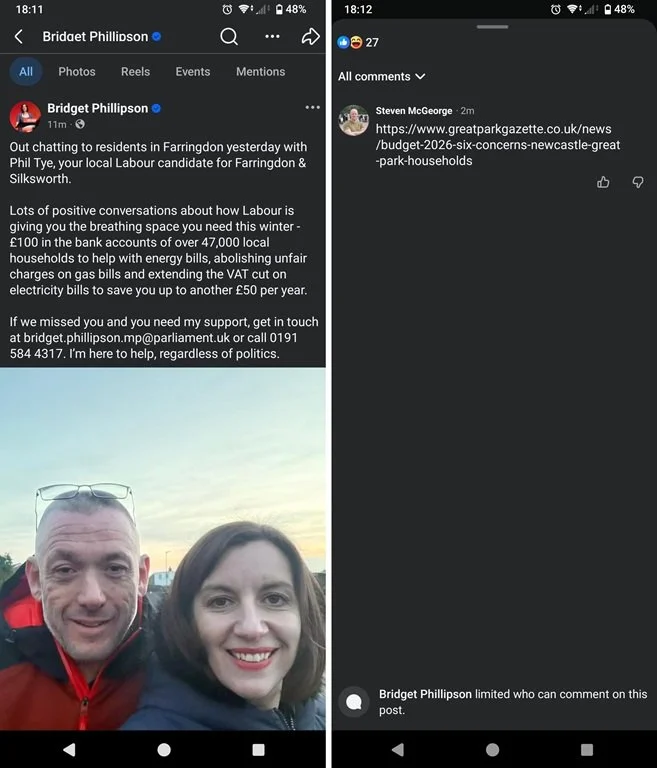
Facebook comments restricted following Great Park Gazette's response: Two screenshots taken just one minute apart, at 6:11pm (left) and 6:12pm (right) on Saturday 31 October 2026, show Labour MP Bridget Phillipson's post promoting the Government's Autumn Budget energy measures and a subsequent view of the comments displaying a link to Great Park Gazette's critical Budget analysis. The Gazette editor reports that commenting was restricted shortly after the link was posted. The second screenshot shows Facebook's notice confirming that Ms Phillipson had limited who could comment. Although the sequence raises questions about the timing, the screenshots alone cannot establish whether the restriction was in a response to the Gazette's comment. Images: Supplied to Great Park Gazette
Screenshots from Labour MP Bridget Phillipson's Facebook page show a Great Park Gazette article questioning the Autumn Budget posted beneath her claims about household energy support. A notice subsequently seen on the post stated that commenting had been restricted within two minutes after the comment was made, raising questions about public debate and scrutiny.
A Facebook post by Labour MP Bridget Phillipson promoting the Government's Autumn Budget has prompted questions about transparency and political accountability after a link to critical Budget analysis from Great Park Gazette was shared beneath it.
The incident took place on Saturday 31 October 2026, when Ms Phillipson published an update about campaigning in Farringdon, Sunderland, alongside Labour candidate Phil Tye.
Her post highlighted the financial assistance the Government says it is delivering to local households, including a £100 energy payment, changes to gas standing charges and an extension of the temporary VAT reduction on electricity.
However, the editor of the Great Park Gazette subsequently shared a link to a Great Park Gazette investigation examining six concerns about the Autumn Budget.
According to the editor, a restriction on who could comment on Ms Phillipson's Facebook post became apparent shortly afterwards.
Screenshots supplied to Great Park Gazette show both the article link in the comments and a Facebook notice stating that Bridget Phillipson had limited who could comment on the post.
The screenshots show that Great Park Gazette's critical Budget analysis was successfully shared beneath Bridget Phillipson's Facebook post, with a screenshot taken at 6:12pm confirming that commenting had been restricted. The Gazette editor reports that the restriction appeared within approximately two minutes of posting the link. This sequence raises questions about the timing of the restriction, who authorised it and why it was applied.
Nevertheless, the episode raises a broader question: how can members of the public challenge the claims made by elected representatives when opportunities to respond to political posts are restricted?
What did Bridget Phillipson say?
In the Facebook post, Ms Phillipson described visiting residents in Farringdon with Phil Tye, Labour's local candidate for Farringdon and Silksworth.
She highlighted what she described as positive conversations about the Government's measures to help families with the cost of living.
The post referred to:
£100 payments for more than 47,000 local households to help with energy bills.
The abolition of gas standing charges.
An extension of the electricity VAT cut, with savings of up to another £50 annually.
The measures are based on announcements made in Chancellor John Healey's Autumn Budget on Wednesday 28 October 2026.
They are genuine Government policies.
But there are important conditions, implementation dates and potential disadvantages that are not explained in the Facebook post.
Those details form the basis of Great Park Gazette's earlier investigation.
The Gazette article shared beneath her post
On Friday 30 October, Great Park Gazette published:
Budget 2026 under scrutiny: Six concerns for Newcastle Great Park households
The article examined the difference between the Government's headline announcements and the financial consequences some households might actually experience.
It considered the proposed changes to gas standing charges, the limitations of the £100 Household Energy Payment, pressures on living standards and other financial questions arising from the Budget.
The analysis was based on Government documents and research from independent economic organisations, including the Resolution Foundation.
The following day, the editor of the Great Park Residents Group posted a link to that investigation beneath Ms Phillipson's Facebook update.
The shared link was relevant to the subject of her post: the financial impact of the Autumn Budget on ordinary households.
It was not an unrelated comment or personal allegation.
It directed readers towards a published analysis of the very policies being promoted.
What happened to the Facebook comments?
Two screenshots supplied to Great Park Gazette record the interaction.
The first shows Ms Phillipson's verified Facebook account promoting the Budget measures.
The second shows the link to the Gazette investigation in the comments section.
At the bottom of that second screenshot, Facebook displays a notice indicating that Ms Phillipson had then limited who could comment on the post.
The editor reports that the restriction came into effect immediately after sharing the article.
The Great Park Gazette editor was able to comment on Ms Phillipson's Facebook post without restriction, and the screenshot confirms that the link to our critical Budget analysis was successfully published. Within approximately two minutes, Facebook displayed a notice stating that Ms Phillipson had limited who could comment. The sequence raises questions about the timing of the decision and why the restriction was introduced so soon after the Gazette's contribution. However, the reason for the change has not been established.
However, there is an important evidential limitation.
Facebook allows account holders to restrict who can comment on public posts. Meta says the feature can be used to manage unwanted interactions and encourage more manageable discussions.
There may therefore be explanations unrelated to the Gazette's contribution.
What remains unanswered is whether the restriction was already in place, whether it was changed after the link appeared and what prompted the decision.
Those are questions that can be answered by the account holder.
What does the £100 energy payment actually mean?
One of the most important distinctions concerns the £100 Household Energy Payment.
Ms Phillipson's Facebook post refers to £100 going into the bank accounts of more than 47,000 local households.
But the Government's official Budget documents confirm that the new payment is scheduled to begin in January 2027.
As of 31 October 2026, the new Budget payment has not yet been distributed.
It is also not available automatically to every household.
Under the announced scheme, eligibility in England is primarily linked to Council Tax bands A, B, C and D, subject to the qualifying conditions.
Households in bands E to H will not automatically qualify, even where residents are experiencing financial hardship.
The Government has allocated an additional £100 million to councils for targeted assistance, but the detailed arrangements are still to be confirmed.
The figure of more than 47,000 local households quoted by Ms Phillipson may reflect an estimate of those eligible in her area. Great Park Gazette has not independently verified the underlying local calculation.
This is why the distinction between a headline promise and the practical details matters.
A £100 payment will be useful to many families, but its value and availability must be understood alongside eligibility rules, timing and wider household costs.
Official Government guidance:
What the Autumn Budget 2026 means for your energy bills
Are gas standing charges really being abolished?
Yes. The Government has announced plans to remove the separate daily standing charge from household gas bills.
But that does not mean the costs currently covered by those charges will disappear.
Under the proposals, suppliers will instead recover those costs through the amount charged for each unit of gas consumed.
This is a significant distinction.
People who use relatively little gas could save money.
Households that use larger amounts of gas, including some families living in bigger properties or people with unavoidable heating needs, may pay more.
The Treasury estimates that around 60% of gas customers could benefit from the reform, with average annual savings of approximately £45 among those who gain.
Independent analysis has also warned that millions of households could lose out once the costs are transferred into unit rates.
The Resolution Foundation's examination of the Budget raises concerns about the distribution of financial assistance and the effect on family living standards.
The Government has promised targeted protections for some vulnerable households, but the full details have not yet been announced.
The change is also not immediate.
Ministers have asked energy regulator Ofgem to deliver the reform by the end of 2027, or as soon as possible afterwards.
Removing the standing charge is therefore not the same thing as guaranteeing every household a lower gas bill.
What about the electricity VAT saving?
The temporary removal of VAT from domestic electricity bills began on 1 October 2026.
The Budget announced an extension of that measure until July 2027.
According to the Treasury, the extension is expected to reduce the annual Ofgem price cap by approximately £50 in April 2027 compared with the position without the extension.
That is a forecast effect on a typical annual bill, not a guaranteed £50 cash payment to every household.
Actual savings will depend on electricity consumption and the prices paid.
Again, the distinction is important.
The policy provides financial relief, but it does not eliminate the wider pressures associated with higher energy prices.
Ofgem confirmed that the typical dual-fuel energy price cap rose by 4% for October to December 2026, despite the electricity VAT reduction.
This helps explain why some households may continue to experience rising bills even while benefiting from specific Government measures.
Independent economists have raised wider concerns
The Gazette's original investigation was not based solely on political disagreement.
On 29 October, the Resolution Foundation published its assessment of the Budget, titled Spread thin.
Its analysis warned that the Government's cost-of-living support was spread across a broad range of households rather than being concentrated on those facing the greatest financial hardship.
The Foundation calculated that the poorer half of households would gain an average of £158 from the relevant measures, compared with £144 for the better-off half.
It also forecast that typical non-pensioner household incomes could fall by 3%, equivalent to approximately £1,050 annually, between 2026–27 and 2028–29.
These are economic projections, not guaranteed outcomes for individual families.
They nevertheless demonstrate why scrutiny of the Budget extends beyond party-political argument.
The Government argues that its package delivers assistance during a period of substantial international economic pressure.
Independent researchers have questioned whether that support will be sufficient and effectively targeted.
Both positions deserve to be examined using the evidence.
Read the full independent assessment:
Resolution Foundation – Spread thin: Analysing the Autumn 2026 Budget
Should politicians restrict comments on public posts?
Politicians, like other Facebook users, have access to the platform's moderation and comment-control features.
There are legitimate reasons why an account might restrict discussion, including abusive language, harassment, spam and attempts to disrupt conversations.
A Facebook comment restriction is not, by itself, evidence of wrongdoing.
However, public posts by elected representatives can also provide an opportunity for constituents and other members of the public to question policy announcements.
The difference between personal abuse and respectful, evidence-based criticism is particularly important.
A link to a relevant news investigation is not inherently abusive simply because the article questions the Government's interpretation of its policies.
The incident therefore raises questions about how elected representatives balance moderation with meaningful public discussion.
For residents concerned about their energy bills, the underlying policy questions remain important regardless of what happened to the Facebook comments.
Questions for Bridget Phillipson
Great Park Gazette believes the following factual questions would help clarify the episode:
1. Who made the decision to restrict comments immediately following Great Park Gazette's contribution?
The Gazette editor successfully posted a link to our critical Budget analysis at 6:10pm on Saturday 31 October 2026, and by 6:12pm on Saturday 31 October 2026, Facebook displayed a notice confirming that commenting had been limited. The editor reports that the restriction appeared within approximately two minutes of the interaction.
Was the decision to restrict comments made personally by Bridget Phillipson, or by someone managing her official Facebook account?
2. If the restriction was applied afterwards, what was the reason?
Was it routine moderation, a response to unrelated activity or connected to comments received on the post?
3. How was the estimate of more than 47,000 eligible local households calculated?
What area and eligibility assumptions does the figure cover?
4. Does Ms Phillipson agree that some households may pay more for gas when standing charges are transferred into unit rates?
What protections does she expect to be available for those affected?
5. How should people question Budget claims through her public social-media channels when comments are restricted?
Are there alternative opportunities for open discussion?
These are reasonable questions about a public communication concerning Government policy.
Great Park Gazette has not established why the Facebook restriction appeared and would welcome clarification from Ms Phillipson.
Her response can be published alongside this report.
What does this mean for Newcastle Great Park?
Although Ms Phillipson represents Houghton and Sunderland South rather than Newcastle Great Park, the Budget measures discussed apply to eligible households across England.
That makes the wider debate relevant to residents here.
Many Great Park households face substantial heating costs, mortgage payments and other living expenses.
Some will qualify for the £100 Household Energy Payment.
Others will not.
Some may eventually benefit from the removal of gas standing charges.
Others may find that higher unit rates reduce or outweigh the potential savings.
Residents deserve clear explanations of these differences, irrespective of which political party is in government.
Great Park Gazette will continue examining Government announcements, independent research and the practical consequences for local households.
The questions remain open
The Facebook screenshots document a Gazette article link beneath a Labour MP's Budget update and a restriction on who could comment.
The editor reports that the restriction became visible shortly after the link was posted.
What the available evidence does not establish is a direct connection between those events.
It would therefore be premature to conclude that the restriction was imposed to prevent scrutiny.
But the underlying questions about the Budget are unaffected by the Facebook settings.
When a Government announces financial support, the public is entitled to understand who qualifies, when the help arrives, who might lose out and whether the measures deliver the benefits being advertised.
Those are the questions Great Park Gazette will continue asking.
Read our original investigation:
Budget 2026 under scrutiny: Six concerns for Newcastle Great Park households
Sources: HM Treasury Budget 2026; Department for Energy Security and Net Zero; Ofgem; Resolution Foundation; Meta's published information about Facebook comment controls; and screenshots supplied to Great Park Gazette.
Published Saturday 31 October 2026.
Editorial clarification: The screenshots document the presence of a comment restriction but do not independently establish when it was applied or the account holder's reasons for applying it. Great Park Gazette welcomes a response or correction supported by additional evidence.
