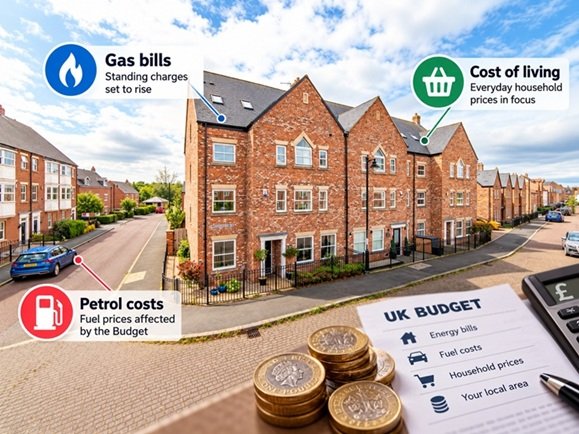
Newcastle Great Park homes are at the centre of the Autumn Budget 2026 debate, as concerns grow over rising household costs, changes to gas standing charges, fuel prices and the wider cost of living. Great Park Gazette examines six key Budget concerns and what they could mean for local families
Just two days after Chancellor John Healey delivered his first Autumn Budget, fresh analysis has raised questions about whether some of the measures designed to help families could leave others worse off. Great Park Gazette examines six key concerns, from gas bills and mortgage costs to the £100 energy payment and household incomes.
Chancellor John Healey's Autumn Budget 2026 was presented as an opportunity to give British households some much-needed financial breathing space.
But less than 48 hours after the announcement, independent economists and financial experts have begun questioning whether some of its headline measures will deliver the savings families are hoping for.
The Budget, delivered on Wednesday 28 October, included plans to abolish gas standing charges, provide £100 energy payments to millions of households, extend the existing fuel duty cut and increase taxes on bank profits.
However, fresh analysis suggests that the changes could produce very different outcomes depending on a household's energy consumption, Council Tax band, income and financial circumstances.
For families living in Newcastle Great Park, the distinction between the Government's announcements and the potential financial consequences is particularly important.
Here are six areas attracting scrutiny, and what residents need to know.
1. Scrapping gas standing charges could actually increase bills for millions
One of the biggest announcements in the Budget was the Government's plan to abolish standing charges on household gas bills.
The average charge currently costs approximately £108 per year.
Unlike the amount charged for the gas itself, the standing charge is a fixed daily fee that households pay even if they use very little gas.
The Government has asked energy regulator Ofgem to remove the charges by the end of 2027, or as soon as possible afterwards.
At first glance, this sounds like welcome news for households struggling with rising energy costs.
But there is an important catch.
The cost of the standing charge is not disappearing. It is being transferred into the price of gas.
Instead of recovering certain fixed costs through a daily standing charge, suppliers will recover them through higher charges for each unit of gas consumed.
Who could end up paying more?
Government estimates suggest that approximately 60% of gas customers could save an average of £45 per year.
However, analysis attributed to the Resolution Foundation suggests that around 9.9 million gas-connected households, approximately 43%, could actually see their bills rise.
Those affected could pay an average of approximately £61 more annually, according to the reported estimates.
Higher gas-consuming households are more likely to lose out.
This may include families living in larger properties, households with several children, and people who need to keep their homes warmer because of age, illness or disability.
The Government says it will introduce targeted protections for households disadvantaged by the changes, although the details have not yet been published.
What does this mean for Great Park?
Newcastle Great Park contains a mixture of apartments, smaller homes and larger family properties.
A household in a smaller, well-insulated property using relatively little gas could benefit from the reform.
However, a family heating a large four-bedroom or five-bedroom property may find that higher unit prices offset the removal of the standing charge.
The precise impact will depend on individual energy consumption and the final tariffs introduced by suppliers.
Important: The change has not taken effect yet. Residents should not expect £108 to disappear from their next gas bill.
2. Questions remain over plans to reduce the benefits bill
The Chancellor has faced criticism over the Government's approach to welfare spending.
Before the Budget, ministers had spoken about the need to control rising expenditure and support more people into employment.
However, substantial decisions about further welfare reform have been left for later announcements.
The Government is awaiting the conclusions of reviews examining support for young people and people with disabilities or health conditions.
A White Paper is expected in early 2027, with legislation potentially following later in the year.
The Office for Budget Responsibility forecasts substantial pressure on future welfare expenditure, reflecting factors including an ageing population, health-related benefit claims and inflation-linked increases.
Critics argue that postponing decisions leaves uncertainty about how the Government intends to control spending while protecting vulnerable claimants.
What does this mean for Great Park?
Residents receiving Universal Credit, Personal Independence Payment or other benefits may understandably want to know whether their entitlements will change.
For now, the Budget does not establish a complete new set of welfare rules based on the reviews still taking place.
It would therefore be premature to suggest that specific existing benefits have been abolished or reduced as a result of this week's announcements.
The Government says its longer-term intention is to improve employment support, strengthen the welfare system and manage costs sustainably.
Further details are expected over the coming months.
3. Defence spending commitments leave further questions for 2027
The Budget also outlined plans for increased defence spending amid continuing international security concerns.
The Government intends to raise defence expenditure to 3% of GDP by 2030, while working towards a NATO commitment of 3.5% by 2035.
However, the detailed plan for achieving those longer-term targets will not be set out until next year's Spending Review.
Critics have questioned how the additional expenditure will be financed without increasing taxes, government borrowing or pressure on other public services.
There is an important distinction, however.
The Budget did confirm funding for an existing £15 billion Defence Investment Plan, including £4.7 billion that had previously required a funding decision.
The unresolved question concerns how the Government will meet its wider defence commitments over the years ahead.
Why does this matter locally?
Defence spending does not directly change an individual household bill.
However, decisions about government expenditure can influence how much money is available for other priorities, including transport, public infrastructure and local services.
The North East also has engineering, manufacturing and technology businesses that could potentially benefit from defence-related investment and contracts.
The Government has argued that stronger defence investment can support employment and economic growth.
Economists, meanwhile, have warned that the wider spending targets could place considerable pressure on public finances.
The detailed financial choices are expected to become clearer in 2027.
4. The £100 energy payment could exclude some struggling families
One of the Government's most immediate measures is a new £100 Household Energy Payment.
The payment is intended to support up to 20 million households in England from January 2027.
Eligibility will generally be determined by Council Tax band.
Households in bands A, B, C and D will qualify, subject to the scheme's conditions.
However, those in bands E, F, G and H will not automatically receive the payment.
This has prompted criticism because Council Tax bands are not necessarily an accurate measure of a household's current financial circumstances.
Why are Council Tax bands controversial?
In England, Council Tax bands are based on estimated property values as they would have stood on 1 April 1991.
Even homes built many years later are assessed against that historical valuation date.
As a result, a property's Council Tax band does not necessarily reflect the income of the people living there today.
A household in a higher-band property may be struggling financially because of unemployment, reduced earnings, childcare costs or other circumstances.
Equally, a financially comfortable household living in a lower-band property may still qualify for the payment.
The Resolution Foundation has criticised the broad approach, arguing that more targeted support could provide greater help to families experiencing the greatest hardship.
What does this mean for Newcastle Great Park?
This issue is especially relevant in a community with a variety of property sizes and Council Tax bands.
Residents should check their own property's band rather than assume they qualify because of their income or house type.
You can check your Council Tax band through the Government's official website:
https://www.gov.uk/council-tax-bands
If you live in an eligible property and pay Council Tax by Direct Debit, the Government says the payment should be made automatically into your bank account.
Other eligible households will receive further instructions about how payments will be arranged.
The Government has also announced £100 million in additional funding for local authorities to provide targeted support to households facing acute energy-cost pressures.
However, the detailed arrangements for that assistance have not yet been announced, and it should not be assumed that every household in a higher Council Tax band will receive alternative support.
5. Could higher taxes on banks affect mortgages and savings?
Another significant Budget announcement was a temporary increase in the Bank Corporation Tax Surcharge.
The surcharge will rise from 3% to 6% for 15 months, beginning on 1 January 2027 and ending on 31 March 2028.
The Government says the additional revenue will help fund energy support for households.
But some financial experts have warned that banks could seek to recover part of their additional tax costs from customers.
Could mortgages become more expensive?
Possible responses by banks could include changes to mortgage pricing, reduced cashback incentives, changes to account fees or less competitive savings products.
However, these outcomes are not guaranteed.
Mortgage rates are influenced by several factors, including Bank of England interest rates, wholesale funding costs and competition between lenders.
Some financial specialists believe banks may absorb much of the temporary tax increase rather than pass it directly to customers.
Others argue that particular lending products or savings deals could become less competitive.
What does this mean for Great Park homeowners?
With many homeowners across Newcastle Great Park holding mortgages, this is a development worth watching.
Residents approaching the end of a fixed-rate mortgage may want to compare available deals well before their current agreement expires.
Those saving for a deposit or keeping money in savings accounts should also compare interest rates and account conditions.
There is currently no evidence that the Bank Surcharge increase has automatically added a specific amount to Great Park residents' mortgage payments.
Any actual impact will depend on decisions made by individual banks and wider market conditions.
6. Household incomes could fall by £1,050 over the next two years
Perhaps the most concerning warning comes from independent analysis of the wider economic outlook.
The Resolution Foundation has forecast that typical working-age household disposable incomes could fall by approximately 3%, equivalent to £1,050 per year, between 2026–27 and 2028–29.
This is a forecast of the change in the inflation-adjusted income of a typical household, not a new tax bill or a prediction that every family will lose exactly £1,050.
The analysis reflects the continued pressure on household finances from rising prices, economic conditions and Government tax and spending decisions.
The Foundation has also warned that the financial support announced in the Budget may be insufficient to offset the increase in energy costs faced by many households.
Its assessment suggests that household living standards could remain under significant pressure through the remainder of the current Parliament.
Why is this important for Great Park?
Even households with steady employment can experience financial pressure when wages fail to keep pace with rising prices.
For families with mortgages, childcare costs, vehicles and substantial household energy consumption, relatively small changes across several bills can add up.
The latest analysis suggests that the financial challenges facing British households are unlikely to disappear simply because some temporary support measures have been announced.
However, these forecasts remain projections and could change if economic growth, wages, inflation or interest rates turn out differently from current expectations.
What the Government says about the Budget
The Government maintains that the Budget provides immediate assistance to households while addressing longer-term economic challenges.
Chancellor John Healey has argued that the measures will give families breathing space during a period of high energy costs and international uncertainty.
Alongside the policies attracting criticism, the Budget includes several measures intended to provide financial relief.
These include the extension of the temporary 0% VAT rate on domestic electricity until July 2027, the continuation of the existing 5p-per-litre fuel duty reduction until July 2027, and increased minimum wage rates from April 2027.
The Chancellor has also defended increased investment in housing, infrastructure and national security.
The Government argues that controlling costs while supporting growth and employment will strengthen the economy over time.
Independent analysts, however, say some of the most difficult decisions about public spending and long-term fiscal pressures have been postponed.
The Institute for Fiscal Studies has warned that the spending plans for the coming years are tight and could mean some public services face real-terms cuts when the Government conducts its next Spending Review.
What should Great Park residents do now?
Although the Budget has generated considerable debate, many measures will not take effect immediately.
There are some practical steps households can consider in the meantime:
Check your Council Tax band to establish whether you are likely to qualify for the £100 Household Energy Payment.
Review your gas usage, particularly if you live in a larger property, ahead of the proposed standing charge reforms.
Compare mortgage and savings deals rather than assuming the bank tax increase will have the same effect on every provider.
Keep an eye on future welfare announcements if you receive benefits or support someone who does.
Review household budgets to understand how rising energy, food, childcare and transport costs could affect your finances.
Residents should also remain cautious of scams claiming to offer early access to Government energy payments.
Official information about the £100 payment will be provided through the Government and local authorities. Residents should not provide bank details in response to unexpected messages claiming to guarantee the payment.
The bigger picture for Newcastle Great Park
Two days after the Chancellor's Autumn Budget, it is becoming clearer that the headline announcements do not tell the whole story.
Some households could benefit from lower gas costs, energy payments and temporary tax relief.
Others may find that changes to gas tariffs, ineligibility for support or wider economic pressures leave them with little financial improvement.
The actual impact will vary considerably depending on household circumstances.
For Great Park residents, understanding the difference between confirmed measures and forecasts about their possible consequences is essential.
The £100 Household Energy Payment is due to begin in January 2027, while changes to gas standing charges are not expected until later in 2027 or afterwards.
The Government's longer-term plans for welfare, defence spending and public services will become clearer next year.
Great Park Gazette will continue examining the implications of the Autumn Budget for local families, homeowners, pensioners and businesses as further details emerge.
Further reading
Read our original Budget 2026 report:
Official sources and independent analysis:
Resolution Foundation – Spread Thin: Analysing the Autumn 2026 Budget
Government – Check your Council Tax band
Published Friday 30 October 2026.
Sources: HM Treasury, Office for Budget Responsibility, Resolution Foundation, Institute for Fiscal Studies, UK Government energy guidance and financial-sector analysis.
