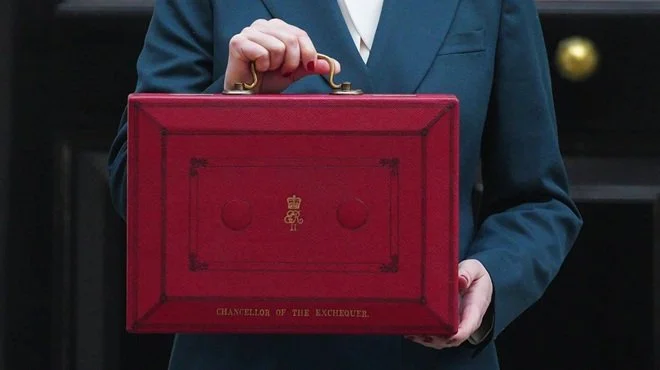
The traditional red Budget box outside Downing Street. The Autumn Budget 2026 includes major announcements affecting household energy bills, petrol and diesel costs, wages and taxation, with implications for Newcastle Great Park residents
Chancellor John Healey has unveiled the Autumn Budget 2026, announcing changes to household energy bills, petrol and diesel costs, wages, housing and taxation. Great Park Gazette looks at the key announcements and what they could mean for families living in Newcastle Great Park.
Residents of Newcastle Great Park could see changes to their household finances following the Autumn Budget, delivered in the House of Commons on Wednesday 28 October 2026.
Among the headline announcements are plans to abolish standing charges on household gas bills, extend the existing 5p-per-litre fuel duty reduction and provide a £100 energy payment to millions of eligible households.
The Chancellor, John Healey, described the Budget as an attempt to provide financial breathing space amid continued pressure on household budgets.
With many Great Park residents relying on their cars for commuting, school runs and everyday journeys, while also facing rising household energy costs, the motoring and gas bill announcements are likely to be particularly relevant locally.
However, the Budget also includes important changes affecting wages, pensions, savings, first-time buyers, carers and businesses.
Here is what residents need to know.
Gas standing charges to be abolished from 2027
One of the biggest announcements is the Government's intention to scrap standing charges on household gas bills.
At present, most households pay a fixed daily standing charge for their gas supply, regardless of how much gas they actually use.
The charge covers costs associated with maintaining and operating the gas network and other essential services.
According to the Treasury, the typical household currently pays approximately £108 per year in gas standing charges.
The Government has now asked energy regulator Ofgem to remove the charge, with implementation targeted for 2027 or as soon as possible afterwards.
Will Great Park households save £108 a year?
Not necessarily.
Although the separate standing charge will disappear, the costs it currently covers will still need to be paid.
Under the proposals, those costs would instead be incorporated into the price charged for each unit of gas consumed.
This means households that use less gas could benefit, while those with higher consumption may see smaller savings or potentially higher bills.
The Treasury estimates that approximately 60% of households could save an average of £45 per year.
For Great Park residents, the impact will depend largely on how much gas their homes use.
Households with efficient heating systems, good insulation and relatively low gas consumption may benefit more than those with larger or less energy-efficient properties.
The Government says it will consider additional protections for vulnerable households with unavoidable high energy needs.
Importantly, the changes are not taking effect immediately, and residents should continue paying their existing bills as normal.
£100 energy payment for millions of households
The Budget also includes a new £100 Household Energy Payment intended to help families with rising energy costs.
The payment will be available to eligible households in England living in properties within Council Tax bands A, B, C or D.
Up to 20 million households are expected to qualify.
Payments are scheduled to begin in January 2027.
Will Great Park residents receive the £100?
Eligibility will depend on the Council Tax band of the property and the household meeting the scheme's other conditions.
Residents living in bands A to D as their main home should generally qualify if they are responsible for the Council Tax bill.
Those who pay Council Tax by Direct Debit will not normally need to apply, with the payment made automatically to their bank account.
For households that do not pay by Direct Debit, Newcastle City Council is expected to provide details of how to claim.
Homes in Council Tax bands E to H will not automatically qualify for the payment.
However, the Government is providing an additional £100 million to councils to support households facing financial difficulties who would otherwise miss out.
Residents can check their property's Council Tax band using the Government's official website:
Electricity bills: VAT cut extended until July 2027
There is further assistance for households with electricity bills.
The temporary reduction in VAT on qualifying domestic electricity supplies from 5% to 0%, introduced on 1 October 2026, will now be extended until 1 July 2027.
The Treasury estimates this extension will reduce the annual Ofgem price cap by approximately £50 in April 2027.
The exact benefit will depend on household electricity consumption and the applicable tariff.
The Government has also announced plans to reform electricity standing charges, although further details are expected next year.
A proposed new charge on gas bills to fund hydrogen projects has also been cancelled, with the Government instead planning to fund those projects through public finances.
Petrol and diesel: 5p fuel duty cut extended
There is some relief for motorists following the announcement that the existing 5p-per-litre reduction in fuel duty will continue.
The temporary reduction was originally introduced in March 2022 and has been extended several times.
It had been scheduled to end on 31 December 2026.
However, the Chancellor has confirmed that the reduced rate will remain in place until 30 June 2027, with the planned increase postponed until 1 July.
This will also delay a planned inflation-linked rise in fuel duty.
Does this mean petrol prices will fall by 5p?
No. This is an important distinction.
The Government is extending an existing reduction rather than introducing a new cut to fuel duty.
Consequently, motorists should not expect petrol or diesel prices at the pumps to fall automatically by 5p per litre following the Budget.
Instead, the announcement prevents a previously planned increase in taxation from taking effect in January.
Actual pump prices will continue to depend on factors such as wholesale oil prices, supply costs and retailer pricing.
The RAC has welcomed the extension while pointing out that it does not directly reduce the price motorists are already paying.
For Great Park residents who commute daily, particularly those travelling to Newcastle city centre, Cobalt Business Park, Team Valley or other parts of the North East, the extension may help prevent further pressure on fuel costs.
However, the Government has indicated that fuel duty is currently scheduled to increase from July 2027.
Higher mileage allowances for people who drive for work
There is additional support for employees and self-employed workers who use their own cars or vans for business journeys.
The Government has confirmed that the tax-free mileage rate of 55p per mile for the first 10,000 qualifying business miles will be made permanent.
The rate for mileage above 10,000 miles will also increase from 25p to 35p per mile from April 2027.
This could benefit care workers, community nurses, engineers, tradespeople and other professionals travelling between workplaces or customers.
These are tax-free mileage allowance rates, rather than automatic cash payments to every driver.
Ordinary commuting between home and a permanent workplace does not generally qualify.
Electric vehicle drivers could save £150 annually
Drivers of electric vehicles who rely on public charging points are also being offered additional support.
The Government has announced £100 million over two years to reduce charging costs at local, lower-powered public charging points.
These include chargers typically found on residential streets.
The scheme is expected to begin in spring 2027, with the Treasury estimating average annual savings of approximately £150 for eligible drivers who rely on this type of charging.
For Great Park residents without access to private home charging, the measure could be particularly relevant.
However, the final impact will depend on which local chargers participate and how the scheme is implemented.
Minimum wage to increase from April 2027
Millions of workers are expected to benefit from an increase in the National Living Wage and National Minimum Wage.
From 1 April 2027, the new hourly rates will be:
£13.21 for workers aged 21 and over.
£11.27 for workers aged 18 to 20.
£8.31 for workers aged 16 to 17 and eligible apprentices.
The increase represents a 3.9% rise across the main age groups.
The Treasury estimates that a full-time worker receiving the National Living Wage could earn approximately £910 more per year before tax.
This may benefit residents working in retail, hospitality, cleaning, care and other lower-paid sectors throughout Newcastle Great Park and the wider region.
Changes for pensioners and unpaid carers
The Budget includes measures affecting pensioners and people who provide unpaid care.
A new Pension Tax Allowance will be introduced from April 2027, intended to prevent pensioners whose income is at or below the full new State Pension from becoming liable for income tax solely because of State Pension increases.
For unpaid carers, the Government has announced plans to change the Carer's Allowance earnings rules.
Currently, exceeding the earnings limit can result in the entire allowance being lost.
Under the proposed reform, payments will instead reduce gradually as earnings rise above the threshold.
However, this change is not expected to be introduced until 2030–31.
Families and parents to receive additional support
The Government has announced plans to extend parental pay to more families, including eligible self-employed fathers, partners and adopters.
The changes are expected to benefit more than 150,000 parents annually when introduced in April 2029.
There will also be additional funding to help improve access to books for children aged under five, supporting early learning and school readiness.
For families in Great Park, the parental pay changes could be particularly relevant to households where one or both parents are self-employed.
First-time buyers and homeowners
The Budget also includes housing measures intended to help more people onto the property ladder.
A new Your First Home scheme will provide government-backed equity loans to eligible first-time buyers.
The £4.7 billion programme aims to assist approximately 70,000 households in England.
A new First Time Buyer ISA is also planned from April 2029, offering a 25% government bonus on eligible savings towards a first home.
Meanwhile, the Government is reducing the Lifetime ISA withdrawal charge from 25% to 20% for qualifying first-time buyers purchasing homes above the current £450,000 property price limit.
That particular change takes effect on 29 October 2026.
For residents considering purchasing their first property in Great Park or elsewhere in Newcastle, these changes may be worth examining as further eligibility details become available.
The Government has also announced £1.5 billion in additional funding for social and affordable housing.
Savings and tax changes
The Chancellor has confirmed that the annual cash ISA allowance will remain at £20,000, abandoning a previous proposal to reduce it.
However, there are changes affecting people who receive taxable income from savings and property.
From April 2027, income tax rates on taxable savings income will increase by two percentage points.
The rates will become 24%, 44% and 49%, depending on the taxpayer's applicable band.
Separate two-percentage-point increases will apply to taxable property income in England, Wales and Northern Ireland.
These changes do not mean that all savings or rental income will automatically be taxed at the new rates. Existing allowances, exemptions and applicable tax rules remain important.
Residents with savings outside tax-free accounts or income from rental properties may wish to review the changes.
Changes to everyday shopping costs
The Budget includes measures aimed at reducing the cost of some everyday household purchases.
The Government is temporarily suspending tariffs on more than 100 additional imported food and drink products.
These include certain items commonly found in supermarkets, such as chocolate and other packaged foods.
The aim is to reduce importing costs, although any reduction in prices paid by shoppers will depend on how retailers and suppliers respond.
Tariffs on certain fertilisers and heating oil products are also being suspended.
Help for local shops, cafés, pubs and businesses
There is potentially welcome news for small businesses operating in and around Newcastle Great Park.
The Government is increasing the rateable value threshold for 100% Small Business Rate Relief for qualifying retail, hospitality and leisure premises in England from £12,000 to £18,000.
The upper threshold for tapered relief will also increase to £21,000.
The Treasury estimates that approximately 70,000 additional businesses will no longer pay business rates under the changes.
Other qualifying retail, hospitality and leisure businesses will benefit from a two-year real-terms freeze or reductions in their rates.
Additional relief is also being provided for pubs, social clubs and live music venues.
For independent businesses in Great Park and surrounding shopping areas, the actual benefit will depend on each property's rateable value and circumstances.
The Budget will also increase the tax-free trading allowance from £1,000 to £3,000 from April 2027, potentially benefiting people running small businesses or earning qualifying income from side ventures.
Wider investment, transport and the North East
The Budget also announces additional investment in British businesses, infrastructure, housing, energy and regional economic development.
The National Wealth Fund and British Business Bank are set to receive a combined £20.4 billion in additional capital.
More powers and funding are also planned for regional mayors and strategic authorities, including proposals to give local leaders greater control over business rates revenue and investment decisions.
There are several developments of particular interest to the North East.
The Budget confirms that main construction works on the A66 dualling project are expected to begin in November 2026, under a revised programme.
It also identifies investment of more than £85 million in offshore renewable energy research and testing facilities in Blyth.
A £7 million feasibility study will examine the possibility of a future Olympic and Paralympic bid in northern England.
These measures do not amount to direct funding commitments for Newcastle Great Park itself, but could have wider economic and transport implications for the region.
How will the Government pay for the measures?
The Budget includes tax changes and adjustments to public spending intended to help fund its commitments.
Among them is a temporary increase in the Bank Corporation Tax Surcharge from 3% to 6% between January 2027 and March 2028.
Tax on certain higher-stakes gaming machines will also rise, while changes to VAT collection by online marketplaces are intended to address unpaid tax.
The Government says the Budget will maintain its fiscal rules, with the Office for Budget Responsibility forecasting economic growth of 1.2% in 2026.
The Chancellor has also committed to funding the Government's defence investment programme while pursuing further savings and reforms across public administration.
What does the Budget mean for Newcastle Great Park?
For many Great Park households, the most immediate points of interest are likely to be energy bills and motoring costs.
The proposed abolition of gas standing charges could particularly benefit households with lower gas consumption, although it will not mean an automatic £108 saving for everyone.
The £100 Household Energy Payment is another important announcement, but residents will need to check their Council Tax bands to establish whether they qualify.
Drivers will benefit from the continuation of the existing fuel duty reduction until July 2027, although the announcement does not guarantee lower prices at petrol stations.
Other measures, including increases in the minimum wage, help for first-time buyers and changes to savings taxation, will affect households differently depending on their individual circumstances.
Many of the announcements will not take effect until 2027 or later, with further details still to be confirmed.
Great Park Gazette will continue to report on the measures that matter most to local residents as the Budget announcements are implemented.
Residents can read the Government's full Budget documents here:
Budget 2026 – Official HM Treasury document
What the Autumn Budget 2026 means for your energy bills
Published: Wednesday 28 October 2026. Sources: HM Treasury, Department for Energy Security and Net Zero, Office for Budget Responsibility and ChronicleLive.

