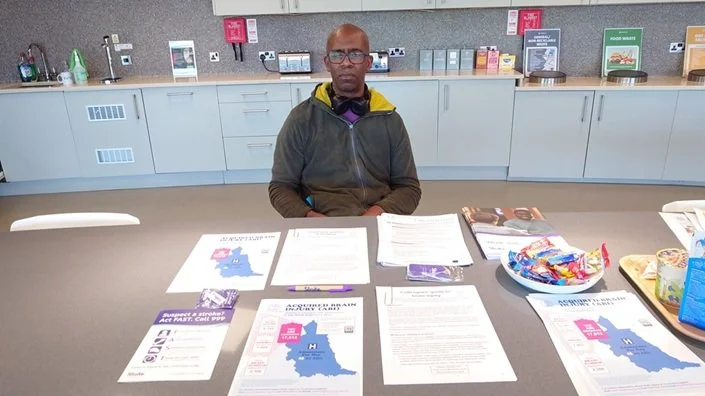
Newcastle stroke survivor and awareness campaigner Chris Marcus, who suffered a life-changing stroke in 2016. Ten years on, Chris is sharing his experience to raise awareness of stroke symptoms, the importance of urgent treatment and the long-term impact on survivors as part of World Stroke Day 2026
Ten years after suffering a life-changing stroke, Newcastle campaigner Chris Marcus is helping raise awareness of the warning signs, the importance of urgent treatment and the lasting physical and emotional effects of brain injury.
On World Stroke Day, Thursday 29 October 2026, a Newcastle stroke survivor is sharing his personal experience to help others recognise the warning signs of a medical emergency that can strike without warning.
Chris Marcus suffered a stroke in 2016, transforming his life and leaving him with lasting difficulties affecting his mobility, walking and balance.
Now, a decade later, Chris is spearheading a local awareness effort in Newcastle, sharing his experiences and working with brain injury and stroke support organisations to help people better understand the devastating consequences a stroke can have.
His message reflects this year's World Stroke Day campaign: Every Minute Counts.
The morning that changed Chris's life
For Chris, the first indication that something was seriously wrong came when he woke up one morning in 2016.
His leg felt strangely rubbery, almost as though it no longer belonged to him.
He found himself unable to place his left foot flat on the floor and support his own body weight.
Initially, the symptoms were unusual rather than obviously life-threatening.
But what Chris was experiencing was the beginning of a stroke.
He managed to arrange an Uber to take him to hospital, a decision he believes helped him access medical care before his condition deteriorated further.
By the time he arrived, however, the symptoms had become significantly more serious.
His legs were increasingly unsteady, his balance had deteriorated and he was eventually unable to stand.
Doctors identified an ischaemic stroke, caused by a blood clot interrupting the supply of blood to part of his brain.
Chris recalls being told he was too late to receive clot-busting treatment.
Instead, he received medical treatment to stabilise his condition and reduce the risk of further clotting, including the antiplatelet medication clopidogrel.
Clopidogrel helps prevent new blood clots forming; it does not directly dissolve an existing clot.
Chris remained in hospital for four months.
What had begun as a strange sensation in one leg became a life-changing medical emergency with consequences that continue to affect him ten years later.
Although Chris travelled to hospital by Uber in 2016, current NHS advice is clear: anyone experiencing a suspected stroke should call 999 immediately rather than independently arranging transport.
Recognising a stroke: FAST could save someone's life
One of Chris's main priorities is ensuring people recognise the warning signs before serious symptoms progress.
The NHS and Stroke Association promote the FAST test:
F – Face: Has one side of the person's face dropped? Can they smile normally?
A – Arms: Can they raise both arms and keep them raised, or does one arm drift downwards?
S – Speech: Is their speech slurred, confused or difficult to understand? Are they struggling to find or say words?
T – Time: Call 999 immediately if any of these symptoms appear.
You do not need to experience every symptom for a stroke to be occurring.
Importantly, Chris's experience demonstrates that stroke can also present with sudden problems affecting the legs and ability to walk.
Other possible warning signs include sudden loss of balance, dizziness, weakness or numbness on one side of the body, changes to vision and a severe unexplained headache.
Someone who suddenly cannot stand, walk normally or coordinate their movements could be experiencing a stroke even if their face and speech appear unaffected.
If you suspect a stroke, call 999 immediately. Do not wait for more symptoms to develop.
Even when symptoms disappear after a few minutes, urgent assessment is essential. This could indicate a transient ischaemic attack (TIA), sometimes called a mini-stroke, which may warn of a future stroke.
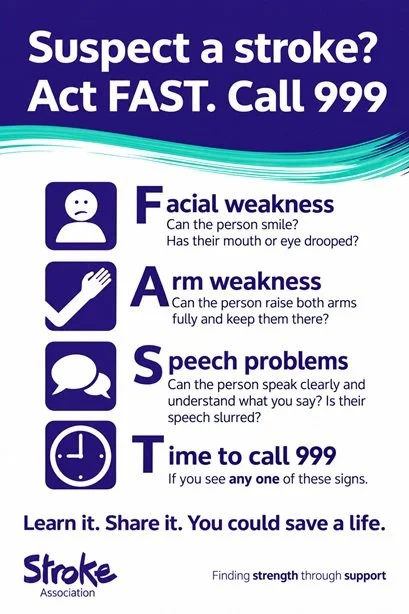
Recognising the warning signs of a stroke could save a life. The Stroke Association's FAST campaign urges people to check for facial weakness, arm weakness and speech problems, and to call 999 immediately if a stroke is suspected. Image: Stroke Association
What actually happens when someone reaches hospital?
Stroke treatment has developed considerably, with specialist teams using urgent brain scans to establish what has happened.
There are two main types of stroke:
Ischaemic stroke: A blood clot blocks the blood supply to part of the brain.
Haemorrhagic stroke: A blood vessel bursts, causing bleeding in or around the brain.
These conditions require different treatments, making rapid diagnosis essential.
A CT scan is commonly used to identify bleeding and help determine the type of stroke. Further scans may be needed to locate a blocked artery and assess whether treatment could save threatened brain tissue.
For eligible patients with an ischaemic stroke, clot-busting treatment known as thrombolysis can generally be administered within four and a half hours of symptom onset.
Some people with an uncertain onset time, including those who wake up with symptoms, may also be eligible following specialist imaging.
Another treatment, mechanical thrombectomy, physically removes a clot from an affected blood vessel and can benefit selected patients up to 24 hours after they were last known to be well.
There is no single 45-minute deadline after which all treatment becomes impossible.
However, the sooner someone receives specialist assessment, the greater the opportunity to access time-sensitive treatments.
This is why emergency services need to know when a person was last seen or known to be well.
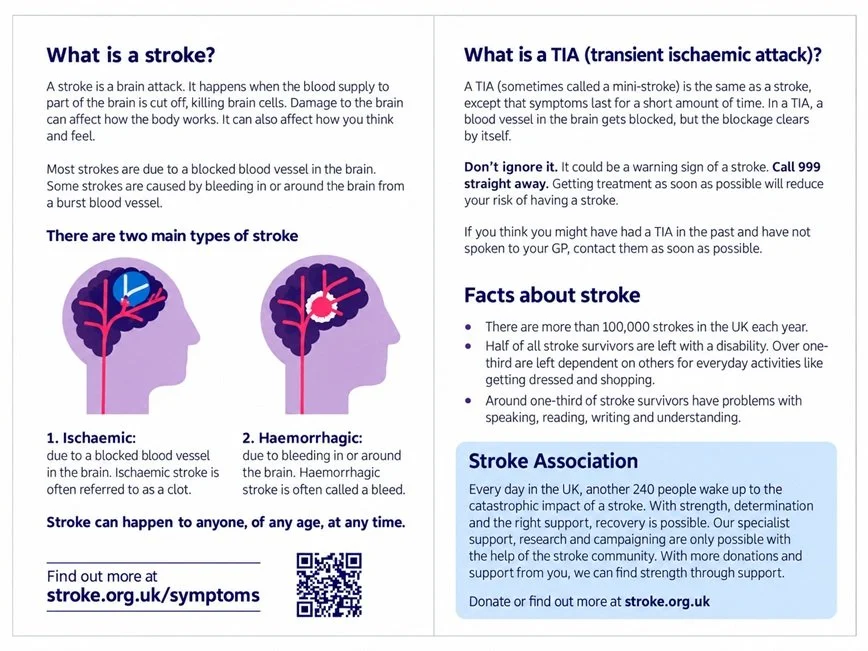
Understanding the different types of stroke and transient ischaemic attacks (TIAs). Strokes can be caused by a blood clot or bleeding in the brain, while a TIA can be an important warning sign of a future stroke. Image: Stroke Association.
Should you take aspirin if you suspect a stroke?
Although aspirin is sometimes prescribed to reduce the risk of future blood clots, it should not be taken as a self-administered emergency treatment for a suspected stroke.
Some strokes are caused by bleeding rather than a blockage, and aspirin can make bleeding worse.
The correct action is to call 999, explain the symptoms and follow the instructions provided.
People already prescribed aspirin or other medication should follow their existing medical advice and tell the emergency team what they take.
Ambulance response times in the North East
Chris has also raised concerns about the importance of reaching hospital quickly, particularly when ambulance services are under pressure.
The latest NHS England figures, covering September 2026, provide some important context.
There are different ambulance response categories.
Category 1 is reserved for the most immediately life-threatening situations, such as cardiac or respiratory arrest, with a national average response standard of seven minutes.
Suspected strokes are generally classified as Category 2 emergencies, for which the national response standard is an average of 18 minutes.
In September 2026, North East Ambulance Service recorded an average Category 2 response time of approximately 21 minutes and nine seconds.
That was above the longstanding 18-minute standard.
However, it was considerably faster than the England average of approximately 31 minutes and 18 seconds for the same month.
In fact, the North East recorded the fastest average Category 2 response time among England's 11 ambulance services.
These figures are regional averages. They do not guarantee how long an individual ambulance will take, and journeys and circumstances can vary considerably between urban and rural locations.
There is therefore no evidence from these figures alone that someone living in Newcastle necessarily receives a worse ambulance response than a patient elsewhere in England.
The figures do, however, demonstrate why rapid recognition and immediate contact with emergency services remain so important.
For a suspected stroke, the NHS advises calling 999, not driving yourself or independently arranging an Uber or taxi.
Ambulance crews can begin urgent assessment, communicate with specialist teams and help ensure patients reach an appropriate stroke service.
If a response is delayed or symptoms worsen, remain in contact with the emergency call handler and follow their instructions.
Living with the consequences of stroke
For Chris, surviving the initial medical emergency was only the beginning.
His stroke left him with problems affecting movement, balance, walking and standing.
These are consequences that can dramatically change a person's independence, confidence and everyday life.
Activities that many people take for granted, from walking across a room to preparing food or leaving the house, can become considerably more challenging.
But Chris is particularly concerned about another devastating potential consequence: losing the ability to communicate.
When someone can no longer find the words
A stroke can damage the parts of the brain responsible for language, leading to a condition known as aphasia.
Aphasia can affect speaking, understanding conversations, reading and writing.
Chris has encountered stroke survivors who struggle to communicate even their most basic needs.
He describes situations where someone may need to use the toilet but cannot find the words to explain what they need.
For those affected, the frustration can be overwhelming.
A person may understand what is happening around them and know exactly what they want to communicate, yet be unable to express it.
This can affect their independence, dignity, relationships and mental wellbeing.
Chris believes that the emotional impact of communication difficulties deserves far greater recognition.
People living with aphasia can experience isolation, anxiety, frustration and depression, particularly when others misunderstand their difficulties.
Importantly, aphasia does not automatically mean someone has lost their intelligence or understanding.
Families, carers and healthcare professionals can help by allowing extra time for responses, reducing background noise, using clear language and exploring alternative ways of communicating.
Speech and language therapists also provide specialist support to help survivors rebuild communication skills.
Can the brain repair itself?
Chris is particularly interested in neuroplasticity, the brain's ability to reorganise itself and form new connections following injury.
When a stroke damages part of the brain, other areas can sometimes adapt and help compensate for lost abilities.
This process is central to rehabilitation and recovery.
Repeated exercises, physiotherapy, speech therapy and everyday practice can encourage improvements in movement, language and other skills.
Recovery varies considerably between individuals.
Some people regain most or all of their previous abilities, while others experience permanent disabilities requiring long-term support.
Although improvements are often greatest during the first few months, recovery and adaptation can continue for years.
This is why ongoing rehabilitation, encouragement and access to appropriate therapy can make such a difference.
The mental health impact should never be forgotten
Stroke can bring profound emotional changes alongside physical disability.
People may experience grief for the life they had before, anxiety about another stroke, depression, isolation or frustration at being unable to do familiar activities.
Newcastle Hospitals NHS Foundation Trust recognises that emotional difficulties after stroke can affect confidence, relationships and recovery.
Support may include psychological therapies, counselling, medication where appropriate and specialist rehabilitation.
Family members and unpaid carers can also experience considerable emotional strain and may need support themselves.
Chris's campaigning seeks to ensure that stroke survivors are recognised as people with continuing needs, rather than simply patients who have survived a medical emergency.
Stroke can happen to younger people too
Although the risk of stroke increases with age, it is not a condition confined to older people.
Young adults can also experience strokes.
Risk factors include high blood pressure, smoking, diabetes, certain heart conditions, recreational drug misuse and some inherited or underlying medical conditions.
In younger people, injuries to arteries in the neck can sometimes cause a stroke.
This can happen following trauma, including certain sporting injuries, road accidents or other incidents involving the head and neck.
A tear in the lining of an artery, known as cervical artery dissection, can interfere with blood flow to the brain.
Serious neck compression, including non-fatal strangulation, can also damage blood vessels and increase the risk of stroke or other brain injury.
There is no safe way to strangle someone, including during sexual activity.
New legislation coming into force in England and Wales on 6 November 2026 will also criminalise the possession and publication of certain pornographic images explicitly and realistically depicting strangulation or suffocation.
Head injuries, infections and brain tumours can also cause acquired brain injury, although these are not all necessarily strokes.
The important message is that no adult should assume they are too young to experience a stroke.
The North East's brain injury figures
Information provided by brain injury charity Headway highlights the scale of the problem locally.
Its North East acquired brain injury statistics for 2023–24 recorded:
17,612 hospital admissions associated with acquired brain injury.
7,905 hospital admissions associated with stroke.
6,145 hospital admissions associated with head injuries.
2,306 hospital admissions associated with brain tumours.
These are admissions rather than numbers of individual patients, and some people may have been admitted more than once.
The figures are historical, covering 2023–24, but they illustrate the substantial demand for care and support across the region.
The impact extends beyond hospital treatment, with many survivors requiring rehabilitation, adaptations, help with employment and ongoing community support.
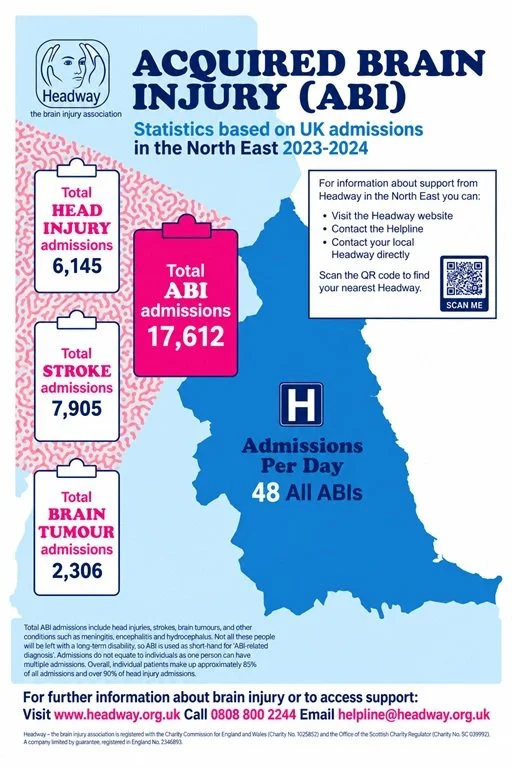
Figures published by brain injury charity Headway highlight the scale of acquired brain injuries across the North East during 2023–24, including 7,905 stroke-related hospital admissions. The figures represent admissions rather than individual patients. Image: Headway – The Brain Injury Association
Chris Marcus helping raise awareness in Newcastle
Ten years after his own stroke, Chris is determined to use his experience to make a difference.
He is helping spearhead stroke and brain injury awareness in Newcastle and has described working with Headway and the Stroke Association to promote greater understanding.
Headway supports people affected by acquired brain injury, including stroke survivors, and provides information about rehabilitation, employment, relationships and life after brain injury.
The Stroke Association provides specialist information, recovery support, research and campaigning to improve the lives of people affected by stroke.
For Chris, awareness is about more than recognising the initial emergency.
It also means understanding the long-term consequences of stroke, supporting survivors who face physical disabilities, and recognising the importance of communication and mental health.
His experience is a reminder that a stroke can change someone's life in a matter of minutes, but the consequences can last for decades.
Where to find help and support
Stroke Association
Website: https://www.stroke.org.uk
Stroke Support Helpline: 0303 3033 100
Information about stroke symptoms, treatment, rehabilitation, aphasia and support for families.
Headway – The Brain Injury Association
Website: https://www.headway.org.uk
Headway UK Helpline: 0808 800 2244
Advice and support for people living with brain injuries, including guidance on rehabilitation, employment and independent living.
Headway support in the North East
https://www.headway.org.uk/supporting-you/in-your-area/groups-and-branches/north-east/
Newcastle Hospitals – Stroke Services
https://www.newcastle-hospitals.nhs.uk/services/stroke-unit/
Information about local stroke care, recovery and support services.
This World Stroke Day, learn FAST and share it
World Stroke Day 2026 is highlighting a simple but potentially life-saving message: Every Minute Counts.
Chris Marcus knows firsthand how unexpectedly a stroke can begin and how quickly a person's life can change.
His experience of waking up with an unsteady leg, being unable to stand and spending four months in hospital highlights why symptoms should never be dismissed.
Recognising the warning signs, calling 999 immediately and ensuring people receive specialist medical care as soon as possible can make a significant difference.
For people already living with the effects of stroke, continued understanding, rehabilitation and support are equally important.
Great Park Gazette is supporting Chris Marcus's efforts to raise awareness across Newcastle and the wider North East.
If sharing his experience encourages even one person to recognise the signs of a stroke and seek emergency help, it could make a life-changing difference.
Remember FAST: Face, Arms, Speech, Time to call 999.
Published Thursday 29 October 2026 – World Stroke Day.
Sources: Chris Marcus's personal account; NHS; NHS England ambulance statistics; North East Ambulance Service; Stroke Association; Headway; Newcastle Hospitals NHS Foundation Trust; World Stroke Organization.

