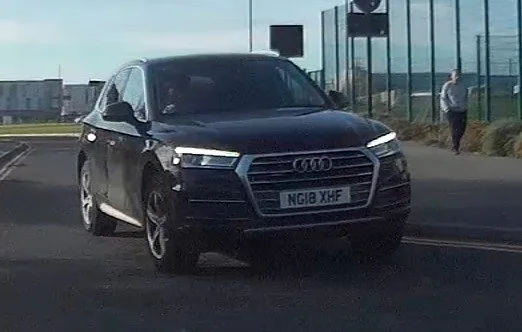
The dark-coloured Audi SUV captured on dashcam approaching a priority chicane on Roseden Way in Newcastle Great Park. Footage shows the Audi continuing through the narrowed section of road despite the oncoming motorist having priority, forcing the recording driver to brake sharply to avoid a possible collision. The incident raises concerns about road safety and driver behaviour in the estate's 20mph residential areas. Image: Dashcam footage supplied to Great Park Gazette
Footage shared with Great Park Gazette shows a driver forced to brake sharply as an oncoming SUV continues through a traffic-calming chicane on a residential road with a 20mph speed limit. The incident raises fresh questions about driver behaviour and road safety in Newcastle Great Park.
A potentially dangerous encounter between two vehicles on a road on Roseden Way in Newcastle Great Park has been captured on dashcam, highlighting the importance of obeying give-way signs and slowing down through residential traffic-calming measures.
The footage, supplied to Great Park Gazette, shows a dark-coloured SUV approaching a priority chicane despite the recording motorist travelling in the direction clearly marked as having priority over oncoming vehicles.
As the vehicles approach one another, the SUV continues into the narrowed section of road, leaving the recording driver with little apparent room to proceed.
The dashcam driver says they were forced to brake sharply to avoid a possible collision.
Fortunately, the vehicles pass without any visible contact.
However, the incident could have had far more serious consequences, particularly on a road used by local residents, families, pedestrians and people visiting nearby community and sports facilities.
Watch the dashcam footage
The short recording shows the approach to the priority chicane, the oncoming SUV continuing towards the camera and the close encounter between the vehicles.
What exactly does the footage show?
Great Park Gazette has examined the recording, which lasts approximately ten seconds.
The footage begins as the recording vehicle travels along a road bordered by residential landscaping, pavements and community or sports facilities.
A pedestrian can also be seen on the pavement further ahead.
As the dashcam vehicle continues forward, a blue road sign comes into view.
The sign displays a large white upward arrow alongside a smaller red downward arrow, accompanied by the words:
“Priority over oncoming vehicles.”
The meaning is clear: traffic travelling in the recording driver's direction has priority through the narrowing.
A dark SUV is visible approaching from the opposite direction.
Rather than waiting for the priority vehicle to pass, the SUV continues towards the narrowed section.
Within moments, the two vehicles are close together, and the oncoming SUV passes along the right-hand side of the dashcam's view.
The motorist who supplied the recording says they had to brake hard.
The footage shows a concerning encounter, but it does not allow Great Park Gazette to establish the other driver's intentions or determine whether a road traffic offence has occurred.
Nevertheless, the sequence illustrates exactly why priority systems exist: to prevent two opposing vehicles from attempting to occupy a restricted section of road at the same time.
Why are priority chicanes installed?
Traffic-calming chicanes are a common feature of residential roads across Newcastle Great Park.
They narrow or alter the road layout, encouraging motorists to reduce their speed and proceed more carefully.
Some are designed so that vehicles travelling in one direction must wait for traffic approaching from the opposite direction.
The system normally relies on road signs and markings to establish which direction has priority.
A blue sign displaying a larger white arrow and a smaller red arrow means that traffic travelling in the direction of the white arrow has priority.
The corresponding sign facing traffic travelling in the opposite direction instructs those drivers to give way.
These signs are not merely suggestions about politeness or whose turn it might be.
They are part of a traffic-management system designed to protect road users.
If a driver continues through a narrowing when an approaching vehicle has priority, the other motorist may be forced to brake, stop or take avoiding action.
In some circumstances, a misjudgement could result in a head-on or sideswipe collision.
The situation can become even more serious if another vehicle is following closely behind, or if a pedestrian or cyclist is nearby.
What does the Highway Code say?
The Highway Code addresses this situation directly.
Rule 153, which covers traffic-calming measures, explains that drivers should reduce their speed when approaching features such as road humps, chicanes and narrowings.
It also makes clear that motorists should give way to oncoming road users when directed to do so by signs.
The rule further advises drivers to maintain a reduced speed while travelling through traffic-calming measures.
Rule 152 concerns driving in built-up and residential areas.
It reminds motorists to drive slowly and carefully where pedestrians, cyclists, parked vehicles and children may be present.
The Highway Code also cautions that no road user should assume priority means they can proceed regardless of the danger. Drivers must still take reasonable action to avoid a collision.
In the footage supplied to Great Park Gazette, the recording vehicle approaches a sign indicating priority in its direction.
The oncoming SUV's continued movement creates the apparent conflict.
It is precisely the type of situation that giving way at a chicane is intended to prevent.
Residents can read the official guidance on the Government's Highway Code website.
Why this is especially concerning in a 20mph residential area
The incident is particularly worrying because it takes place in Newcastle Great Park, where 20mph roads and traffic-calming features are intended to help protect people living and moving around the estate.
These are not high-speed through-roads.
They are routes used by residents going about their everyday lives, including parents taking children to school, people visiting local facilities, dog walkers and cyclists.
Even at relatively modest speeds, two vehicles coming towards one another can create a serious risk when the space between them becomes restricted.
An unexpected need to brake sharply can also create danger for passengers and following motorists.
Children or other passengers could be thrown forward if they are not properly restrained, while a driver following too closely might be unable to stop in time.
If a cyclist were navigating the narrowing, the consequences of a close pass could be particularly severe.
The purpose of a 20mph limit is not simply to encourage people to drive slightly more slowly.
It is part of a wider effort to make residential streets safer, reduce the likelihood and severity of collisions, and give motorists more time to react to unexpected hazards.
But a speed limit alone cannot prevent every dangerous situation.
Drivers also need to observe the road layout, understand priority signs and exercise patience.
Saving a few seconds by pressing ahead through a chicane is never worth risking a collision.
Road safety concerns have been raised in Great Park before
The issue of driving standards around Newcastle Great Park is not new.
In a previous notice published on the official Newcastle Great Park website, the Great Park Management Company drew attention to concerns involving speeding motorists across the estate.
The notice specifically mentioned Roseden Way, the access to the Community Centre and Brunton First School.
It urged motorists to take extra care and remain vigilant when travelling through Great Park.
The warning underlined the importance of ensuring that people living and working in the development could travel safely.
The original notice can be read here:
Newcastle Great Park – Driving on Great Park
That earlier warning does not establish any pattern of behaviour involving the motorist in the current recording.
However, it demonstrates that road safety and driver behaviour have been matters of concern within the community for several years.
Was the oncoming driver's behaviour deliberate?
The person who supplied the footage believes the manoeuvre may have been intentional, particularly because no obvious apology or acknowledgement was noticed as the vehicles passed.
However, it is important to distinguish that understandable impression from what the recording can prove.
The clip cannot establish what the SUV driver saw, whether they noticed the approaching vehicle or whether they misunderstood the priority system.
It is also not possible to determine a driver's intentions from the absence of a visible hand gesture.
What can be said is that the oncoming vehicle appears to proceed through a narrowing where the direction of the recording vehicle has priority, creating a situation in which the dashcam driver reports having to brake sharply.
Whether the conduct amounts to careless or dangerous driving would be a matter for the police to assess, not something that can be conclusively determined from a brief video alone.
The priority should be preventing similar incidents in the future.
Can dangerous driving captured on dashcam be reported?
Yes.
Northumbria Police operates an online service allowing motorists and members of the public to submit dashcam footage of suspected driving offences in Tyne and Wear and Northumberland.
The force accepts reports involving potentially dangerous or careless driving, along with several other road traffic offences.
People making a report are asked to provide details including the date, time and precise location of the incident.
They may also be required to provide a witness statement and attend court if necessary.
The police will then decide whether the footage provides sufficient evidence to justify further action.
Reports can be made using the official service:
Northumbria Police – Submit your dashcam footage
There is no confirmed information at the time of writing about whether this particular incident has been referred to police or investigated.
A reminder to all Great Park drivers
It is easy for motorists to become familiar with the roads they travel every day.
But familiar surroundings should not lead to complacency.
Give-way signs, priority arrows, chicanes and 20mph limits are there for good reasons.
They help manage traffic where road space is restricted and provide additional protection in areas where people live, walk, cycle and spend time outdoors.
For anyone travelling through Great Park's priority narrowings, the message is straightforward:
Slow down, read the signs, give way when required and never assume an approaching motorist will stop in time.
Even if you believe you have priority, remain alert and be ready to brake if someone else makes a mistake.
The dashcam footage is a timely reminder of how quickly an ordinary journey through a residential neighbourhood can develop into a potentially dangerous situation.
This time, no collision is visible.
Next time, those involved might not be so fortunate.
Have you experienced something similar in Great Park?
Great Park Gazette would like to hear from residents about road safety across Newcastle Great Park.
Have you encountered motorists failing to give way at priority chicanes?
Are there particular roads, junctions or traffic-calming measures where you regularly witness dangerous driving?
Do you believe existing signs and road layouts are clear enough?
We welcome responsible discussion and first-hand accounts that could help identify genuine safety concerns.
Residents can contact Great Park Gazette at editor@greatparkgazette.co.uk or through the contact form at www.greatparkgazette.co.uk.
Our message to motorists is simple: Newcastle Great Park is a community, not a racetrack. Please drive with patience, awareness and consideration for everyone around you.
Editorial note: This article is based on dashcam footage provided to Great Park Gazette, the recording motorist's account, official Highway Code guidance and previously published Great Park road-safety information. The precise speeds of the vehicles and the intentions of the other driver have not been established. No allegation of a criminal offence has been independently determined.

