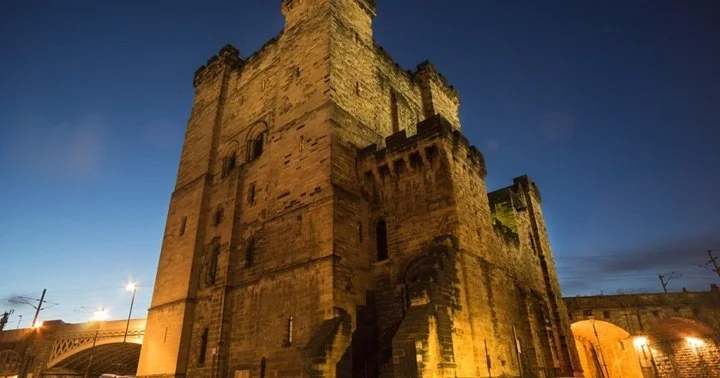
Newcastle Castle Keep is home to one of the city's most enduring ghost stories, the mysterious Poppy Girl. From medieval fortresses and Victorian theatres to ancient pubs and historic streets, Newcastle has centuries of supernatural folklore to explore this Halloween. Image: Newcastle Castle, illustrative photograph
From the mysterious Poppy Girl of Newcastle Castle to a phantom stagehand, a heartbroken Grey Lady and the ghost of a former king, Newcastle has centuries of supernatural folklore waiting to be discovered. This Halloween, Great Park Gazette explores 12 of the city's most intriguing haunted locations.
Newcastle might be famous for its football, nightlife, bridges and architecture, but beneath its bustling streets lies a darker history of unexplained encounters, tragic events, mysterious figures and ghostly legends.
As Halloween arrives on Saturday 31 October 2026, there is no need for residents of Newcastle Great Park to travel to York, Edinburgh or distant castles to discover some fascinating supernatural stories.
Many of the North East's best-known ghost tales are associated with familiar buildings in Newcastle city centre, just a journey away from Great Park.
From a medieval fortress where visitors claim to smell flowers when nobody is carrying them, to a Victorian theatre where a backstage tragedy allegedly left a permanent presence, the city has no shortage of chilling stories.
Great Park Gazette has explored the historical records, local folklore and accounts preserved by Newcastle's museums and heritage organisations to uncover 12 of the most intriguing.
A note to readers: The buildings, historical events and legends featured are real parts of Newcastle's heritage. Claims of ghosts and supernatural activity, however, remain folklore or unverified personal experiences.
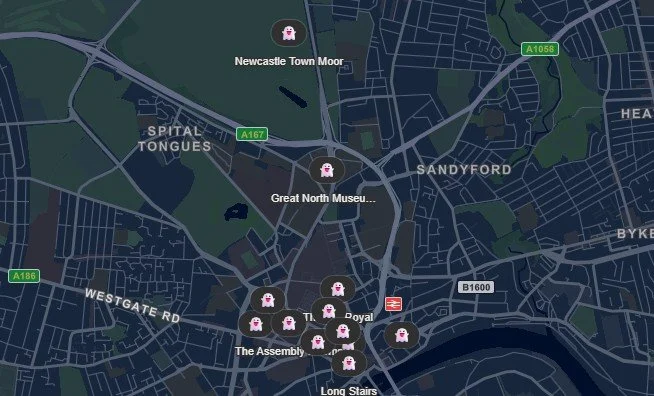
Newcastle's haunted history revealed: Our map highlights 12 locations across the city associated with chilling ghost stories and centuries-old legends, from Newcastle Castle's mysterious Poppy Girl to the Grey Lady of Theatre Royal and the ghostly tales of the historic Quayside. Explore the locations featured in Great Park Gazette's Halloween special and discover the spooky stories on our doorstep. Map: Great Park Gazette
1. Newcastle Castle – The mysterious Poppy Girl
Location: Castle Garth, Newcastle city centre
Perhaps Newcastle's most famous ghost story belongs to the very castle that gave the city its name.
The Castle Keep has stood above the River Tyne for centuries, witnessing imprisonment, conflict, punishment and considerable human suffering.
But among all its stories, none is quite as haunting as that of the Poppy Girl.
According to local legend, a young girl made her living selling flowers around Castle Garth at a time when the medieval fortress was being used as a prison.
The circumstances that led to her imprisonment vary between retellings. Some suggest she was accused of theft, while another version involves a flower she sold containing a bee that stung an important customer.
Whatever the supposed offence, the story ends tragically, with the young girl dying while imprisoned in the castle.
Visitors and paranormal investigators have since claimed to experience her presence in the building.
But rather than hearing footsteps or seeing an apparition, some report something altogether more unusual.
The smell of fresh flowers or poppies, appearing without an obvious source.
Other tales surrounding the castle include unexplained footsteps, moving shadows, strange sounds and sensations of being touched in empty rooms.
In October 2026, Newcastle Castle's programming manager Becca Whittaker discussed the Poppy Girl and staff experiences in an interview about the attraction's Halloween ghost tours.
Whether the young flower seller ever existed exactly as described remains uncertain.
But her story has become one of Newcastle's most enduring supernatural legends.
2. Tyne Theatre and Opera House – The ghost of a Victorian stagehand
Location: Westgate Road
One of Newcastle's most remarkable ghost stories has its origins in a recorded tragedy.
The Tyne Theatre and Opera House opened in 1867 and became known for spectacular Victorian stage productions.
Before modern sound systems, theatres used ingenious mechanical methods to create effects such as thunder.
On 7 April 1887, disaster struck.
According to Newcastle's Historic Environment Record, a heavy cannonball being used as part of a theatrical thunder effect fell approximately 12 feet and fatally struck a member of the backstage staff.
The employee is named Bob Courtenedge in the council's historic record, although many popular ghost-story accounts refer to him as Bob Crowther.
The difference in names illustrates how details can change as stories are passed down through generations.
Over the years, theatre workers have described unexplained knocking, mysterious figures, doors moving and the feeling of someone passing close by backstage.
Some accounts also describe the smell of tobacco appearing unexpectedly.
The ghost is said to be the former stagehand, still occupying the theatre where he lost his life.
The real tragedy is preserved in Newcastle's heritage records.
Whether the reported presence is connected to it is another question entirely.
Nevertheless, few Newcastle ghost stories have such a striking connection between recorded history and the supernatural legend that followed.
3. Theatre Royal – The heartbroken Grey Lady
Location: Grey Street
Thousands of people visit Newcastle's magnificent Theatre Royal each year, but some believe one mysterious guest has never left.
The Grey Lady is said to be the spirit of a young Victorian woman who fell in love with an actor appearing at the theatre.
According to one popular version, the actor promised to marry her and run away with her when his production finished.
Excited by the prospect of their future together, she arrived ready to leave Newcastle.
But the actor allegedly revealed that he had never intended to honour his promise.
Devastated by the betrayal, the woman supposedly fell from an upper section of the auditorium and died.
Some versions claim she deliberately jumped; others say her death was accidental.
Ever since, the Grey Lady has allegedly been spotted in the theatre's corridors, galleries and backstage areas.
Staff have been associated with reports of fleeting figures, unexplained noises and a mysterious female presence.
Local folklore researcher Icy Sedgwick has examined the legend and points out that the woman's identity, the actor involved and the circumstances of her supposed death remain unverified.
There are also historical references to a fall in the theatre, but they do not establish the full romantic tragedy described in the ghost story.
For now, the Grey Lady remains one of Newcastle's most atmospheric theatrical legends.
4. The Old George Inn – Is King Charles I still visiting?
Location: Old George Yard, off Cloth Market
Tucked away in the heart of Newcastle is the Old George Inn, a pub whose history is traditionally traced back to 1582.
It also has one of the city's most unusual supernatural residents.
King Charles I.
The real monarch spent time in Newcastle in 1646 and 1647 after surrendering during the English Civil War.
Although he was effectively a prisoner, he reportedly enjoyed certain freedoms while staying in the city.
Local tradition suggests that the king occasionally visited the Old George and sat in a chair that became associated with him.
The pub has long embraced its royal connection.
But some stories suggest Charles never entirely left.
Customers and staff have reportedly experienced the sensation of being watched, while other accounts describe an unexplained royal-looking figure.
Newcastle Castle's own historical writing confirms that the king was held in the city and discusses the tradition of his visits to the Old George.
The idea that his ghost still frequents the pub, however, belongs firmly to the world of folklore.
Still, it makes for an entertaining thought: could one of England's most famous kings still be keeping an eye on Newcastle's nightlife?
5. The Assembly Rooms – A second Grey Lady
Location: Fenkle Street
Newcastle apparently has room for more than one Grey Lady.
The Assembly Rooms, constructed in 1776, are among the city's finest surviving Georgian buildings.
Once a fashionable destination for elaborate dances, concerts and social gatherings, the building is also associated with a tragic story dating to New Year's Eve 1777.
According to the legend, a young woman suffered a humiliating experience during a celebration and later fell to her death from a gallery overlooking the ballroom.
The exact circumstances differ between versions.
Some describe a cruel prank involving her husband, while others provide less detail.
Her supposed ghost is said to make her presence known through the rustling of a silk or taffeta dress.
Others have reported the smell of lavender or heavy doors opening unexpectedly.
Interestingly, Newcastle's official Historic Environment Record includes the legend alongside the building's architectural history.
That does not establish that the supernatural encounters occurred or that the tragic story happened exactly as told.
But it demonstrates how closely the tale has become associated with one of the city's most distinguished Georgian landmarks.
6. The Lit & Phil – Newcastle's haunted library
Location: Westgate Road
If a quiet old library seems like the perfect location for a ghost story, Newcastle's Literary and Philosophical Society does not disappoint.
Known affectionately as the Lit & Phil, the institution has occupied its historic Westgate Road premises since 1825.
Among its towering bookshelves, reading rooms and staircases, tales of mysterious activity have circulated for years.
Some accounts suggest that as many as 16 ghosts have been associated with the building.
But one of its most intriguing incidents occurred in October 2012.
Staff discovered that an alarmed fire door had opened, apparently without anyone nearby.
When they reviewed CCTV footage, the door could be seen moving, but no person was visible opening it.
The incident was reported on the Lit & Phil's own blog at the time.
Could it have been a sudden change in air pressure, a draught or a mechanical issue?
Quite possibly.
But for those who enjoy a mystery, a door mysteriously opening in one of Newcastle's grandest libraries is an irresistible Halloween story.
And the best part is that the Lit & Phil is a genuine local treasure that visitors can discover throughout the year, regardless of their belief in ghosts.
7. Blackfriars – The monks who allegedly never left
Location: Friars Street
Hidden among Newcastle's modern streets is one of the city's oldest surviving medieval sites.
Blackfriars was founded in the 13th century and was once home to Dominican friars.
The historic buildings now house restaurants and event spaces, while parts of the old friary remain visible.
But folklore suggests that some of its former occupants are reluctant to leave.
Stories describe shadowy figures wearing monks' robes, unexplained noises and disturbances around the historic rooms and cloisters.
Another colourful legend claims that secret underground passages once connected Newcastle's religious houses.
According to the tale, a monk and a nun used these passages for secret meetings, with tragic consequences when their relationship was discovered.
There is no reliable documentary evidence establishing the supposed secret passage affair.
However, the story has become part of Newcastle's wider tradition of ghostly monks and medieval mysteries.
Blackfriars' genuine history is fascinating enough without the supernatural additions, but the legends certainly provide another reason to look more closely at this remarkable city-centre building.
8. Newcastle Cathedral – The knight and the haunted churchyard
Location: St Nicholas Square
Newcastle Cathedral has centuries of history beneath its magnificent lantern tower.
The building has witnessed religious upheaval, conflict, burials and major changes in the city around it.
Its medieval crypt was once used to store human remains from the overcrowded churchyard.
But there are also stories of figures that supposedly cannot rest.
One longstanding legend describes a shadowy knight moving through the cathedral, sometimes accompanied by the sound of armour.
Another concerns a woman named Martha Williams, who is said to haunt the former churchyard.
According to the story, she encountered grave robbers and was murdered.
Newcastle's Historic Environment Record includes the tradition associated with the churchyard, although that should not be confused with independently verified evidence of a haunting.
The cathedral's remarkable history, monuments and underground spaces make it one of Newcastle's most intriguing historic landmarks.
9. Great North Museum: Hancock – The wandering Egyptian mummy
Location: Barras Bridge
You might expect to find ancient objects, fossils and natural history exhibitions at the Great North Museum: Hancock.
But local legend suggests that one of its oldest residents may occasionally take a walk.
The museum houses two ancient Egyptian mummified people, known as Irtyru and Bakt en Hor.
Both are part of the museum's remarkable historical collections.
Over the years, stories have circulated about a mysterious Egyptian figure supposedly seen moving through the museum after dark.
The tale was being recorded in paranormal listings by the early 2000s.
Newcastle Castle's own blog has also explored the legend, while acknowledging that the story does not clearly establish which of the museum's Egyptian individuals the apparition is supposedly associated with.
There is no established evidence that an ancient Egyptian ghost walks the galleries.
But there is something wonderfully unsettling about the idea of a centuries-old museum where one of the exhibits supposedly refuses to remain still.
The museum itself is free to visit, making it an interesting destination for Great Park families wishing to discover Newcastle's history and collections.
10. Long Stairs – The ghostly victim of the press gangs
Location: The Close, near Newcastle Quayside
Newcastle's Long Stairs provide one of the city's more atmospheric connections between the upper streets and the historic riverside.
Steep, narrow and surrounded by old buildings, the steps are associated with a particularly grim tale.
According to local folklore, a young man named Henry Hardwick attempted to escape a press gang.
Press gangs were groups involved in forcibly recruiting men into naval service.
The story claims Hardwick was caught near the Cooperage, attacked and killed.
Some versions contain particularly gruesome details about the injuries he suffered.
His ghost is said to wander the steps and surrounding streets, unable to escape the place where his life supposedly ended.
Although the story is repeated in Newcastle ghost guides, the precise historical details have not been independently established.
Even without the supernatural legend, Long Stairs provides a reminder of a period when life around the city's bustling riverside could be extremely harsh.
11. Broad Chare – The mysterious Silky Ghost
Location: Broad Chare, Newcastle Quayside
Not all of Newcastle's ghost stories are associated with castles or grand theatres.
Some belong to ordinary people whose lives ended in tragedy.
One such tale concerns Martha Wilson, a seaman's widow who lived in accommodation associated with Newcastle's Trinity House.
North East Museums has documented her story in a feature exploring the ghosts of Victorian Newcastle.
Martha died in April 1817 after a period of severe emotional distress.
Because of the attitudes and religious practices of the time, she was buried at a crossroads rather than in consecrated ground.
Later, reports began circulating of a strange female figure around Broad Chare.
Witnesses supposedly heard the rustling of a woman's clothing, while one particularly unsettling tale describes a veiled apparition whose face could not be seen.
The ghost became known as the Broad Chare Silky, a name associated with the mysterious sound of flowing fabric.
The underlying historical account also reveals something important about Newcastle's past: how differently people experiencing mental illness and emotional distress were treated more than two centuries ago.
It is a sad story that deserves to be remembered with sensitivity, rather than simply treated as a frightening Halloween attraction.
12. Newcastle Town Moor – Witch trials and the city's darkest history
Location: Newcastle Town Moor
Not every chilling location in Newcastle is a building.
The vast open spaces of the Town Moor have a troubling history that many residents may not know.
On 21 August 1650, Newcastle witnessed one of the most notorious episodes in its history when people accused of witchcraft were executed.
Northumberland Archives preserves records from St Andrew's parish relating to the executions.
Historical accounts describe the hanging of 15 people accused of witchcraft, among other executions that day.
It was part of a period when accusations, superstition and fear could have deadly consequences.
For centuries, the Town Moor was associated with the city's gallows and public punishments.
Today, it is a familiar green space used for walking, recreation and major events.
But folklore has attached ghostly figures, unexplained cries and unsettling encounters to the landscape.
Unlike the supernatural claims, the history of the executions is supported by surviving documentary records.
It is perhaps the most sobering story in this collection, and a reminder that Newcastle's darker past was often far more frightening than anything invented for Halloween.
Can you explore Newcastle's haunted history for yourself?
For residents of Newcastle Great Park, many of the locations featured are within Newcastle city centre and can be explored as part of a historical walk.
The Castle Keep, Cathedral, Old George, Blackfriars, Assembly Rooms, Theatre Royal, Lit & Phil and Tyne Theatre are all associated with streets and buildings that are important parts of Newcastle's heritage.
Some are open to the public, while others operate as working theatres, venues, pubs or businesses, so access to their interiors will depend on normal opening arrangements.
For Halloween 2026, Newcastle Castle has been running its Ghosts of History programme, including storytelling, guided tours and family activities.
Its special after-hours ghost tours for 29–31 October are listed as sold out, but other advertised activities continue into early November.
North East Museums has also produced an excellent Weird Walks experience, featuring broadcaster Alan Robson MBE exploring Newcastle's darker history through videos and a downloadable walking map.
Visitors can find further details at:
Newcastle Castle – Halloween events
North East Museums – Weird Walks
Are Newcastle's ghosts real?
Whether any of the city's reported ghosts are genuine supernatural phenomena remains a matter of personal belief.
There is no reliable scientific evidence establishing that the apparitions described in these stories are spirits of the dead.
Old buildings can produce unexplained noises because of changing temperatures, airflow, structural movement and everyday activity.
Shadows, reflections and expectations may also influence how unusual experiences are interpreted.
Some of Newcastle's legends have changed considerably over time, with names, locations and circumstances differing between accounts.
But that does not make the stories uninteresting.
They often preserve memories of genuine historical events, reveal attitudes from earlier centuries and encourage people to discover parts of the city they might otherwise overlook.
Newcastle's ghost stories are therefore a fascinating mixture of history, tragedy, imagination and local tradition.
Great Park Gazette wants to hear your ghost stories
With Halloween upon us, Great Park Gazette would also love to hear from residents of Newcastle Great Park who have experienced something unusual.
Have you ever visited one of Newcastle's reportedly haunted buildings?
Have you taken part in a local ghost walk?
Or do you have a mysterious story of your own involving Great Park or the surrounding area?
Whether you're a firm believer in ghosts or a complete sceptic, we'd welcome your experiences and photographs.
Email: editor@greatparkgazette.co.uk
Or contact us through www.greatparkgazette.co.uk.
As you enjoy Halloween this year, remember that some of Newcastle's most intriguing ghost stories are not hidden in distant castles or unfamiliar cities.
They're right here on our doorstep.
Published Saturday 31 October 2026 – Halloween.
Research sources include Newcastle Castle, Newcastle City Council's Historic Environment Record, Northumberland Archives, North East Museums, the Lit & Phil, Get Into Newcastle and local folklore historians.
The supernatural accounts featured are traditional stories and unverified reports, not established evidence of paranormal activity.

