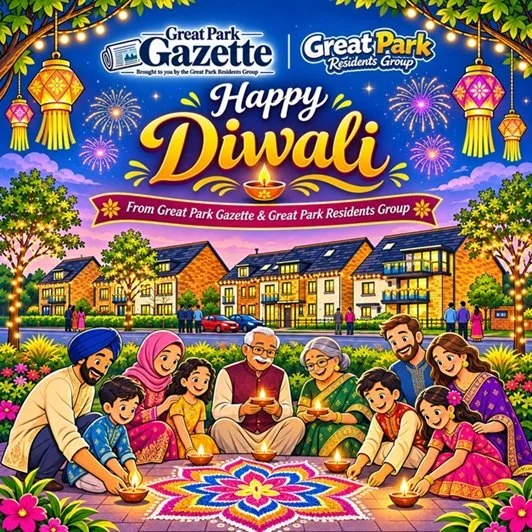
Happy Diwali 2026! 🪔✨ Great Park Gazette and Great Park Residents Group wish everyone celebrating across Newcastle Great Park and the wider community a joyful Festival of Lights. This specially created illustration celebrates Diwali with colourful rangoli decorations, glowing traditional oil lamps (diyas), festive lanterns and families coming together in the heart of Great Park. May the festival bring happiness, peace, prosperity and new beginnings to all
Today, Sunday 8 November 2026, millions of people around the world are celebrating Diwali, one of the most important and colourful festivals in the religious and cultural calendar.
Known as the Festival of Lights, Diwali is a time for families and communities to come together, decorate their homes, share food, exchange gifts and celebrate hope, kindness and new beginnings.
For many, it is also an important occasion for prayer, reflection and gratitude.
From the glow of traditional oil lamps to beautiful decorations and gatherings with loved ones, Diwali is a celebration filled with warmth and meaning.
Here at Great Park Gazette, we would like to wish everyone marking the occasion a wonderful day filled with happiness, peace and prosperity.
But what exactly is Diwali, why is it celebrated, and what do its traditions represent?
What Is Diwali?
Diwali, also known as Deepavali, takes its name from a Sanskrit expression meaning a row of lights.
The festival is most closely associated with Hinduism, although it also holds important significance for Jain and Sikh communities, while some Buddhist communities observe related traditions.
Its central message is often described as the triumph of light over darkness, good over evil and knowledge over ignorance.
Light has a particularly important symbolic meaning.
It represents hope during difficult times, the importance of wisdom and the belief that goodness can overcome adversity.
For families celebrating Diwali, lighting lamps and decorating their homes can be a way of expressing these values.
Although the festival has deep religious roots, its themes of generosity, family, kindness and new beginnings are also appreciated by people from many different backgrounds.
Why Is Diwali Celebrated?
Diwali has different religious meanings and traditions depending on the community and region.
The Return of Lord Rama
One of the best-known Hindu stories associated with Diwali is the return of Lord Rama to Ayodhya after 14 years in exile.
According to the Ramayana, Rama returned with his wife Sita and his brother Lakshmana after defeating the demon king Ravana.
In the traditional story, the people of Ayodhya welcomed their return by lighting rows of oil lamps.
The lamps symbolised the victory of good over evil and the return of hope after hardship.
This story remains an important part of Diwali celebrations for many Hindu families.
Honouring Lakshmi, Goddess of Prosperity
Diwali is also closely associated with Lakshmi, the Hindu goddess of wealth, prosperity and good fortune.
Many families clean and decorate their homes before the festival and offer prayers seeking blessings for the year ahead.
The celebration is not simply about material wealth.
For many worshippers, prosperity also includes good health, happiness, spiritual wellbeing and harmony within the family.
Different Traditions Across India
Diwali is celebrated in different ways across India and among communities around the world.
In some regions, the festival commemorates Lord Krishna's victory over the demon Narakasura.
Elsewhere, celebrations are associated with Goddess Kali or mark the beginning of a new year.
These regional differences reflect the richness of the cultures and traditions connected with Diwali.
What Does Diwali Mean to Sikh and Jain Communities?
Although Diwali is widely known as a Hindu festival, this time of year also carries important meaning for other faith communities.
Sikhism – Bandi Chhor Divas
Many Sikhs celebrate Bandi Chhor Divas, the Day of Liberation, around the same time as Diwali.
The occasion commemorates the release of Guru Hargobind, the sixth Sikh Guru, from imprisonment at Gwalior Fort.
According to Sikh tradition, he also secured the freedom of 52 imprisoned princes.
The occasion celebrates freedom, justice and standing up for others.
Sikh gurdwaras may be beautifully illuminated during the celebrations, with prayers and gatherings bringing communities together.
Jainism – Remembering Lord Mahavira
For Jains, Diwali marks the attainment of moksha, or spiritual liberation, by Lord Mahavira, the 24th Tirthankara.
It is a time for spiritual reflection, prayer and contemplation.
The lighting of lamps symbolises spiritual knowledge and the enduring importance of Lord Mahavira's teachings.
These different observances share themes of enlightenment, compassion and hope, while retaining their own distinct religious meanings.
How Do Families Celebrate Diwali?
Diwali is famous for its colourful traditions, many of which have been passed down through generations.
Lighting Diyas
One of the most recognisable traditions is the lighting of small clay oil lamps, known as diyas.
These are placed around homes, in windows and at entrances.
The warm glow of the lamps symbolises the victory of light over darkness.
Some families also use decorative candles and electric lights to illuminate their homes.
Creating Rangoli Decorations
Many households create beautiful patterns called rangoli near doorways and entrances.
These colourful designs may be made using coloured powder, rice, flower petals or other materials.
Rangoli patterns are often intricate and can include flowers, geometric shapes and traditional symbols.
They are a way of welcoming guests and bringing colour and beauty to the celebrations.
Sharing Food and Sweets
Food plays an important role in Diwali.
Families prepare special meals and traditional sweets, which are shared with relatives, friends and neighbours.
Popular treats include laddoo, barfi, jalebi and other regional specialities.
The exchange of food and gifts reflects the importance of generosity, friendship and togetherness.
New Clothes and Family Gatherings
Many people wear new or special clothing for Diwali.
Families may visit temples, attend religious services, exchange gifts and spend time celebrating together.
For some households, the festival also marks an opportunity to make a fresh start, settle disagreements and look ahead with optimism.
Fireworks and Celebrations
Fireworks and illuminated displays are another familiar part of Diwali celebrations in some communities.
However, not everyone chooses to celebrate with fireworks.
Some families prefer quieter gatherings, particularly out of consideration for pets, wildlife, neighbours and the environment.
The most important elements of the celebration remain its spiritual meaning and the opportunity to spend time with loved ones.
Why Does the Date of Diwali Change Each Year?
Unlike Christmas, which takes place on a fixed date, Diwali follows a lunar-based religious calendar.
As a result, it falls on different dates in October or November each year.
In 2026, the main day of Diwali falls on Sunday 8 November in the United Kingdom.
The wider festival traditionally extends over several days, with different observances before and after the main celebration.
This year, the five-day period runs from approximately 6 to 10 November.
Different regions, faith communities and families may observe particular rituals on different days.
For many people, the preparations and celebrations begin well before the main festival day.
Diwali Celebrations in Newcastle
Diwali is celebrated by families and communities throughout Newcastle and the North East.
One of the region's important centres for Hindu worship and cultural activities is Hindu Temple Newcastle, situated on West Road in the city's West End.
The temple has confirmed a programme of activities for Diwali on Sunday 8 November 2026.
It also organises wider community celebrations intended to bring families and friends together.
Newcastle Diwali Fireworks Festival – Saturday 14 November
Residents who would like to experience the atmosphere of a larger Diwali celebration can also look forward to a special event taking place next weekend.
Organised by Hindu Temple Newcastle, the Diwali Fireworks Festival 2026 is scheduled for:
Date: Saturday 14 November 2026
Time: 4pm–8pm
Venue: Westgate Community College, West Road, Newcastle upon Tyne, NE4 9LU
The advertised programme includes a fireworks display, Indian street food, a bazaar, a funfair, live music, cultural performances, children's lantern-making activities and entertainment.
The event is advertised as family-friendly, with entry based on a donation of the visitor's choice.
Further information and event arrangements are available through Hindu Temple Newcastle:
Visitors should check the organiser's latest updates before travelling.
Celebrating Diwali in a Diverse Community
Newcastle Great Park is home to people from different cultural, religious and family backgrounds.
That diversity is something worth recognising and celebrating.
Diwali provides an opportunity not only for those who observe the festival to enjoy their traditions, but also for neighbours to learn more about the beliefs and customs that are important to one another.
You do not need to celebrate Diwali yourself to appreciate its central messages.
Hope, kindness, generosity, family and community are values that can bring people together throughout the year.
For children, learning about festivals such as Diwali can help develop understanding and respect for different traditions.
For neighbours, even a simple greeting of “Happy Diwali!” can be a thoughtful way of recognising somebody else's special occasion.
Taking an interest in the celebrations and traditions of others helps create a welcoming and inclusive community.
A Message from Great Park Gazette
As homes and communities across the world light lamps and celebrate the Festival of Lights, Great Park Gazette would like to extend our warmest wishes to everyone observing Diwali.
Whether you're celebrating with family, attending prayers, decorating your home, sharing delicious food or simply enjoying a quiet evening with loved ones, we hope the occasion brings happiness and peace.
May the year ahead bring good health, new opportunities, success and prosperity.
To all our Hindu, Sikh, Jain and other neighbours marking this special time: Happy Diwali and Bandi Chhor Divas!
Shubh Deepavali! 🪔✨
From everyone at Great Park Gazette and Great Park Residents Group, we wish you and your loved ones a joyful Festival of Lights.
Have Your Say
Are you celebrating Diwali in Newcastle Great Park this year?
What are your favourite traditions, foods or family memories associated with the Festival of Lights?
Have you decorated your home with diyas or rangoli, or are you attending a celebration in Newcastle?
We would love to hear how our local community is marking the occasion.
If you have photographs of your Diwali decorations or celebrations that you would like to share, Great Park Gazette would be delighted to feature them with your permission.
Sources and Further Reading
High Commission of India, London – Official 2026 Holiday Calendar
https://www.hcilondon.gov.in/page/list-of-the-holidays/
Hindu Temple Newcastle – Diwali Celebrations 2026
Hindu Temple Newcastle – Diwali Fireworks Festival
https://www.eventbrite.com/e/diwali-fireworks-festival-2026-tickets-2003407705377
Imperial College London – Diwali and Bandi Chhor Divas
https://www.imperial.ac.uk/equality/resources/religion-and-belief/diwali-and-bandi-chhor-divas/
Diwali in London – About the Festival of Lights

