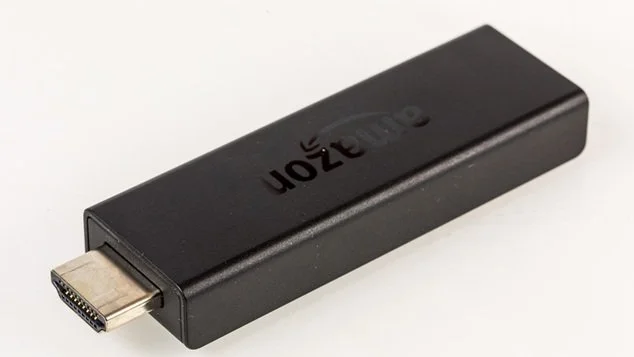
An Amazon Fire TV Stick. The devices themselves are perfectly legal, but using unauthorised streaming services to access copyrighted television, films or sports can have legal consequences. Photograph: ubahnverleih / Wikimedia Commons
Millions of households across Britain use streaming devices to watch television, films and live sport, but renewed warnings about so-called "dodgy Firesticks" have raised questions about whether police are now identifying individual viewers through their bank payments.
The warnings follow comments made by former police officer and BBC Morning Live presenter Rav Wilding, who explained that investigators are examining the financial records of illegal streaming suppliers to identify people who may have purchased unauthorised television subscriptions.
But does this mean that anyone who owns an Amazon Fire TV Stick could receive a visit from the police? Are viewers automatically breaking the law? And can investigators really identify customers through their bank transactions?
Great Park Gazette has examined official government guidance, police investigations, statements from the Federation Against Copyright Theft (FACT) and previous prosecutions to establish what is actually happening.
The answer is that illegal streaming enforcement is real, but owning a Fire TV Stick is not itself a criminal offence, and appearing in a seller's payment records does not automatically prove wrongdoing.
For residents across Newcastle Great Park, Gosforth, Kingston Park, Wideopen and the wider North East, understanding the difference is important.
First, is owning an Amazon Fire TV Stick illegal?
No.
An ordinary Amazon Fire TV Stick is a completely legitimate device designed to allow people to watch television and other content through internet-based services.
Millions of people use them with legitimate applications, including BBC iPlayer, ITVX, Netflix, Prime Video, Disney+ and other authorised platforms.
There is nothing inherently unlawful about owning or using one.
Nor is installing third-party software automatically a criminal offence.
The distinction is what that software is being used to access.
The UK Intellectual Property Office explains that streaming devices can be used legally with authorised content, but problems arise when they are adapted or used to access copyrighted television programmes, films or subscription sports without the necessary permission.
Some devices are advertised as "fully loaded", "jailbroken" or offering access to virtually every premium television channel for a relatively small annual payment.
These descriptions can be warning signs, although the technical act of modifying a device does not automatically establish criminal wrongdoing.
It is the unauthorised access to protected content, not the mere possession of the equipment, that creates the legal problem.
What exactly is a "dodgy Firestick"?
The term usually refers to an ordinary streaming device that has been configured to receive unauthorised television services.
These services often use Internet Protocol Television, commonly known as IPTV.
IPTV itself is a perfectly legitimate technology.
Many authorised broadcasters and streaming companies use internet-based television delivery.
The issue arises when an IPTV provider supplies channels, films or sporting events without the rights holder's permission.
For example, a person might pay an unofficial seller to access subscription sports channels, premium films and other paid-for television services through a single application.
The seller may charge considerably less than authorised providers.
However, paying the unofficial seller does not make the underlying service legal.
The same principle applies whether someone watches using a Fire TV Stick, Android television box, smart television, mobile phone, tablet or computer.
Are police really tracing customers through bank payments?
Yes, there is genuine evidence that investigators are examining financial transactions and customer information connected with illegal streaming businesses.
However, the situation is more specific than some headlines suggest.
When police investigate an illegal IPTV supplier, they may obtain evidence from the operation, including payment records, subscription information, customer lists, messages and computer equipment.
Those records can reveal people who have paid for access to the service.
FACT confirmed in December 2025 that investigators had obtained customer information during investigations into illegal streaming operations.
Following those investigations, the organisation contacted more than 1,000 individuals across the UK by email and text, warning them to stop using illegal streaming services or risk prosecution.
This demonstrates that enforcement organisations are not exclusively interested in the people selling illegal subscriptions.
They are also seeking to discourage customers from continuing to use them.
Does that mean police can automatically inspect everyone's bank account?
No. That would be an inaccurate description of the evidence.
Investigators can examine financial evidence obtained through lawful investigative processes.
This can include records held by suspected sellers, financial information lawfully obtained during an investigation and customer records recovered from electronic devices.
In a separate case involving viewers in the Republic of Ireland, Sky obtained a court order requiring the financial technology company Revolut to provide customer information connected with payments to an illegal streaming supplier.
That case was reported by BBC News in May 2026.
The important distinction is that these were targeted investigative and legal processes, not evidence that police are routinely searching the bank accounts of every British television viewer.
Does making a payment prove someone watched illegal television?
Not necessarily.
A payment could provide evidence of a financial relationship between a customer and a suspected illegal streaming supplier.
However, it does not automatically establish what service was purchased, whether copyrighted content was accessed or whether a particular criminal offence has been committed.
Investigators may need additional evidence, depending on the circumstances.
That could involve communications with a supplier, account records, evidence of service access or information recovered during an investigation.
In May 2026, BBC News reported comments from Dr Amy Thomas, an intellectual property and information law lecturer at the University of Glasgow, who explained that identifying an individual was not the same as proving copyright infringement.
This is an important qualification.
A name appearing on a payment list does not mean that person has automatically been convicted, fined or found guilty of illegal streaming.
Nevertheless, customers who knowingly purchase access to unauthorised television services should not assume that their activities are beyond investigation.
Have people actually been prosecuted?
Yes.
There are documented cases involving criminal convictions and prison sentences.
One significant example involved Jonathan Edge, from Liverpool, who was sentenced in November 2024 after supplying illegal television streaming services through modified Fire TV Sticks.
He received a prison sentence of three years and four months.
Importantly, the prosecution included a separate offence relating to his own use of the illegal streaming service.
A concurrent sentence of two years and three months was imposed for that activity.
However, this was not a case involving an ordinary household customer who simply owned a Fire TV Stick.
Edge was operating an illegal streaming business and was also personally accessing the unauthorised content he supplied.
It would therefore be misleading to suggest that everyone who has ever purchased an illegal IPTV subscription faces an equivalent prison sentence.
A more recent prosecution in October 2026
Another case was confirmed by FACT on 22 October 2026.
Aaron Smith, aged 41, from Clacton, was sentenced to two years in prison, suspended for two years, after selling access to illegal streaming services.
According to FACT, he supplied modified Fire TV Sticks and subscriptions to more than 540 customers.
Investigators identified hundreds of payments into bank accounts associated with the operation, totalling more than £72,000.
They also recovered communications and evidence relating to the sale of the devices.
Smith admitted offences relating to money laundering and the sale or hire of an article infringing copyright.
Again, this was a prosecution of a supplier, not evidence that all 540 customers had themselves been prosecuted.
The case demonstrates how financial records can form part of an investigation and why operators of illegal streaming services may be identifiable.
Could ordinary viewers receive fines or go to prison?
There is a genuine legal risk, but the outcome depends on the circumstances.
The Federation Against Copyright Theft has warned that individuals knowingly accessing illegal streaming services may face criminal liability, including under Section 11 of the Fraud Act 2006.
That provision concerns obtaining services dishonestly.
Copyright law and potential civil claims may also be relevant, depending on the particular conduct.
However, a criminal prosecution requires sufficient evidence of an applicable offence.
A fine or custodial sentence is not an automatic consequence of somebody's details appearing in a customer database.
The distinction between the person running a large-scale illegal subscription business and a household customer is also important when considering how offences are investigated and prosecuted.
Cases involving substantial commercial operations, repeated offending, dishonesty and significant financial gains may involve very different circumstances from those concerning individual viewers.
There is no general rule that simply owning a modified Fire TV Stick results in an immediate fine or prison sentence.
Has this happened in Newcastle or the North East?
There is evidence of enforcement activity in the region.
In June 2024, the North East Regional Organised Crime Unit announced an operation in Stockton-on-Tees involving suspected illegal streaming, fraud and money laundering.
Officers executed a search warrant and arrested a man suspected of involvement in supplying services associated with illegal streaming.
The operation was part of a wider effort to disrupt organised criminal activity.
FACT has also confirmed that previous nationwide enforcement operations included Northumbria and other parts of the North East.
Its December 2025 announcement specifically acknowledged the involvement of the North East Regional Organised Crime Unit among its enforcement partners.
These are documented examples of regional involvement.
However, Great Park Gazette has not established evidence of a new operation specifically targeting household Fire TV Stick users in Newcastle Great Park, Gosforth or the surrounding residential communities.
Nor have we established that local residents are currently receiving police visits simply because they previously paid for an IPTV subscription.
The fact that national enforcement is taking place should not be confused with evidence of a particular local crackdown.
Are four million households using illegal Fire TV Sticks?
The figure of approximately four million people or households has been repeated in media coverage.
However, the precise number of households currently accessing unauthorised streaming services is difficult to establish.
Such services are not registered with the authorities in the way legitimate broadcasters are, and estimates can differ according to the research method and the definition of illegal streaming.
Some studies count individuals, others count households, and some include unauthorised streaming websites rather than just modified television devices.
Great Park Gazette has not independently verified the four-million figure as an official count of households currently using illegal Fire TV Sticks.
It should therefore be treated as an estimate rather than an established total.
There's another risk that viewers shouldn't overlook
While much attention has focused on possible police action, cybersecurity experts and investigators have warned about the risks associated with unofficial streaming services.
Unlike established streaming platforms, illegal IPTV services may lack appropriate security protections.
Users may be encouraged to install unfamiliar applications, disable device security restrictions or provide personal information to unknown sellers.
Potential risks include:
Malicious software capable of compromising devices.
Exposure of personal information and payment details.
Fraud involving recurring subscription payments.
Identity theft and online scams.
Children encountering inappropriate content without effective parental controls.
Unregulated hardware or power supplies presenting possible electrical safety concerns.
Not every unofficial application necessarily contains malicious software, but the risks can be difficult for ordinary consumers to assess.
Police and FACT have repeatedly warned that some illegal streaming businesses are associated with wider organised criminal activity.
For residents concerned about online security, those warnings are worth considering independently of the copyright issues.
What should you do if you already own a Fire TV Stick?
Residents who use a Fire TV Stick for legitimate services do not need to stop using their device because of these reports.
If you use authorised applications and subscriptions, the device itself is not the problem.
For those who have purchased an unofficial IPTV subscription or a preconfigured device offering unauthorised channels, the government's guidance recommends removing the software responsible for the illegal streams and using legitimate services instead.
Anyone who is unsure whether an application is authorised should check the service and its provider.
People concerned that they may have supplied payment details to an untrustworthy operator should also consider reviewing bank transactions, monitoring accounts for suspicious activity and updating compromised passwords.
If you have installed unfamiliar software, checking the device for security problems and removing untrusted applications is sensible.
What if someone contacts you claiming to be the police?
The publicity surrounding illegal streaming investigations also creates opportunities for fraudsters.
Residents should be cautious about unexpected telephone calls, emails or messages claiming they must pay an immediate fine because their Fire TV Stick has been detected.
Do not assume a message is genuine simply because it refers to FACT, the police, a broadcaster or an alleged IPTV investigation.
Verify any approach independently through the relevant organisation's official contact details.
Do not provide banking passwords, one-time security codes or card details to someone making an unsolicited demand.
If police wish to interview you as a suspect, you can seek independent legal advice, including the right to free legal advice at a police station.
Is this the same as needing a TV Licence?
No. These are separate legal issues.
A television licence is generally required in the UK to watch or record live television broadcasts on any channel or service, or to use BBC iPlayer.
You do not normally need a TV Licence simply to watch on-demand programmes through services such as Netflix or Disney+.
However, having a TV Licence does not give someone permission to access copyrighted subscription channels through an unauthorised IPTV provider.
Equally, using a legitimate streaming device does not remove the requirement to hold a TV Licence when watching services for which one is legally required.
Residents should distinguish between television licensing rules, copyright permissions and the use of legitimate subscription services.
What does all this mean for Great Park residents?
The latest warnings are worth taking seriously, but there is no reason for households using ordinary streaming equipment legally to panic.
There are three important conclusions.
First, Amazon Fire TV Sticks are legal devices.
There is no offence simply because a household owns one, uses third-party applications or has modified the device's software settings.
Second, accessing unauthorised copyrighted content can have legal consequences.
Police and anti-piracy investigators have pursued illegal IPTV businesses, and there is evidence that some customers have been identified and contacted.
Third, a payment record is not the same as a criminal conviction.
Investigators must still establish the relevant facts and legal basis for enforcement action.
For residents across Great Park and the wider Newcastle area, the sensible approach is to use legitimate streaming services, be cautious about unusually cheap offers promising unrestricted access to premium content and protect personal financial information.
The wider police investigations are genuine.
But the evidence does not support the suggestion that every Fire TV Stick owner is a criminal or that every person who has paid an IPTV seller is automatically facing prosecution.
Have your say
Have you noticed illegal television subscriptions being advertised online or through social media?
Were you aware that investigators have recovered customer information from illegal streaming operations?
Or do you think the high cost of legitimate sports and television subscriptions is contributing to the popularity of unauthorised alternatives?
Great Park Gazette welcomes readers' views on the issue.
Please avoid publicly identifying individuals or making unverified allegations about local residents or businesses.
The aim is to provide accurate information and encourage informed discussion rather than unnecessarily alarm people who are using perfectly legal television equipment.
Official sources and further reading
UK Intellectual Property Office – Illicit streaming devices: the law and consumer guidance
FACT – Warning to more than 1,000 illegal streaming customers, December 2025
FACT – Clacton illegal streaming supplier sentenced, October 2026
North East Regional Organised Crime Unit – Illegal streaming enforcement operation
Editorial note: This article distinguishes confirmed enforcement activity from broader claims about the extent of illegal streaming and the consequences for individual viewers. Great Park Gazette has not independently confirmed any current local operation targeting household users in Newcastle Great Park. The article provides general consumer information rather than individual legal advice.

