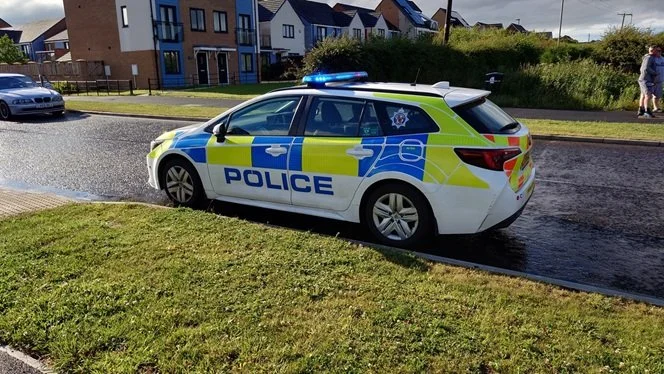
A Northumbria Police patrol car pictured on Roseden Way in Newcastle Great Park. Newly released College of Policing figures reveal that 22 Northumbria Police officers were added to the national barred list during 2025/26, raising questions about professional standards and accountability across the force
The number of Northumbria Police officers banned from working in policing has risen, with 22 officers added to the national barred list during the latest reporting year, according to newly released College of Policing figures.
The figures cover the period from 1 April 2025 to 31 March 2026 and show a substantial increase compared with the previous 12 months, when 15 Northumbria officers were barred.
Across England and Wales, a record 757 regular police officers were added to the barred list during the same period, the highest annual total since the system was introduced in December 2017.
The figures raise important questions about police accountability, professional standards and public confidence, particularly for communities served by Northumbria Police.
The force is responsible for policing Newcastle, North Tyneside, Northumberland, Gateshead, Sunderland and South Tyneside, including Newcastle Great Park and surrounding communities.
However, the statistics also require careful interpretation.
Being placed on the barred list means an officer has been dismissed or would have been dismissed following relevant disciplinary proceedings, preventing them from returning to policing.
It does not necessarily mean they have been convicted of a criminal offence.
Northumbria Police: How many officers have been barred?
The latest figures reveal that Northumbria Police recorded its highest annual number of barred officers in the five years examined.
The figures show:
2021/22 – 7 officers barred
2022/23 – 8 officers barred
2023/24 – 19 officers barred
2024/25 – 15 officers barred
2025/26 – 22 officers barred
That represents 71 officers added to the barred list over five reporting years, with the latest annual figure more than three times the number recorded in 2021/22.
The increase from 15 to 22 between the two most recent reporting years represents a rise of approximately 47%.
Although the figures fell slightly between 2023/24 and 2024/25, the latest increase takes the annual total above the previous five-year high of 19.
These figures relate specifically to regular police officers and should not be confused with separate barred-list statistics for police staff and special constables.
Nor should the annual totals be interpreted as the number of officers found guilty of crimes.
The disciplinary system covers a range of serious breaches of professional standards, including behaviour that does not necessarily result in a criminal prosecution.
What does being placed on the police barred list actually mean?
The College of Policing maintains a national barred list designed to prevent officers and other relevant police personnel who have been dismissed from returning to policing.
The system was introduced in December 2017 as part of efforts to strengthen accountability and transparency.
An officer can be added following a misconduct hearing where their behaviour is found to warrant dismissal.
Importantly, the disciplinary process can continue even if an officer has resigned or retired before proceedings conclude.
If a misconduct panel determines that the individual would have been dismissed had they remained in service, they can still be placed on the barred list.
This is intended to prevent someone from avoiding the consequences of serious misconduct simply by leaving their job before an investigation is completed.
It also helps prevent individuals dismissed from one police force from quietly obtaining employment within another.
Does every officer on the list have a criminal conviction?
No.
There is an important distinction between criminal proceedings and police misconduct proceedings.
A criminal court determines whether somebody has committed an offence under criminal law.
Police disciplinary proceedings examine whether an officer has breached the professional standards expected of them.
Examples of potential gross misconduct include dishonesty, serious discrimination, misuse of confidential information, inappropriate relationships and behaviour that discredits the police service.
Some cases may involve criminal conduct and lead to prosecution.
Others may result in dismissal without a criminal conviction.
The fact that an officer appears on the barred list should therefore not automatically be interpreted as evidence that they have been convicted in court.
Two Northumbria Police cases highlight the consequences of serious misconduct
Among the cases involving Northumbria Police are two former officers whose conduct resulted in criminal convictions and subsequent disciplinary action.
Former detective Sue Thorpe
Former Northumbria Police detective Sue Thorpe was convicted following a stalking campaign against her former partner.
Newcastle Crown Court heard that Thorpe had repeatedly contacted the man and made false allegations about him, including accusations involving child sexual abuse.
The court also heard that she had misused the Police National Computer to obtain information about him.
Her conduct included accessing confidential policing systems for reasons unrelated to legitimate police work.
She received a two-year prison sentence suspended for two years and a ten-year restraining order.
Following the criminal proceedings, a police misconduct hearing concluded that her actions warranted inclusion on the barred list.
The case illustrates why the misuse of police information systems is regarded as particularly serious.
Officers have access to sensitive information about members of the public, including victims, witnesses and suspects.
Using those systems for personal purposes undermines the trust placed in officers and can expose individuals to considerable harm.
Former officer Robert Stringer
Another case involved former Northumbria Police officer Robert Stringer, who had served within Newcastle Area Command and was based at Etal Lane Police Station.
Stringer admitted stalking an ex-partner following the breakdown of their relationship.
The case involved repeated unwanted contact, including telephone calls, messages and visits to the woman's home.
He pleaded guilty to stalking involving serious alarm or distress.
Following the criminal proceedings, police disciplinary action concluded that his behaviour amounted to gross misconduct.
He was subsequently placed on the barred list.
Northumbria Police had previously described his conduct as unacceptable and made clear that it did not represent the behaviour expected of its officers.
Both cases demonstrate that misconduct outside normal policing duties can still have serious professional consequences.
Police officers are expected to maintain appropriate standards of behaviour both on and off duty.
These cases are examples of publicly reported misconduct proceedings. They should not be taken as representative of every Northumbria officer included in the latest figures.
A record 757 officers barred nationally
The increase in Northumbria comes against the backdrop of rising barred-list numbers across England and Wales.
The latest College of Policing figures show:
2021/22 – 299 officers
2022/23 – 394 officers
2023/24 – 594 officers
2024/25 – 735 officers
2025/26 – 757 officers
The latest total represents an increase of 22 officers compared with the previous year.
It is also more than double the number recorded in 2021/22.
Since the barred list was established in December 2017, a total of 3,591 regular police officers have been added.
The Metropolitan Police recorded the largest number of officers added during the latest reporting period, followed by Greater Manchester Police and West Midlands Police.
However, comparisons between forces need to take account of their different workforce sizes and the timing of disciplinary proceedings.
A large force may record more dismissals simply because it employs substantially more officers.
Likewise, an increase in barred-list numbers does not, on its own, establish whether misconduct is becoming more common or whether investigations and disciplinary procedures have become more effective at identifying and removing officers.
Both possibilities need to be considered when interpreting the national trend
What are officers being dismissed for?
The national College of Policing figures identify a range of conduct associated with officers who were removed from policing.
Among the reasons recorded during 2025/26 were:
Dishonesty – 142 cases
Discriminatory behaviour – 110 cases
Unlawful access or disclosure of information – 101 cases
Sexual offences or sexual misconduct – 87 cases
Within the sexual misconduct category, the national figures included:
Six instances involving child sexual abuse.
Five involving rape.
Forty-six involving abuse of position for a sexual purpose.
These are serious findings and allegations within the disciplinary reporting categories.
However, the figures relate to England and Wales as a whole.
They must not be interpreted as meaning that any particular number of Northumbria Police's 22 barred officers were dismissed for these specific reasons.
The national data also allows more than one reason to be recorded against an individual officer, meaning the categories cannot simply be added together to calculate the number of officers dismissed.
Not every recorded disciplinary category necessarily represents a separate criminal conviction
Police officers resigning does not necessarily end an investigation
Another important finding concerns the number of individuals who had already left policing before the disciplinary process concluded.
Of the 757 regular officers added to the barred list nationally during 2025/26:
334 were serving officers when dismissed.
397 had resigned before disciplinary proceedings concluded.
26 had retired before the relevant disciplinary outcome.
This means that more than half of those barred during the year had already resigned or retired.
It is important not to assume that every officer who resigned did so to avoid an investigation.
People leave policing for many reasons, and the statistics do not establish individual motivations.
Nevertheless, the figures demonstrate why it is important for disciplinary proceedings to continue where appropriate after someone has left a force.
Without such arrangements, there could be a risk of officers leaving one force while serious allegations remained unresolved and subsequently attempting to return to policing elsewhere.
What about Durham Constabulary?
Northumbria Police is not the only force in the region affected by the latest figures.
Durham Constabulary recorded eight regular officers added to the barred list in 2025/26.
That compares with two officers in 2024/25.
The previous annual figures were:
2021/22 – 1 officer
2022/23 – 2 officers
2023/24 – 2 officers
2024/25 – 2 officers
2025/26 – 8 officers
Combined, Northumbria Police and Durham Constabulary accounted for 30 regular officers added to the barred list during the latest reporting year.
It is important to recognise that the forces differ considerably in size and cover different geographical areas.
The figures alone do not establish which force has stronger professional standards or a higher underlying rate of misconduct.
Northumbria Police serves approximately 1.5 million residents
Northumbria Police is one of England's larger territorial police forces.
According to workforce information published by the force in October 2026, it employed approximately 3,904 police officers.
The force also reported 2,253 police staff and 110 Police Community Support Officers.
Its operational area includes six local authority areas:
Newcastle upon Tyne
North Tyneside
Northumberland
Gateshead
Sunderland
South Tyneside
These communities rely on the force to investigate crime, respond to emergencies, protect vulnerable people and maintain public safety.
The relationship between officers and the communities they serve depends heavily on public confidence.
Residents must be able to trust officers with sensitive personal information, report crimes without fear and expect that police powers will be exercised fairly and lawfully.
That makes the effective investigation of officer misconduct particularly important.
However, the force-wide figure of 22 barred officers does not reveal how many were based in Newcastle, North Tyneside or any other individual area command.
There is therefore no basis for suggesting that 22 officers were removed specifically from policing Newcastle Great Park or nearby communities.
Does the increase mean police misconduct is getting worse?
This is one of the most important questions arising from the figures.
The number of officers being barred has clearly increased nationally, and Northumbria Police's latest annual figure is higher than in each of the preceding four years.
However, there are several possible explanations.
One possibility is that misconduct has become more prevalent or that historic failures in professional standards are continuing to emerge.
Another is that police forces have strengthened their internal investigations, vetting processes and disciplinary procedures.
Greater willingness among victims, colleagues and members of the public to report inappropriate behaviour could also lead to more cases being identified.
Changes in the speed at which hearings are completed may affect the number of officers appearing in a particular reporting year.
The barred-list statistics alone cannot distinguish between these explanations.
For a fuller assessment, it would be necessary to examine additional information, including complaints received, allegations investigated, gross misconduct findings, the time taken to conclude proceedings and the number of cases dismissed or not proven.
An increase in officers being removed may be troubling, but it can also indicate that disciplinary mechanisms are identifying conduct that should not be tolerated.
Both considerations matter when evaluating public confidence in policing.
College of Policing says officers will be held accountable
The College of Policing has emphasised that maintaining professional standards is essential to public trust.
Assistant Chief Constable Arman Mathieson, the College's director of operational standards, said the latest figures demonstrate that action is being taken against officers who fall short of the conduct expected of them.
He also pointed out that the 757 officers barred nationally represented approximately 0.5% of serving officers.
The College stressed that the overwhelming majority of officers carry out their duties with professionalism and integrity.
The organisation maintains that identifying misconduct and removing individuals who breach professional standards is an essential part of maintaining public confidence.
This is particularly important given the authority police officers hold, including powers of arrest, access to sensitive information and responsibility for protecting vulnerable members of society.
Who holds Northumbria Police accountable?
Responsibility for police conduct and accountability is shared between several organisations.
Northumbria Police's Professional Standards Department is responsible for handling conduct matters within the force.
Serious matters can also be referred to the Independent Office for Police Conduct, known as the IOPC.
The IOPC oversees the police complaints system in England and Wales and can investigate particularly serious cases independently.
In Northumbria, the Police and Crime Commissioner also has an important role in holding the Chief Constable to account.
The current Police and Crime Commissioner is Susan Dungworth.
The Commissioner is responsible for scrutinising the force's performance and ensuring that the Chief Constable is held accountable for delivering an effective police service.
However, the Commissioner does not personally decide the outcome of every individual misconduct allegation.
Those decisions are made through the relevant investigative and disciplinary processes.
The College of Policing maintains the national barred list and publishes figures intended to improve transparency.
Can members of the public attend police misconduct hearings?
Yes, in many cases.
Northumbria Police publishes information about misconduct hearings and allows members of the public and press to request attendance.
Hearings provide an opportunity for allegations to be examined, evidence to be presented and officers to respond to the case against them.
Certain proceedings, or parts of them, may be held in private where necessary to protect vulnerable individuals, sensitive information or other legitimate interests.
The force states that public hearings are intended to demonstrate openness and accountability within the disciplinary system.
Further information is available on the Northumbria Police website:
How can Great Park residents report concerns about police conduct?
Anyone who believes they have experienced inappropriate behaviour from a Northumbria Police officer, member of police staff or volunteer can make a formal complaint.
This could involve concerns about abuse of authority, discrimination, inappropriate behaviour, misuse of information or other breaches of professional standards.
Complaints can be submitted directly to Northumbria Police or through the Independent Office for Police Conduct.
Northumbria Police provides an online complaints process:
https://www.northumbria.police.uk/fo/feedback/complaints/complaints/complain-about-the-police/
Residents can also contact the force on 101 for non-emergency matters.
For allegations involving serious corruption or abuse of a policing position, there is a separate anonymous reporting service operated by Crimestoppers.
Police Anti-Corruption and Abuse Reporting Service
Telephone: 0800 085 0000
https://www.northumbria.police.uk/notices/pac/police-anti-corruption-and-abuse-reporting-service/
People should provide accurate information and avoid making assumptions about individual officers or repeating unverified allegations.
Where someone is in immediate danger or a crime is taking place, the appropriate emergency number remains 999.
What do the figures mean for Great Park and the wider North East?
For residents of Newcastle Great Park, Gosforth, Kingston Park, Wideopen and surrounding communities, the latest figures provide an insight into how police professional standards are being enforced.
Northumbria Police is responsible for the safety of hundreds of communities across a large geographical area.
The majority of its officers continue to serve without being subject to the sort of disciplinary findings that result in inclusion on the barred list.
However, the actions of a relatively small number of officers can have serious consequences for victims, colleagues and public confidence.
The misuse of confidential information, abuse of authority, dishonesty and criminal conduct are particularly concerning because of the responsibilities entrusted to police officers.
The latest increase in barred-list numbers therefore deserves scrutiny.
But it should also be recognised that identifying misconduct and removing officers found responsible is part of ensuring that professional standards are maintained.
The figures demonstrate the number of people removed from policing following the relevant proceedings.
They do not, by themselves, establish the overall prevalence of misconduct within Northumbria Police.
What questions remain for Northumbria Police?
The latest figures provide an opportunity for further examination of professional standards within the force.
Among the questions worth exploring are:
1. What types of misconduct resulted in Northumbria's 22 barred officers being removed during 2025/26?
National categories are available, but the latest figures do not establish the detailed reasons for each individual Northumbria case.
2. How many disciplinary cases involved officers from Newcastle and North Tyneside?
Force-wide statistics do not identify which local area commands the officers were assigned to.
3. How many officers resigned or retired while under investigation?
National figures show that this is a significant feature of the disciplinary system, but a separate local breakdown would help clarify the position within Northumbria.
4. How long are serious misconduct investigations taking?
Timely investigations matter both for public confidence and for the fair treatment of officers facing allegations.
5. What improvements are being made to prevent further misconduct?
The answer may involve recruitment, vetting, supervision, training, internal reporting mechanisms and the protection of whistleblowers.
These are questions for further investigation rather than conclusions that can be drawn from the barred-list figures alone.
Public trust depends on transparency and accountability
Police officers hold positions of considerable responsibility.
They are entrusted with enforcing the law, protecting vulnerable people and exercising powers that can significantly affect the lives of members of the public.
It is therefore reasonable for communities to expect high standards of conduct and effective disciplinary procedures when those standards are breached.
The removal of 22 Northumbria Police officers from policing in a single reporting year represents a notable increase and raises legitimate questions about the nature of the cases involved.
At the same time, the figures should not be used to suggest that misconduct is representative of the thousands of officers who continue to serve.
The challenge for policing is to demonstrate both that wrongdoing is taken seriously and that the public can have confidence in the systems designed to detect and address it.
For residents across Newcastle Great Park and the wider North East, transparency about those processes is essential.
Have your say
Do you believe police forces are sufficiently transparent about misconduct investigations and disciplinary outcomes?
Should more information be published about the reasons officers are dismissed and the areas in which they previously served?
Or do the increasing numbers of officers being barred demonstrate that professional standards are being enforced more effectively?
Great Park Gazette welcomes constructive discussion about police accountability, public confidence and the standards residents should expect from those entrusted with keeping communities safe.
Readers are reminded not to publish unverified allegations about identifiable officers or share confidential personal information.
Research and further reading
Editorial note: The latest 2025/26 figures have been reported following the release of new College of Policing data on 3 November 2026. Earlier figures have been checked against the College's published historical tables. The specific Northumbria breakdown for 2025/26 has not been independently retrieved from the College's latest full report at the time of drafting. National categories of misconduct should not be interpreted as representing the types of offences committed by individual Northumbria officers. Figures concerning misconduct hearings and the barred list are distinct from statistics on criminal convictions.

