Community update – an evening with Northumbria Police hosted by the Great Park Residents Group
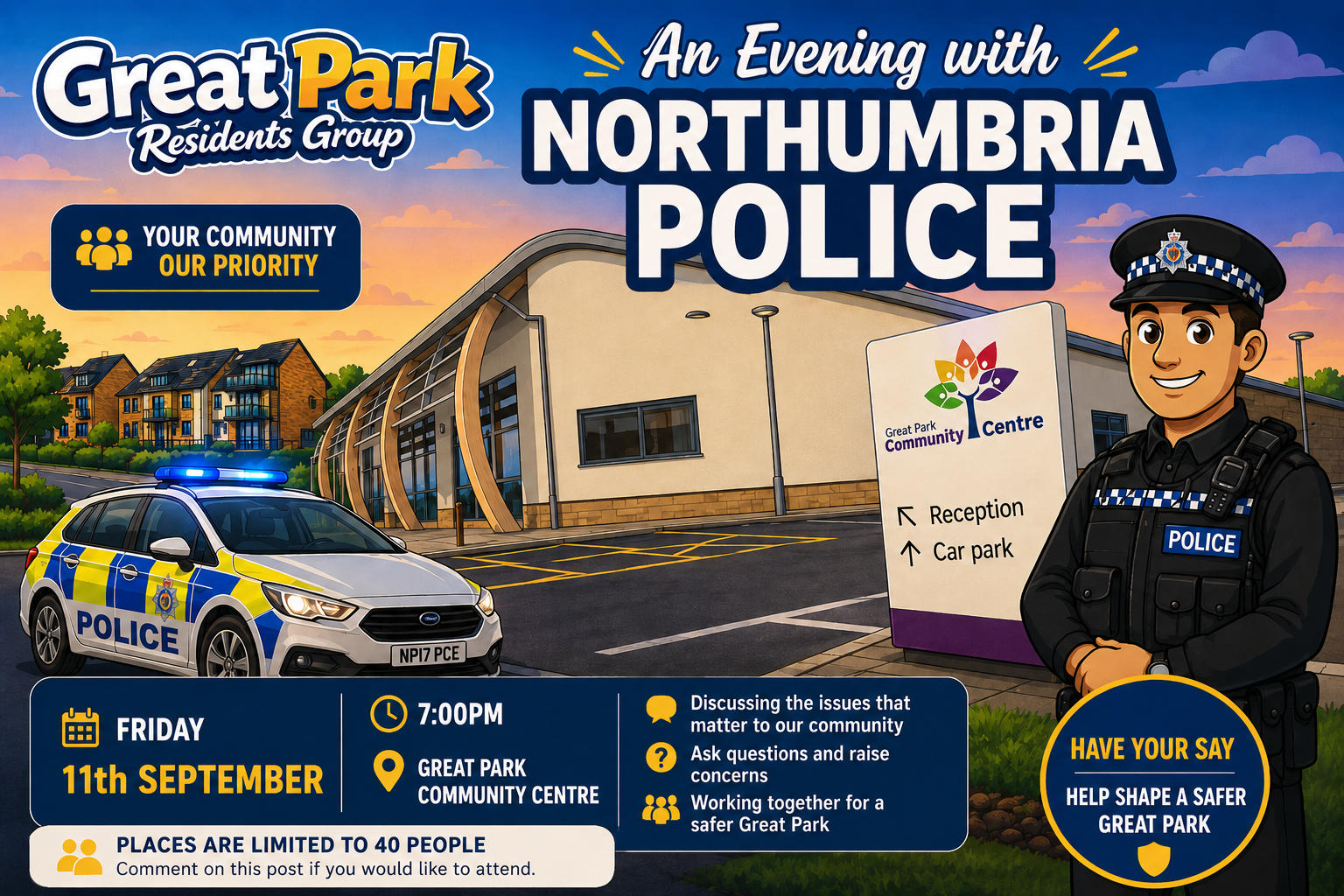
An Evening with Northumbria Police
Thank you to everyone who submitted questions for An Evening With Northumbria Police, and thank you to Northumbria Police and Newcastle City Council’s EPiC team for attending.
The event went well, but as we only had one hour, we were not able to get through every question. I have summarised the main points below.
The key message from the evening was very clear:
Please report incidents directly to the police or council.
Posting in the Facebook group is useful because it helps us spot patterns and understand what residents are experiencing, but it does not create an official police log. The police work from reported incidents, data and intelligence, so if something is not reported, it may look on paper as though it is not happening.
SUMMARY OF WHAT WAS DISCUSSED
1. Newcastle City Council’s EPiC team
The EPiC team explained that they are part of Newcastle City Council’s Community Safety Team.
EPiC stands for Empowering People in the Community, and their role is to help communities tackle anti-social behaviour issues by working with residents, rather than simply taking over responsibility from them.
They explained that their work is about collaboration, helping residents understand what they can report, how to report it, and how communities can be part of the solution.
They also explained that they can support residents with reporting issues to both the police and the council. This includes helping people understand how to use the Your Local Services website, where a wide range of issues can be reported, including things such as fly-tipping, graffiti, damaged paving and other local environmental concerns.
Their message was that residents should not feel powerless. If people see something, know something, or are affected by something, they should report it through the correct channels so it can be logged and acted on.
2. Reporting incidents
Police explained that 101 is not the only way to report non-emergency issues.
Residents can also report online or contact Northumbria Police through their social media channels, including Facebook Messenger.
Digital reporting can sometimes be quicker and allows people to send details, screenshots, photos, CCTV or extra information without waiting on the phone.
For anything urgent, ongoing, or where someone is at immediate risk, residents should call 999.
3. Why reporting matters
The neighbourhood team explained that they review logs and look for patterns. If there is evidence of repeated problems in a particular area, they can look at putting resources there.
This means the more accurate reports residents make, the stronger the case becomes for targeted action.
The police also explained that some of the figures they have cover wider beat areas which include Great Park but also surrounding areas and roads, so they are not always purely Great Park-specific. However, they did confirm that issues being discussed locally are not always filtering through as formal reports.
4. Motorbikes, e-bikes, scooters and nuisance riding
Police confirmed they are aware of concerns around nuisance bikes, scooters and e-bikes.
They explained that neighbourhood officers cannot simply chase riders if doing so would create a greater risk to the rider, the public or innocent road users. Instead, they build an intelligence picture.
The most useful information includes:
• Date and time
• Exact location
• Direction of travel
• Description of the rider
• Description of the bike
• Any distinctive clothing or features
• CCTV, dashcam or Ring doorbell footage
• Repeated patterns, such as same place and same time
They explained that action can include Section 59 warnings, and where there is enough intelligence, other police resources and tactics may be considered.
5. Do not put yourself at risk
Police were clear that residents should not put themselves in danger to get evidence.
If it is safe to take a photo or video in a public place, that can help. However, if there is any risk of confrontation, residents should step away and report it instead.
If you know there may be CCTV nearby, such as a Ring doorbell, shop camera or council camera, include that in the report so police know where potential evidence may be available.
6. Fires and incidents around the nature reserve
We discussed concerns about fires and incidents around the nature reserve.
Police explained that even if police officers do not attend and the Fire Service deals with the immediate incident, the report still matters because it creates a log.
If repeated reports show a pattern of fires or anti-social behaviour in a particular area, that can help justify more targeted patrols or further action.
7. Children, young people and parental responsibility
Police explained that where children or young people are involved in repeated anti-social behaviour, the matter is not simply ignored.
Depending on the circumstances, police can speak with parents or carers and make referrals to safeguarding, children’s services or early help teams where appropriate.
The focus is not always immediate enforcement. In many cases, early intervention and preventing escalation is the preferred approach.
8. Speeding and traffic concerns
We raised concerns about speeding and traffic around Greenside, Wagonway Drive and near the One Stop area.
Police advised that they believe they can carry out speed monitoring activity in areas accessible to the public, even where some roads have not yet been adopted by Newcastle City Council.
They explained that speedwatch-style deployments are mainly used to gather data. Drivers may receive warning letters, and if a clear pattern is shown, the information can potentially be passed to roads policing for further action, including consideration of a speed camera van.
Police cannot directly force speed bumps, double yellow lines or traffic calming measures, but data gathered by police could help support discussions with the relevant landowner, developer, consortium, council or Open Spaces.
9. Great Park Town Centre and One Stop
We also raised concerns about anti-social behaviour around Great Park Town Centre and the One Stop area.
Concerns discussed included:
• Young people throwing slate and other items
• Damage caused to vehicles
• Seed pods and berries being thrown at windows
• Staff being provoked or targeted for a reaction
• Incidents being filmed for social media
• Impact on residents in nearby apartments and flats
Police acknowledged the concerns and said they would be open to a more visible presence in the area where time and resources allow.
There was also discussion about whether council neighbourhood wardens or the EPiC team could be involved.
Again, the main message was that these incidents need to be reported directly so the scale of the problem is properly recorded.
10. Schools and engagement
Police confirmed that they do liaise with local schools where issues are identified.
They explained that they do not want every school visit to be negative or confrontational, as that can sometimes have the opposite effect. However, where there is a clear issue or a school raises concerns, police can engage with them.
11. Parish council meetings and police attendance
We also discussed how to improve attendance from Northumbria Police at parish council and community meetings.
The police explained that they do receive invites, but because of shift patterns and operational demand, they cannot always attend meetings that are fixed on a regular calendar date.
They said they would be open to sharing shift patterns where appropriate, so meetings could potentially be arranged around times when officers are more likely to be available.
The point was also made that meetings arranged in the way this event was arranged worked well: police provided available dates, the community centre availability was checked, and a date was agreed from there.
There was also discussion about police needing to remain politically neutral, so where councillors or political representatives are involved, the police would need any meeting to be a combined community meeting rather than something that appears linked to one political group or party.
Police also explained that if they cannot attend a meeting, they may still be able to provide more recent local data in advance where requested, rather than relying on information that may already be out of date.
12. Stolen items, Apple Find My and AirTags
A question was raised about stolen items where Apple Find My or an AirTag appears to show the item at an address.
Police explained that an approximate location alone does not automatically give officers the power to enter a property.
They would usually need either an immediate risk to life, a warrant, or other clear legal grounds. If there is stronger evidence, such as a known suspect, description, CCTV or other information, that may help officers take further action.
A few additional points from the evening:
Police explained that the local neighbourhood team covers a much wider area than just Great Park, including Gosforth, Great Park, the surrounding villages, areas towards Seaton Burn and towards the airport. This is around 25 square miles, so while residents may understandably want to see officers more often, the team is covering a large area with limited resources.
Police also shared that, over the previous eight weeks, the three policing beats that include Great Park had 177 jobs reported. However, this figure also includes areas such as the A1 and nearby locations, so it is not purely Great Park-specific. Of those reports, only 12 related to motorcycle, scooter or e-bike anti-social behaviour. This again highlights why direct reporting is so important, because many of the issues being discussed locally are not necessarily showing in police data.
They also explained the difference between neighbourhood policing and response policing. The neighbourhood team does not attend every emergency call. Urgent incidents are dealt with by 24/7 response officers, while the neighbourhood team focuses more on patterns, repeat issues, local intelligence, diary appointments, online reports and longer-term problem solving.
Police gave an example of how motorbike issues can be dealt with. In one case, where a bike was being seen repeatedly at similar times, officers gathered information over a period of time, identified where the person lived, and dealt with the matter safely at the address rather than chasing the rider at the time.
They also explained Section 59 warnings in more detail. These can apply to both the rider and the vehicle. If further behaviour occurs within 12 months, the vehicle can potentially be seized.
Another useful point was that residents may not always notice police activity, as officers can carry out plain-clothes patrols. Police confirmed that they had previously carried out plain-clothes patrols around the school, Morrisons and surrounding streets after information was received.
Police also said that some of the motorbike issues may involve people who do not live in Great Park, but who are using Great Park and Kingston Park as a route through the area. This is why details such as times, locations, direction of travel, descriptions and repeat patterns are so important.
Finally, there was discussion around wider ASB tools, such as dispersal or exclusion-type measures, but these depend on there being enough evidence and reported incidents to justify them. Again, the message was clear: the more residents report through the correct channels, the stronger the case for action becomes.
ACTION POINTS FOR RESIDENTS
Please report incidents directly to Northumbria Police or the council.
Use 999 if there is immediate danger or an incident is happening now.
Use 101, online reporting or Northumbria Police social media channels for non-emergency reports.
Ask for and keep any reference number you are given.
Include as much detail as possible: time, date, exact location, descriptions, direction of travel, photos, CCTV or dashcam footage.
Do not put yourself at risk or confront groups.
If you see CCTV nearby, mention this in your report.
If the issue relates to council matters such as fly-tipping, graffiti, damaged paving, highways or public spaces, report it through the council route as well.
The Great Park Residents Group will continue to collate recurring concerns and raise patterns, but residents still need to make direct reports so the official data reflects what is actually happening.
Overall, it was a positive and constructive evening. We now have a clearer understanding of how police handle these issues, what evidence they need, and why direct reporting is so important.
Thank you again to everyone who submitted questions and to those who attended.
