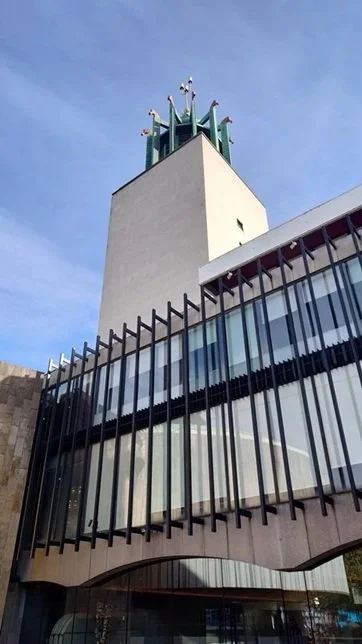
Newcastle Civic Centre
Newcastle City Council is asking residents to help shape its next budget and encouraging people across the city to “make your voice heard”.
But for residents living on privately managed and unadopted estates such as parts of Newcastle Great Park, that invitation raises an important question:
What happens when residents do speak up about an issue affecting their household finances – but receive no answer?
The Great Park Residents Group recently raised detailed concerns with Newcastle City Council about homeowners who pay full council tax while also being required to pay compulsory private estate management charges.
The group says Newcastle City Council responded to a number of other comments beneath its budget-related social media posts but did not publicly respond to the questions raised about privately managed and unadopted estates.
That does not establish that the Council has deliberately refused to engage with the issue, nor does a lack of response to a Facebook comment necessarily represent the Council’s formal policy.
However, when residents are specifically being encouraged to participate in a public conversation about council tax, spending and whether people feel they are “paying more for less”, the absence of an answer to a detailed question about this particular group of taxpayers is concerning.
Newcastle asks residents to help balance the budget
Newcastle City Council is currently running its People’s Budget exercise for 2027/28.
The consultation asks residents to consider how almost £400 million of council spending should be prioritised and what choices they would make over services and council tax.
The Council says it has had to make savings of £251 million since 2015 and continues to face pressure from inflation, rising costs and increasing demand, particularly within adult and children’s social care.
It has repeatedly said that it wants residents to influence the decisions elected councillors will eventually make.
That invitation should include residents of privately managed estates.
The issue facing Great Park residents
Many homeowners on newer housing developments are in a different position from residents living on fully adopted estates.
They pay council tax in exactly the same way as other households.
But depending on their estate arrangements, they may also be legally required to pay a private management company towards the maintenance of communal areas such as:
• green spaces
• landscaping
• roads or paths
• drainage infrastructure
• play areas
• other shared parts of the development
These payments are commonly known as estate management charges or estate rentcharges.
This does not mean residents are paying twice for every service provided by the council.
Council tax pays towards a much wider range of services including social care, children’s services, waste collection and many other statutory responsibilities.
The Great Park Residents Group has repeatedly acknowledged that point.
The concern is narrower.
Some households pay exactly the same council tax as households elsewhere while also having an additional compulsory bill relating to the environment and infrastructure immediately surrounding their homes.
There is currently no council tax discount
Government guidance is clear about the current position.
Homeowners living on privately managed freehold estates do not receive a council tax discount simply because they also pay estate management charges.
Council tax is not calculated according to the precise package of services received by an individual household.
That explains how the existing system works.
It does not necessarily answer the question residents are asking about whether that system is fair.
Four reforms proposed
Great Park Gazette has proposed four areas for reform.
They are:
• meaningful financial recognition through a council tax rebate, reduction, allowance or equivalent mechanism for households required to pay compulsory estate management charges
• stronger statutory regulation of estate management companies
• greater transparency and stronger rights for homeowners to scrutinise and challenge unreasonable charges
• a clear framework showing what remains outstanding on unadopted estates, who is responsible for completing the work and when adoption is expected to take place
The argument is not that residents of private estates should stop contributing towards social care, children’s services or the wider responsibilities of local government.
It is that the system should recognise the additional compulsory financial burden faced by some households.
Questions put to Newcastle City Council
Responding to Newcastle City Council’s People’s Budget discussion, the Great Park Residents Group asked a number of specific questions.
They included:
Has Newcastle City Council raised with Government the possibility of a council tax rebate, reduction or allowance for residents paying compulsory private estate charges?
If not, would it be prepared to do so?
Does the Council support stronger statutory regulation of private estate management companies?
And would Newcastle City Council publish clear information for unadopted residential estates explaining what remains outstanding, who is responsible for completing it and the expected timetable for adoption?
At the time of writing, the group says those questions have not received a public response from Newcastle City Council.
Screenshots of Newcastle City Council’s original Facebook post, the Great Park Residents Group’s response, and the surrounding public discussion are included below this article for readers to view in context.
Why the lack of an answer matters
There may be perfectly ordinary reasons why an individual social media comment does not receive a response.
Council social media teams cannot necessarily answer every question, and complex policy matters may require input from other departments.
A Facebook comment is also not the same thing as a formal council consultation response.
Nevertheless, this was not an unrelated complaint left beneath an arbitrary council post.
It was a detailed response to a campaign in which residents were specifically being encouraged to discuss council tax, spending and whether they believe they receive value for money.
For residents already paying both council tax and compulsory estate charges, being encouraged to “make your voice heard” and then seeing no public acknowledgement of the issue risks creating the impression that some questions are easier to engage with than others.
That is precisely why a clear answer would be useful.
This is already recognised as a national problem
The issue is not unique to Newcastle Great Park.
The Government itself has acknowledged significant problems with privately managed freehold estates.
Official government guidance recognises that homeowners on these estates can be required to contribute towards roads, open spaces and other communal areas which are not maintained by the local authority.
Government has also acknowledged that homeowners have historically had limited rights to challenge charges.
The Leasehold and Freehold Reform Act 2024 created the basis for stronger protections, including greater transparency and rights to challenge unreasonable estate management charges.
Further government consultations have examined both stronger protections for existing homeowners and ways of reducing the prevalence of private estate management arrangements altogether.
Those proposals include increasing the adoption of roads, drainage systems and green spaces by public authorities, improving transparency and considering common standards for infrastructure intended for adoption.
The national debate therefore already accepts that there is a genuine problem.
What remains unresolved is whether households paying these additional compulsory costs should receive any recognition through the council tax system.
The issue was also raised nationally
In July 2026, we wrote separately to Kemi Badenoch and Andy Burnham raising the position of residents living on privately managed and unadopted estates.
Both were asked to consider financial recognition for affected households, stronger regulation of management companies and clearer rules surrounding estate adoption.
The correspondence to Andy Burnham specifically argued that residents can find themselves paying full council tax while also paying compulsory estate charges and asked whether future council tax reform could include a meaningful reduction, rebate or allowance for affected households.
No response was received to that correspondence.
The email was sent on 14 July, shortly before Burnham became Prime Minister on 20 July 2026.
With Burnham now leading the Government, the issue ultimately sits within a political system which has the ability to pursue national reform.
Response from Kemi Badenoch’s office
A separate email was sent to Conservative leader Kemi Badenoch on the same issue.
Her office did respond.
The response did not commit the Conservative Party to introducing a council tax rebate or adopting the four proposals.
However, the Leader’s Office confirmed that the concerns had been read and understood.
It said the issue affected a growing number of homeowners and stated that fairness, transparency and value for money should be central to any solution.
We were encouraged to submit the four proposals directly to the Conservative Party’s Policy Renewal Programme so they could be considered by the team developing future policy.
Those proposals were subsequently submitted.
Does that mean only the Conservatives are willing to listen?
It would be wrong to draw that conclusion solely from this correspondence.
Only two national political offices were directly approached in the material considered by the Great Park Gazette.
The evidence therefore does not demonstrate that every other political party is unwilling to discuss the issue.
What can be said is that, of those two approaches, the Conservative Leader’s Office provided a substantive written response while no response was received from Burnham’s office.
That distinction matters.
No Conservatives currently sit on Newcastle City Council
The political picture locally is also unusual.
Newcastle City Council currently has 78 councillors.
Its current political composition is:
• Liberal Democrats – 25
• Green Party – 24
• Reform UK – 23
• Independent Group – 3
• Labour – 2
• Independent – 1
There are currently no Conservative councillors on Newcastle City Council.
The Liberal Democrats lead a minority administration, supported through a memorandum of understanding with the Green Party.
That means the local questions about council tax, estate adoption and the Council’s approach to privately managed developments ultimately need to be addressed by the parties and councillors who currently hold seats in Newcastle.
This is not about party politics
For residents affected by estate management charges, this should not become a party-political argument.
The problem has developed over many years and under governments and councils of different political colours.
Indeed, the correspondence sent to Kemi Badenoch explicitly acknowledged that successive governments have allowed the problem to develop.
What residents need now is not simply competing political claims about who is responsible.
They need answers.
Are private-estate residents a ‘cash cow’?
Some residents understandably question why they must pay full council tax while also funding private maintenance arrangements.
But there is no evidence that Newcastle City Council deliberately regards residents of privately managed estates as a “cash cow”, and it would be wrong to suggest otherwise.
The explanation is that council tax is a general tax used to fund services across the city rather than a direct charge for the maintenance of an individual estate.
However, that explanation does not make the additional private bill disappear.
For affected households, the practical reality remains:
Council tax must be paid.
The estate management charge must also be paid.
And in many cases residents have limited choice over either.
That is the fairness question at the centre of this debate.
What residents need from Newcastle City Council
A useful response from the Council would not necessarily require it to agree to a council tax rebate.
It could simply explain its position.
For example:
Does Newcastle City Council believe the present system is fair?
Would it support national financial recognition for households paying compulsory estate charges?
Has it made representations to Government on the issue?
What is its position on stronger regulation of estate management companies?
Does it support greater adoption of roads, drainage, green spaces and other infrastructure on new developments?
And can residents on each unadopted estate in Newcastle be given clear information showing what remains outstanding and who is responsible for resolving it?
An opportunity to listen
Newcastle City Council is currently asking residents to help shape its future spending priorities.
The People’s Budget consultation says residents’ views will help inform decisions for the 2027/28 budget.
That makes this an appropriate time for the concerns of residents on privately managed and unadopted estates to be acknowledged.
The Great Park Residents Group is not asking for residents to be exempted from contributing towards the wider services everyone relies upon.
It is asking whether a system in which some households pay full council tax plus compulsory private management charges deserves closer examination.
National government has already recognised many of the problems surrounding privately managed estates.
The unanswered question locally is what Newcastle City Council believes should be done about them.
When residents are being encouraged to “make your voice heard”, people living on unadopted estates should be confident that their voices are part of that conversation too.
Have your say
Newcastle City Council’s People’s Budget consultation for 2027/28 runs until 11 October 2026.
Residents wishing to ensure their views form part of the formal consultation can submit them through Newcastle City Council’s Let’s Talk Newcastle consultation service.
Great Park Gazette will update this article if Newcastle City Council publishes a response addressing the issues raised.
Sources: Newcastle City Council; GOV.UK; Ministry of Housing, Communities and Local Government; correspondence supplied to Great Park Gazette.
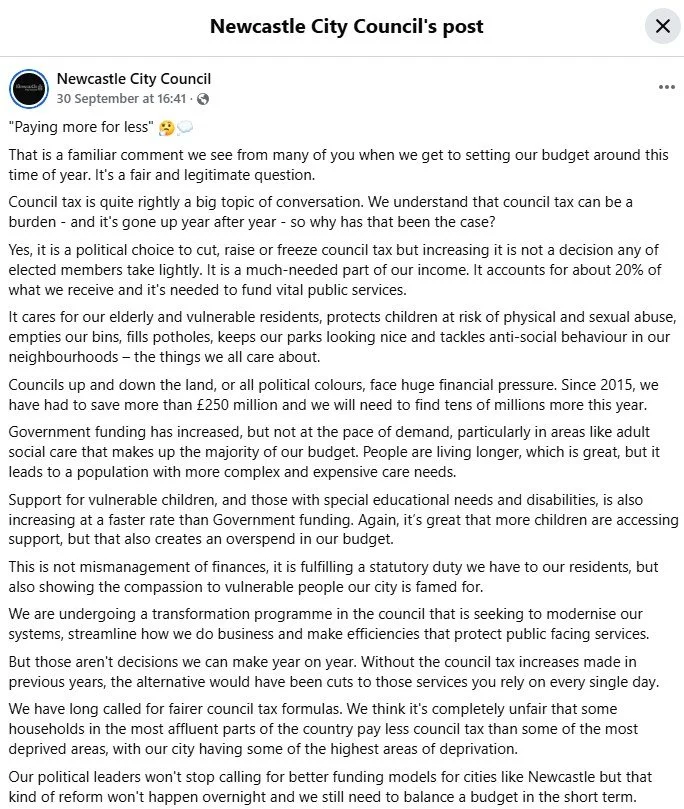
Screenshot of Newcastle City Council’s Facebook post promoting its People’s Budget consultation and asking residents for views on council tax, spending priorities and how the council should balance its budget
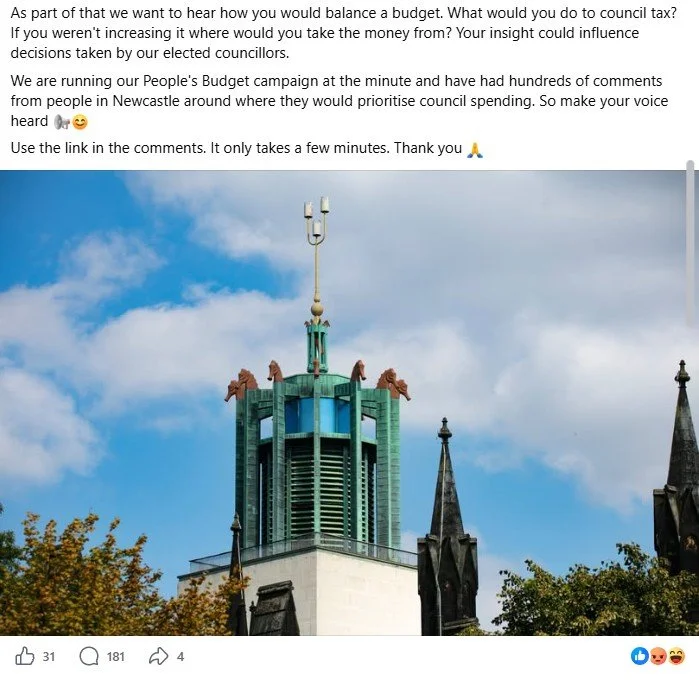
Screenshot continuing Newcastle City Council’s Facebook post promoting its People’s Budget consultation and asking residents for views on council tax, spending priorities and how the council should balance its budget
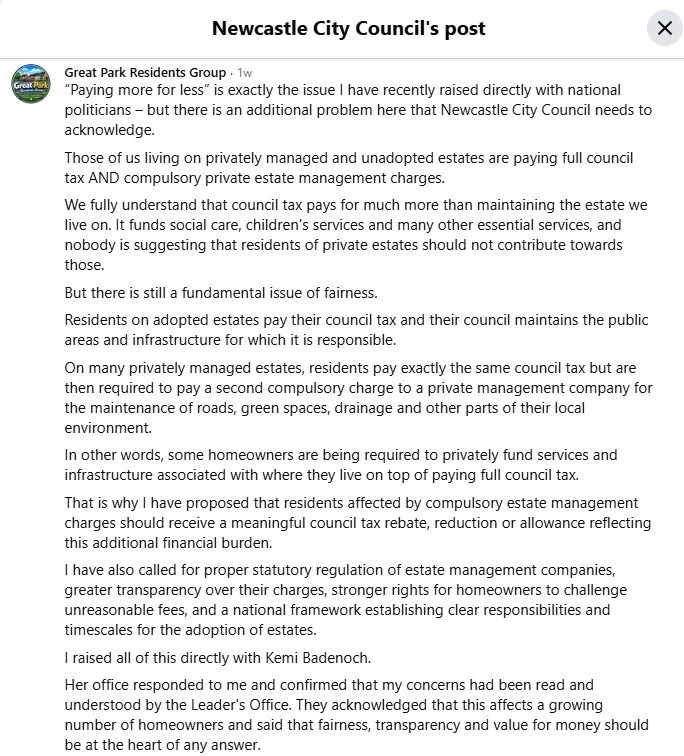
Screenshot of the Great Park Residents Group response to Newcastle City Council, raising concerns about residents who pay full council tax alongside compulsory private estate management charges on privately managed and unadopted estates
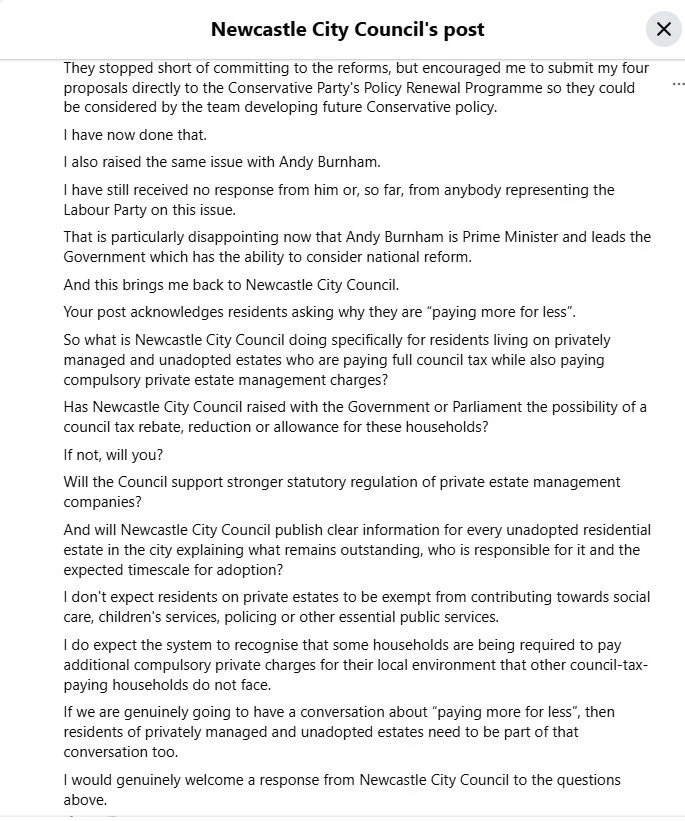
Screenshot continuing the Great Park Residents Group response, outlining proposals for council tax recognition, stronger regulation of estate management companies and greater transparency over the adoption of housing estates

