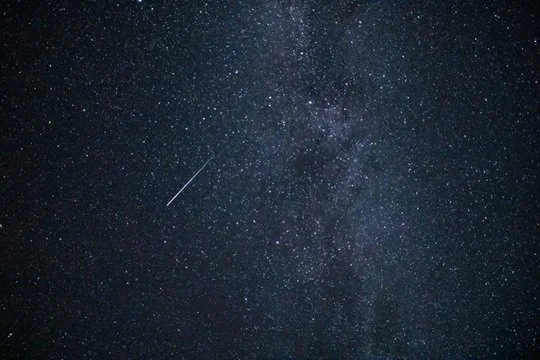
Illustrative photograph of a shooting star. Photo: Rafael Garcin / Unsplash
Residents of Newcastle Great Park could be treated to a spectacular display of shooting stars this week as the annual Orionid meteor shower reaches its peak, with up to 20 meteors an hour possible under ideal viewing conditions.
The celestial event, which occurs every October, is expected to reach its peak overnight on Wednesday 21 October and into the early hours of Thursday 22 October 2026.
And the good news for local astronomy enthusiasts is that there is no need to travel to a specialist observatory or purchase expensive equipment to enjoy it.
Weather permitting, residents should have an opportunity to spot meteors from Newcastle Great Park itself, particularly in locations offering clear views of the night sky away from bright streetlights.
However, cloud cover, moonlight and light pollution will all influence how many shooting stars are actually visible.
When is the best time to watch from Great Park?
The Orionid meteor shower is active from 2 October until 7 November, but its peak is expected overnight on Wednesday 21 October into Thursday 22 October.
According to NASA and the Royal Observatory Greenwich, the shower typically produces around 10 to 20 meteors per hour under favourable viewing conditions.
The best time to watch is generally after midnight and before dawn, when the constellation Orion climbs higher into the sky.
This year, however, the Moon will make observing the display slightly more challenging.
On Wednesday evening, the Moon will be in its waxing gibbous phase, meaning a large proportion of its surface will be illuminated.
The resulting moonlight can make fainter meteors much harder to see.
For residents in Newcastle Great Park, the Moon is expected to set at approximately 2:49am on Thursday 22 October.
This means that the period from around 3am until the approach of dawn could offer some of the best opportunities to see the shower, provided the sky is sufficiently clear.
Of course, residents who would rather not stay up until the early hours may still have a chance to see brighter meteors earlier in the night.
Can you see the meteor shower from Newcastle Great Park?
Yes. The Orionid meteor shower is visible across the UK, including Newcastle Great Park and the wider North East.
Unlike some astronomical events, which require specialist equipment or exceptionally dark skies, meteors can often be seen with the naked eye.
Great Park's residential areas, open spaces and surrounding countryside may offer opportunities to watch the display.
However, residents should be aware that artificial lighting from houses, streetlights and nearby roads can reduce visibility.
For the best chance of spotting meteors, try to find a safe, accessible location with an unobstructed view of a large section of the sky.
An open garden or another suitable outdoor space away from bright lighting may provide a better view than a heavily illuminated street.
You do not need to stand in complete darkness, but the less artificial light around you, the easier it should be to see fainter shooting stars.
Residents should stick to accessible public areas or places where they have permission to be, and avoid isolated or unsafe locations late at night.
What exactly is the Orionid meteor shower?
Although commonly referred to as shooting stars, meteors are not actually stars.
They are small particles of space dust and debris that enter Earth's atmosphere at extremely high speeds.
As they travel through the atmosphere, the particles become intensely hot and produce bright streaks of light across the sky.
The Orionids are particularly special because their origins can be traced back to one of the most famous comets in the solar system: Halley's Comet.
As Halley's Comet travels around the Sun, it leaves behind a trail of dust and small particles.
Each year, Earth passes through part of this debris stream.
Some of the particles enter our atmosphere, creating the annual Orionid meteor shower.
Halley's Comet itself takes approximately 76 years to complete one orbit around the Sun, with its next expected return to the inner solar system in 2061.
Fortunately, residents do not have to wait until then to see something connected with this famous celestial visitor.
The Orionids offer an annual reminder of the comet's journey through space.
Some meteors travel at 41 miles per second
One of the most remarkable features of the Orionids is their incredible speed.
According to NASA, Orionid meteors enter Earth's atmosphere at approximately 41 miles per second, equivalent to around 66 kilometres per second.
Despite their speed, some leave glowing trails that remain visible for several seconds after the meteor itself has disappeared.
Occasionally, particularly bright meteors known as fireballs can illuminate a substantial section of the night sky.
These are among the most exciting sights for meteor watchers.
However, it is important to remember that meteor showers are unpredictable.
The estimate of 10 to 20 meteors per hour refers to favourable conditions, generally involving clear skies, minimal light pollution and an unobstructed view.
Residents watching from a built-up area such as Newcastle Great Park may see considerably fewer.
There may also be lengthy gaps between individual meteors.
Patience is therefore an important part of the experience.
Where should you look?
The Orionids take their name from the constellation Orion, one of the most recognisable groups of stars in the night sky.
Orion is particularly distinctive because of the three bright stars forming Orion's Belt.
The meteors appear to originate from a point close to the constellation, known as the radiant.
However, this does not mean that every meteor will appear directly within Orion.
In fact, shooting stars can streak across almost any part of the sky.
For residents watching from Great Park, looking towards the southern half of the sky during the early hours may help, but the most effective approach is to take in as wide an area of sky as possible.
NASA recommends looking slightly away from Orion rather than concentrating exclusively on the constellation.
This can make the longer meteor trails easier to spot.
There is no need for binoculars or a telescope.
In fact, these can make meteor watching more difficult because they restrict the amount of sky you can see at once.
Five tips for watching the meteor shower
If you're planning to watch the Orionids from Newcastle Great Park, a little preparation could make the experience more enjoyable.
1. Find somewhere with less light pollution
Choose a safe location away from bright streetlights, outdoor security lighting and other sources of artificial light.
2. Give your eyes time to adjust
Allow approximately 20 to 30 minutes for your eyes to become accustomed to the darkness.
Try to avoid looking at your mobile phone screen during this time.
3. Look at a wide area of sky
The meteors may appear anywhere overhead, so don't concentrate on one tiny area or rely solely on spotting Orion.
4. Wrap up warm
October nights in Newcastle can be chilly, especially when standing or sitting outside for long periods.
Warm clothing, suitable footwear and a blanket or comfortable chair can make the experience more enjoyable.
5. Be patient
Meteor showers do not produce shooting stars at regular intervals.
You might see several within a few minutes and then nothing for a while.
Allow yourself plenty of time to watch.
Will the weather cooperate?
Unfortunately, the biggest challenge for North East stargazers could be the weather.
Forecasts for this week indicate unsettled conditions across parts of the UK, with rain, strong winds and cloud potentially affecting visibility.
Even when a meteor shower is at its peak, thick cloud can completely prevent residents from seeing the display.
However, breaks in the cloud may still provide opportunities to spot brighter meteors.
Residents hoping to watch on Wednesday night or Thursday morning should check the latest Newcastle weather forecast before heading outside.
It is also worth remembering that the Orionids do not disappear immediately after their peak.
The shower remains active until 7 November 2026, meaning there may be further opportunities to see meteors if viewing conditions improve.
Although meteor numbers are generally expected to be lower away from the peak, a clear night could still provide an enjoyable experience.
A chance for Great Park families to enjoy the night sky
Events such as the Orionid meteor shower offer a reminder that some of nature's most impressive spectacles can be enjoyed without travelling far from home.
For families in Newcastle Great Park, meteor watching can also provide an opportunity to introduce children to astronomy and encourage an interest in science and the natural world.
Those with younger children may prefer an earlier evening viewing session, even though the most favourable conditions are expected later.
Older children and adults who are happy to stay up might have a better chance of seeing the shower during the early hours of Thursday morning.
Whatever time you choose, there is no guarantee of seeing a shooting star.
But on a clear night, the possibility of watching a tiny piece of debris from Halley's Comet streak across the sky is something special.
Will you be watching from Great Park?
The Orionid meteor shower reaches its peak overnight on Wednesday 21 October into Thursday 22 October 2026.
With up to 20 meteors per hour possible under ideal conditions, residents across Newcastle Great Park and the North East could be treated to an impressive astronomical display.
The best local viewing opportunity is expected to be during the early hours of Thursday morning, particularly after the Moon sets at approximately 2:49am.
However, clear skies will be essential.
The Great Park Gazette would love to hear from residents who manage to spot the Orionids.
If you capture any photographs or videos of the meteor shower from Newcastle Great Park, why not share them with the Great Park Residents Group?
We would love to feature some of the best local photographs and help celebrate another wonderful sight in the skies above our community.
Sources and further information
NASA – Orionids meteor shower
https://science.nasa.gov/solar-system/meteors-meteorites/orionids/
NASA – October 2026 skywatching guide
https://science.nasa.gov/solar-system/whats-up-october-2026-skywatching-tips-from-nasa/
Royal Observatory Greenwich – Orionid meteor shower 2026
https://www.rmg.co.uk/stories/space-astronomy/orionid-meteor-shower-2026-when-where-see-it-uk
Time and Date – Newcastle upon Tyne Moon times, October 2026
https://www.timeanddate.com/moon/uk/newcastle-upon-tyne?month=10

