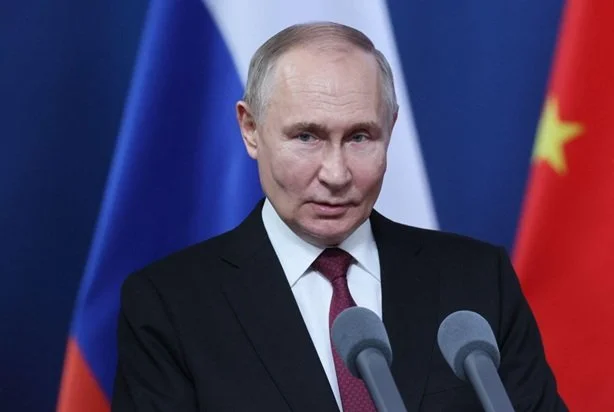
Russian President Vladimir Putin speaking at a forum in Harbin, China, in May 2024. Putin has issued fresh warnings about the possibility of conflict between Russia and Europe, raising concerns about European security. File photograph: Russian Presidential Executive Office / Kremlin.ru, via Wikimedia Commons
Russian President Vladimir Putin has issued a fresh warning to European countries, declaring that Moscow is prepared for war while insisting it does not want a conflict. As tensions continue over Ukraine and security in the Baltic Sea, Great Park Gazette examines what has been said and what it means for households in Newcastle and the wider North East.
Russian President Vladimir Putin has warned that a military confrontation between Russia and Europe could have devastating consequences, telling Western countries that Moscow is ready for war if a conflict develops.
The remarks were made on Thursday 29 October 2026 during a Russia–Africa summit in Moscow, amid continuing tensions between Russia, Ukraine and NATO.
Putin said Russia was prepared for a possible conflict with Europe, although he maintained that Moscow did not want one.
He also warned that if tensions escalated too far, there would be no winners.
The comments have attracted international attention and raised questions about European security, particularly as Russia's war in Ukraine continues and concerns grow over the possibility of wider confrontation.
But what does this actually mean for people living in Newcastle Great Park, Newcastle upon Tyne and the wider North East?
What exactly has Vladimir Putin said?
Speaking at the summit in Moscow, Putin referred to discussions among European countries about strengthening their armed forces and preparing for potential threats later this decade.
He said Russia was ready for a conflict if one developed, but insisted that his government did not seek war with Europe.
The Russian president warned:
“If things go too far, there will be no winners at all.”
He also claimed Western efforts to weaken Russia strategically had failed and suggested that European military planning for the period leading up to 2030 was increasing tensions.
These were statements by the Russian president, rather than independently established conclusions about Western intentions.
Importantly, Putin did not announce that Russia had declared war on Britain or another NATO country.
His comments nevertheless form part of a wider pattern of military warnings and increasingly strained relations between Moscow and Western governments.
Why is Russia talking about war with Europe?
Relations between Russia and European countries have deteriorated substantially since Russia launched its full-scale invasion of Ukraine in February 2022.
The United Kingdom and other NATO members have provided military, financial and humanitarian support to Ukraine, while imposing sanctions on Russia.
Moscow has repeatedly criticised NATO's military assistance to Ukraine and the alliance's activities in Eastern Europe.
Meanwhile, European governments have expressed concern about Russia's military capabilities, incursions into allied airspace, suspected sabotage operations and cyber activity.
On 26 October 2026, defence ministers from Britain, France, Germany, Italy and Poland issued a joint statement identifying Russia as a major long-term threat to European security.
They referred to the war in Ukraine, violations of allied airspace and the growing use of hybrid tactics, which can include cyberattacks, sabotage and other activities intended to cause disruption without conventional warfare.
The latest comments from Putin therefore come against an already tense international backdrop.
Why has the Baltic Sea been mentioned?
Another important part of Putin's remarks concerned the Baltic Sea, which borders several NATO countries as well as Russia.
The region includes important shipping routes, energy infrastructure and communication cables.
Putin warned against a situation developing in the Baltic comparable to disruption in the Strait of Hormuz, a strategically important shipping route in the Middle East.
His remarks have raised concerns about the wider consequences of any future confrontation involving shipping or critical infrastructure.
However, mentioning the possibility of disruption is not the same as announcing that such action has begun.
The Baltic Sea remains strategically important to European trade and security, and any serious disruption there could have repercussions beyond the countries directly involved.
What does this mean for Newcastle Great Park?
For residents of Newcastle Great Park, the most important distinction is between an international security warning and an immediate local threat.
There is no evidence in the information currently available that Newcastle Great Park has been singled out as a target or that residents face an imminent military attack.
Putin's comments were directed towards European governments and NATO more broadly.
Although the United Kingdom is a NATO member and therefore involved in collective defence arrangements, this does not mean that war has begun or that an attack on Britain is expected immediately.
On 14 October, NATO Secretary General Mark Rutte publicly stated that the alliance saw no imminent threat to NATO territory.
He also emphasised NATO's defensive responsibilities and its commitment to protecting member countries.
For Great Park residents, the developments are therefore best understood as part of a significant international security situation that governments continue to monitor, rather than as a reason for immediate alarm.
Could tensions affect household bills and fuel prices?
One possible concern for Newcastle families is whether continuing international tensions could affect the cost of living.
Disruption to major international shipping routes, energy supplies or trade can contribute to fluctuations in oil, gas and transport costs.
These wider pressures can eventually affect household energy bills, petrol and diesel prices, food distribution and the prices businesses pay for imported goods.
Residents across Newcastle Great Park have already experienced substantial changes in household costs in recent years, making international economic developments particularly relevant.
However, there is no evidence that Putin's latest statement has, by itself, caused a specific increase in fuel prices or household bills in Newcastle.
Any future economic effects would depend on what actually happens next, including decisions taken by governments, international markets and businesses.
It is important not to confuse a warning about a potential conflict with an event that has already disrupted supplies.
What is NATO, and why does Britain matter?
The United Kingdom is a founding member of the North Atlantic Treaty Organization, commonly known as NATO.
The alliance is based on the principle of collective defence.
Under Article 5 of the North Atlantic Treaty, an armed attack against one member is considered an attack against all.
This means NATO countries have committed to assisting one another if a member experiences an armed attack.
However, it does not mean that every threatening statement, diplomatic dispute or security incident automatically results in military action.
The precise response to an incident depends on its circumstances and decisions made by member countries.
NATO maintains that it is a defensive alliance, established to protect its members and discourage military aggression.
The UK's membership is one reason why warnings about European security are relevant to people throughout Britain, including those living in Newcastle and the North East.
What about cyberattacks and disruption to everyday services?
Military conflict is not the only concern associated with worsening international relations.
British authorities have previously warned about cyber activity linked to Russian state-aligned groups.
In January 2026, the UK's National Cyber Security Centre warned that such groups were targeting organisations including local authorities and operators of important infrastructure.
These attacks can be designed to interrupt online services or disrupt computer systems.
This does not establish that Newcastle City Council, Great Park businesses or local services are currently being targeted by a particular operation.
It does, however, explain why the government considers the protection of essential services, including communications and energy infrastructure, an important part of national security.
Should Great Park residents be preparing for an emergency?
The government has recently updated its general advice on household emergency preparedness.
On 22 October 2026, a week before Putin's latest remarks, the Cabinet Office announced its new Be Ready campaign.
The guidance is intended to help households prepare for ordinary emergencies and disruptions, including severe weather, power cuts, water interruptions and problems with mobile or internet services.
It was not introduced in response to Putin's comments on 29 October.
The advice includes straightforward steps such as:
Keeping a torch, spare batteries and a charged power bank available.
Making sure essential medication and important contact details are accessible.
Having some bottled water and non-perishable food at home where affordable.
Discussing with family members how to contact one another during a prolonged power cut.
Checking whether elderly or vulnerable neighbours might need additional assistance.
Signing up for the Priority Services Register if someone in the household requires additional support from utility providers.
These measures are useful for many situations, particularly storms and service outages, and do not indicate that the government expects an imminent war in Britain.
Residents can read the official guidance at:
https://prepare.campaign.gov.uk/get-prepared-for-emergencies/
Why reliable information matters
International security stories often attract dramatic headlines, particularly when political leaders discuss possible warfare.
For residents reading such reports, it is worth distinguishing between four different things:
A political warning: A statement intended to communicate a government's position or discourage an adversary.
Military preparedness: Governments investing in armed forces and preparing for possible future scenarios.
An imminent threat: Credible information suggesting an attack may happen in the near future.
An actual military attack: Hostilities that have begun.
These are not interchangeable.
Putin's latest speech represents a serious warning, but it should not be interpreted as confirmation that Britain is about to enter a war.
Official statements from the UK government and NATO remain important sources of information when assessing developments.
What happens next?
The situation remains dependent on political and military decisions taken by Russia, Ukraine, European governments and NATO.
Future developments could include diplomatic talks, further military warnings, changes in defence policy or additional security measures.
The British government and its European partners continue to emphasise the importance of supporting Ukraine, strengthening national security and maintaining the collective defence of NATO member states.
Whether the latest exchange of warnings develops into further confrontation or renewed diplomacy cannot yet be determined.
For people in Newcastle Great Park, the sensible approach is to remain informed through reliable sources without assuming the worst.
Great Park Gazette: Keeping residents informed
Although the latest warning was made thousands of miles away in Moscow, decisions affecting European security can have wider consequences for Britain.
This is why Great Park Gazette will continue to cover major national and international developments where they have a meaningful connection to the lives of Newcastle Great Park residents.
At present, Putin's latest comments do not establish any immediate danger to the Great Park community.
They do, however, highlight the continuing tensions surrounding the war in Ukraine, the future of European security and the importance of preventing further escalation.
For residents, the message is to stay informed, understand the facts and avoid unnecessary alarm.
Further information
UK Government – Be Ready emergency preparedness:
https://prepare.campaign.gov.uk/
NATO – Collective defence and Article 5:
https://www.nato.int/en/what-we-do/introduction-to-nato/collective-defence-and-article-5
National Cyber Security Centre:
https://www.ncsc.gov.uk/
UK Government – European defence ministers' statement, 26 October:
https://www.gov.uk/government/news/e5-defence-ministers-statement-26-october-2026
Published Thursday 29 October 2026.
Sources: Reports of Vladimir Putin's remarks at the Russia–Africa summit, NATO, UK Ministry of Defence, National Cyber Security Centre and Cabinet Office.

