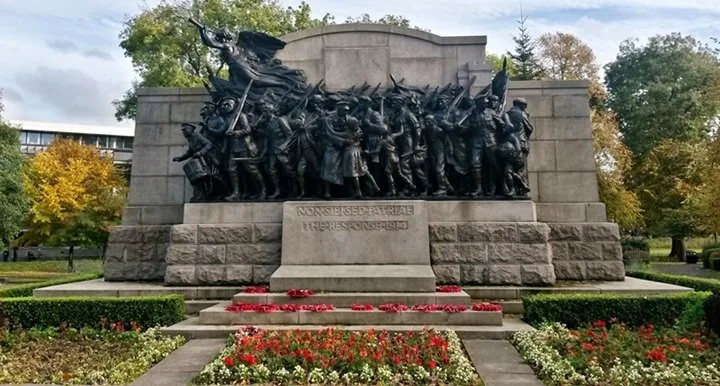
The Response, Newcastle's Northumberland Fusiliers War Memorial, commemorates the service and sacrifice of those who answered the call during the First World War. On Remembrance Sunday 2026, Great Park Gazette joins communities across Newcastle and the North East in honouring those who lost their lives in conflict. Photograph: Chabe01 / Wikimedia Commons
On this Remembrance Sunday, 8 November 2026, we pause from our everyday lives to remember those who never came home.
The sons and daughters who never returned to their parents.
The husbands and wives who never came back to their partners.
The mothers and fathers whose children grew up without them.
The brothers, sisters, friends and neighbours whose lives were cut short by war.
Behind every name engraved on a war memorial was a real person. Someone with hopes for the future, people they loved and a life they hoped to return to.
Today, we remember them.
We also remember the countless families who waited for news that would never bring their loved ones safely home, and those whose lives were forever changed by the physical and emotional consequences of conflict.
Their courage, their service and their sacrifice must never be forgotten.
Remembering Those Who Never Came Home
Remembrance Sunday is one of the most significant occasions in the British calendar.
It is a day when people of different ages, backgrounds, beliefs and generations come together in a shared act of remembrance.
Our thoughts turn to the millions of people affected by the First and Second World Wars and the many conflicts that have followed.
We remember soldiers who fought on distant battlefields, sailors who served at sea and aircrew who flew dangerous missions.
We remember military nurses, medics and support personnel who worked in extraordinary circumstances to save lives.
We remember those who died serving in the Armed Forces, those who returned with lifelong injuries, and those who carried memories of war long after the fighting ended.
And we remember the civilians whose lives were lost or devastated by bombing, persecution, displacement and the destruction of their communities.
War does not affect only those who wear a uniform.
Its consequences reach into homes, families and communities, often continuing for generations.
Remembrance Sunday gives us a moment to recognise the human cost behind the history books, memorials and military ceremonies.
The Sacrifices That Shaped Our Country
For many people living today, the First and Second World Wars are events learned about at school or remembered through family stories.
But for those who lived through them, they were not distant chapters of history.
They were years of fear, uncertainty, loss and extraordinary hardship.
During the First World War, young men left towns and villages across Britain to serve in a conflict that would claim millions of lives.
The North East contributed thousands of servicemen, including those serving with the Northumberland Fusiliers and other regiments connected to the region.
Many were ordinary people before the war.
They were miners, railway workers, factory employees, apprentices, students, shopkeepers and members of families much like our own.
Some were barely adults when they left home.
Many never returned.
A generation later, the Second World War brought further suffering.
Families experienced separation, rationing, bombing, bereavement and anxiety for loved ones serving overseas.
Women and men worked in factories, hospitals, essential services and other roles vital to the war effort.
Service personnel from Britain and across the Commonwealth contributed to the struggle, often at enormous personal cost.
Remembering these events does not mean glorifying war.
It means recognising what people endured, the lives that were lost and the importance of working towards a future in which such suffering is not repeated.
The North East's History of Service and Sacrifice
Newcastle and the wider North East have a long history of military service.
Generations of local men and women have served in the Army, Royal Navy, Royal Air Force and other roles supporting the Armed Forces.
Regiments with strong regional connections became part of the identity of local communities.
During the World Wars, families across Newcastle, Northumberland, Durham and Tyneside experienced the loss of loved ones.
Many communities erected memorials after the First World War to ensure the names of those who had died would not disappear from public memory.
Those memorials remain important today.
They connect modern communities with people whose lives were lost more than a century ago.
They also remind us that the effects of war were felt not only on distant battlefields but in streets, workplaces and homes throughout our region.
Newcastle's War Memorial: More Than a Monument
One of Newcastle's most important places of remembrance is the War Memorial in Old Eldon Square.
Standing at the heart of the city, it has provided a place for people to honour the fallen for more than 100 years.
The memorial was unveiled on 26 September 1923, just five years after the Armistice that brought the fighting of the First World War to an end.
Thousands of local residents gathered to witness its unveiling.
The monument was funded with the help of public donations, including contributions of a shilling from ordinary Newcastle residents.
Many of those attending the ceremony had personally experienced the loss of a relative, friend or colleague.
For families whose loved ones had been buried overseas, or whose remains had never been recovered, the memorial provided somewhere close to home to grieve and remember.
More than a century later, it continues to serve that purpose.
Today, the same memorial will once again become the centre of Newcastle's Remembrance Sunday commemorations.
Its continued importance is a reminder that while generations change, the obligation to remember remains.
Newcastle Comes Together on Remembrance Sunday
Newcastle City Council has organised its annual military parade and Service of Remembrance for Sunday 8 November 2026.
Members of the Armed Forces, veterans, cadets, uniformed services and the Royal British Legion will come together alongside civic representatives and members of the public.
The parade is scheduled to leave Newcastle Civic Centre at 10:30am, accompanied by the Band of the Royal Regiment of Fusiliers.
It will travel along Percy Street and Blackett Street before assembling at the War Memorial in Old Eldon Square.
The service will be led by the Bishop of Newcastle, the Right Reverend Dr Helen-Ann Hartley.
The Lord Mayor of Newcastle, Councillor Henry Gallagher, will join those paying tribute.
At 11am, the Last Post will herald the beginning of the national two-minute silence.
For two minutes, the city and communities across the country will pause.
Afterwards, wreaths will be laid in remembrance of those who served and those who died.
The ceremony is open to everyone who wishes to pay their respects.
Whether people have a personal family connection to the Armed Forces or simply wish to remember the fallen, they are welcome to take part.
Why Do We Fall Silent at 11am?
The two-minute silence is one of the most recognisable traditions associated with remembrance.
Its origins lie in the end of the First World War.
On 11 November 1918, the Armistice between the Allies and Germany came into effect at 11am, bringing the fighting on the Western Front to an end.
The following year, the first national two-minute silence was observed to remember those who had died.
The tradition continues today.
At 11am on Remembrance Sunday, and again on Armistice Day itself, people across the country are invited to pause for two minutes.
There is no requirement to attend a ceremony.
People can observe the silence at home, in their workplace, at a place of worship, in a public space or wherever they happen to be.
For those who have lost a family member through military service, the silence may be deeply personal.
For others, it is an opportunity to think about people they never knew but whose sacrifices are part of our shared history.
Two minutes might seem a small amount of time.
But the act of stopping, reflecting and remembering carries enormous meaning.
Why We Wear the Red Poppy
In the weeks leading up to Remembrance Sunday, millions of people across Britain wear red poppies.
The poppy became a symbol of remembrance following the First World War.
In the devastated battlefields of northern France and Belgium, poppies grew among land disturbed by the fighting.
Their appearance inspired the famous poem In Flanders Fields, written in 1915 by Canadian military doctor John McCrae.
The flower subsequently became associated with remembering those who had died.
The first British Legion Poppy Appeal took place in 1921, raising funds to support former servicemen and their families.
Today, the Royal British Legion continues that work through its annual appeal.
The poppy is a symbol of remembrance, reflection and hope for peace.
Choosing to wear one is personal.
What matters most is understanding the lives and sacrifices behind the tradition.
Remembering Those Who Returned
Remembrance Sunday is not only about those who died.
It is also a time to acknowledge veterans who returned from conflict carrying injuries, trauma, grief or other lasting consequences of their service.
For some, the effects of war are visible.
For others, the difficulties may be less apparent.
Families can also experience the consequences of military service through long separations, caring responsibilities and bereavement.
The Armed Forces community includes serving personnel, veterans, reservists and families who continue to make significant commitments today.
Recognising those sacrifices means remembering that support and gratitude should extend beyond a single Sunday in November.
Organisations such as the Royal British Legion provide assistance to members of the Armed Forces community throughout the year.
What Remembrance Means for Newcastle Great Park
Newcastle Great Park is a relatively young residential community.
Many of our streets, homes and public spaces did not exist during the World Wars.
But the history we remember today belongs to all generations, including those of us living in newer communities.
Among our neighbours will be people whose parents, grandparents or great-grandparents served in the Armed Forces.
There may be veterans living in Great Park today, families with relatives currently serving and others who have experienced the loss of someone in military service.
For some residents, Remembrance Sunday will bring back personal memories.
For others, it may be a time to share family stories with children who are learning about the past.
We do not all have the same experiences of remembrance.
But we can come together in respect for those who suffered and died, and in recognition of the importance of peace.
A community's history is not only the history of its buildings and streets. It is also the history carried by the people who live there.
Teaching Future Generations Why We Remember
As time passes, fewer people remain who can speak from first-hand experience of the Second World War.
That makes the work of remembrance increasingly important.
Children growing up today may not have a living relative who can tell them what it was like to experience wartime Britain.
Schools, museums, memorials and family stories therefore play an important role in keeping those experiences alive.
Remembering the past is not simply about memorising dates or learning the names of battles.
It is about understanding the impact of war on individual lives.
Behind the statistics were children who lost parents, parents who lost children and communities who lost friends and neighbours.
By telling their stories, we help ensure that future generations recognise both the importance of remembrance and the value of peace.
A Moment for Reflection, Gratitude and Peace
Remembrance Sunday can mean different things to different people.
For some, it is a day of sorrow.
For others, it is a time of gratitude, pride, reflection or private prayer.
For many, it is all of these things.
There is no single way to remember.
Some will stand beside a war memorial.
Others will place a poppy wreath, attend a service or observe the silence from home.
Some will think about a particular person whose absence is still felt by their family.
Others will remember the many people whose names and stories are now known only through historical records.
All are acts of remembrance.
What unites them is the recognition that war carries a terrible human cost.
It is possible to honour those who served while also hoping that future generations will never face the same suffering.
Indeed, the hope for a more peaceful future is one of the most important reasons to remember.
Lest We Forget
Today, Great Park Gazette pays tribute to all those who lost their lives in the service of their country, those who suffered as a consequence of war, and the families who endured unimaginable loss.
We remember the men and women who left their homes not knowing whether they would ever return.
We remember those who fought, those who cared for the wounded and those who supported the war effort.
We remember the innocent civilians caught in conflicts they did not choose.
We remember veterans whose sacrifices continued long after their service ended.
And we remember the families who have carried their loved ones' memories through the generations.
To everyone in Newcastle Great Park and the wider North East observing Remembrance Sunday, we invite you to join the nation in a moment of reflection.
At 11am today, please pause for two minutes to remember those who gave so much.
Not because we can ever fully repay their sacrifice.
But because we can ensure that their lives and their stories are not forgotten.
We will remember them.
Lest we forget. 🌺
Remembrance Dates in 2026
Sunday 8 November 2026 – Remembrance Sunday
Newcastle's main parade and Service of Remembrance take place in the city centre, with a national two-minute silence at 11am.
Wednesday 11 November 2026 – Armistice Day / Remembrance Day
The anniversary of the 1918 Armistice will be marked by another two-minute silence at 11am.
Sources and Further Reading
Newcastle City Council – Newcastle Remembers: Honouring Lives, Service and Sacrifice
https://new.newcastle.gov.uk/news/2026/newcastle-remembers-honouring-lives-service-and-sacrifice
Newcastle City Council – History of Old Eldon Square War Memorial
https://new.newcastle.gov.uk/news/2023/newcastle-commemorate-war-memorial-centenary
The Royal British Legion – Two-Minute Silence
https://www.britishlegion.org.uk/get-involved/remembrance/two-minute-silence
The Royal British Legion – The Poppy and Remembrance
https://www.britishlegion.org.uk/get-involved/remembrance/the-poppy
Commonwealth War Graves Commission
Great Park Gazette – Newcastle's Remembrance Sunday Parade and Service 2026
https://www.greatparkgazette.co.uk/news/newcastle-remembrance-sunday-parade-service-2026

