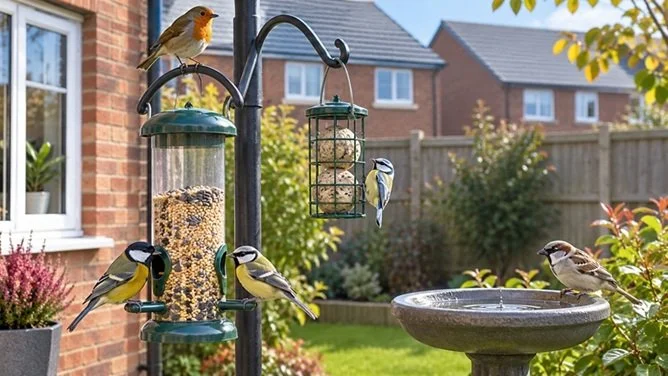
Garden birds, including a robin, sparrow, blue tit and great tits, visiting hanging seed and suet feeders and a bird bath in a residential garden, similar to those found across Newcastle Great Park. The RSPB's updated guidance encourages residents to feed birds safely during winter, clean feeders weekly and replace bird-bath water daily to help prevent the spread of disease. Illustration: Great Park Gazette
For many households in Newcastle Great Park, watching birds visit the garden is one of the pleasures of everyday life.
From house sparrows gathering around feeders to robins, blue tits, blackbirds and goldfinches, garden birds bring life and colour to our outdoor spaces throughout the year.
As colder weather approaches, many residents will be refilling feeders with seeds, peanuts and fat balls to help birds find enough food.
However, the Royal Society for the Protection of Birds (RSPB) has updated its advice on how people should feed garden birds.
The guidance, published on 30 October 2026, follows research into the spread of a disease called trichomonosis, which has had a devastating impact on some British bird populations.
The message is straightforward: feed birds seasonally and feed them safely.
And with November now underway, there are several important things Great Park residents should know.
Can You Still Feed Garden Birds This Winter?
Yes. The RSPB says November to April is the appropriate time to provide a full range of bird food.
Between 1 November and 30 April, residents can offer:
Bird seed and suitable seed mixes
Sunflower hearts and other bird-friendly seeds
Unsalted peanuts in appropriate feeders
Suet pellets, cakes and fat balls
Mealworms
Natural food can be harder for birds to find during winter and early spring, particularly when temperatures drop.
According to the RSPB, the risk of trichomonosis spreading is also lower during these colder months, meaning the benefits of supplementary feeding generally outweigh the risks when it is done properly.
For Great Park residents who have been wondering whether they should stop feeding birds altogether, the answer is reassuring.
There is no general recommendation to stop feeding birds during the winter months.
Instead, residents should pay particular attention to feeder hygiene, the type of feeder they use and how much food they provide.
Why Has the RSPB Changed Its Advice?
The updated guidance is intended to reduce the spread of trichomonosis, an infectious disease caused by a parasite.
The disease affects a bird's throat and digestive tract, making it difficult for infected birds to swallow food.
Affected birds can regurgitate food that is then eaten by other birds, allowing the parasite to spread.
Communal feeding areas can therefore become places where infection passes between birds.
The disease is particularly concerning for finches, including greenfinches and chaffinches, although other species, including house sparrows, can also be affected.
The RSPB reports that the UK's greenfinch population has declined by approximately 65% over the past three decades.
Greenfinches were once among the birds most frequently recorded during the charity's Big Garden Birdwatch.
In 2026, they ranked 18th in the survey, compared with seventh when the event began in 1979.
Scientists have linked trichomonosis to a substantial part of the decline.
The RSPB hopes that changing everyday feeding habits will help reduce the risk of further infections.
Bird Tables and Flat Feeders: The Biggest Change Residents Should Know
One of the most significant changes is the RSPB's recommendation to stop using traditional bird tables and other flat-surfaced feeding stations.
That includes:
Wooden bird tables
Flat feeding platforms
Window feeders with feeding trays
Hanging feeders with broad trays underneath
The concern is that contaminated food can accumulate on flat surfaces, where other birds may then eat it.
Research reviewed by the RSPB indicates that these surfaces present a higher risk of disease transmission than other feeder designs.
Even cleaning a bird table every day may not remove the danger if a healthy bird eats contaminated food before the surface is cleaned.
Instead, the charity recommends using appropriate hanging feeders, such as tubular seed feeders or enclosed feeders designed to minimise food contamination.
Residents using older feeders may wish to check whether their existing equipment includes a feeding tray that could collect dropped food.
Importantly, the RSPB's advice is about reducing risk. Hanging feeders still need regular cleaning and careful use.
Clean Your Bird Feeders Every Week
Perhaps the simplest change residents can make is to establish a weekly cleaning routine.
The RSPB recommends cleaning and disinfecting feeders at least once every seven days.
This helps remove old food, bird droppings and other material that could harbour disease.
How to Clean a Bird Feeder Properly
Wear gloves and work outdoors. Bird-feeding equipment should be cleaned away from kitchens and food preparation areas.
Throw away leftover food. Empty the feeder into an outdoor household bin. Do not reuse old seed or add it to a compost heap.
Take the feeder apart. Remove detachable lids, bases and other components so that hidden areas can be reached.
Wash thoroughly. Use hot, soapy water and a suitable brush to remove food residue and dirt.
Disinfect the feeder. Use an animal-safe disinfectant suitable for bird-feeding equipment, following the manufacturer's instructions.
Rinse and dry completely. Allow all parts to dry before reassembling the feeder and adding fresh food.
Wash your hands and forearms. Good hygiene protects people as well as birds.
Residents should also clear old seed husks, food waste and droppings from the ground beneath feeders.
Simply putting fresh seed on top of yesterday's leftovers is not recommended.
The RSPB advises removing old food before refilling.
Move Your Feeders to a Different Spot Each Week
Another recommendation that may surprise some Great Park residents is to move feeders regularly.
The RSPB recommends changing a feeder's location approximately once a week.
This helps prevent a concentration of discarded food, droppings and potentially contaminated material in one part of the garden.
For example, rather than keeping a feeder in the same spot beside a patio all winter, residents could rotate it between suitable positions.
Where space allows, separate feeding stations may also help avoid large numbers of different bird species congregating around a single source of food.
However, feeders should still be positioned carefully.
Choose somewhere birds can escape from danger, away from places where cats or other predators might hide.
Avoid placing feeders directly beneath branches or other locations where birds regularly perch or roost, as droppings can contaminate the food below.
Don't Put Out More Food Than Birds Can Eat
It can be tempting to fill a bird feeder completely, especially when large numbers of birds visit.
However, the RSPB recommends offering modest quantities rather than leaving food unused for long periods.
Its guidance suggests:
Seeds and peanuts: Provide only enough to be eaten within one or two days.
Suet and fat products: These can remain available for up to seven days, provided they stay in good condition.
Mealworms: Offer small amounts and remove uneaten mealworms by dusk, particularly if they have been placed on the ground.
Food should also be kept as dry as possible.
Wet or stale seed can encourage disease, while spilled food may attract rodents.
Residents should check feeders after periods of heavy rain and remove any food that has become damp or mouldy.
Bird Baths Need Attention Too
Providing clean water is another way residents can support garden birds.
Bird baths can be especially useful during cold weather, although they also require maintenance.
The RSPB recommends:
Replacing drinking and bathing water every day
Using clean tap water
Thoroughly cleaning and disinfecting bird baths at least once a week
Removing old leaves, dirt and other debris
If residents are unable to replace the water daily, the RSPB advises that leaving the bird bath empty may be safer than allowing potentially contaminated water to remain.
The parasite responsible for trichomonosis can survive in water, making regular replacement important.
What Should You Do If You See a Sick Bird?
Garden bird diseases are not always easy to recognise.
However, the RSPB and Garden Wildlife Health project identify several signs that may indicate a bird is unwell.
These include:
Sitting still for unusually long periods with fluffed-up feathers
Appearing weak, lethargic or unusually unresponsive
Difficulty swallowing food
Repeated head shaking or regurgitating food
Wet or matted feathers around the beak
Drooling or laboured breathing
These symptoms do not necessarily mean the bird has trichomonosis, as other conditions can produce similar signs.
If you notice a bird that appears sick around your feeders, stop feeding immediately.
The RSPB advises residents to remove and thoroughly clean their feeders, put them away and temporarily stop providing food.
Its general feeding advice recommends waiting one month before restarting, and only doing so if no more sick birds have been seen.
Residents should also remove potentially contaminated water sources while the problem is being addressed.
Do not attempt to catch, handle or treat a wild bird without appropriate expert advice.
Sick or dead garden birds can be reported to the Garden Wildlife Health project, which monitors diseases affecting wild animals across Britain.
Reports can be made at:
https://www.gardenwildlifehealth.org/
What About Feeding Birds in Summer?
The seasonal part of the RSPB's advice is also important.
From 1 May to 31 October, the charity recommends pausing the provision of seeds and peanuts.
This is because the risk of trichomonosis spreading is higher during warmer months, when birds generally have greater access to natural food sources.
Small quantities of mealworms, suet and fat products can still be offered during this period, provided hygiene precautions are followed.
The advice is a recommendation aimed at protecting bird populations, not a legal ban on feeding birds.
For Great Park households, the next changeover date to remember is 1 May 2027.
You Can Help Garden Birds Without Using Feeders
Bird feeding is not the only way to support wildlife.
Great Park residents can also help by making their gardens and outdoor spaces more welcoming to birds throughout the year.
The RSPB encourages people to provide natural food sources through bird-friendly planting.
Plants such as sunflowers, teasels and ivy can support birds by providing seeds, berries or opportunities to find insects.
Allowing some plants to produce seed rather than cutting everything back immediately can also provide natural food.
Residents with smaller gardens or limited outdoor space may still be able to grow suitable plants in containers.
Providing suitable shelter, avoiding unnecessary pesticide use and allowing wildlife-friendly areas to develop can also make gardens more hospitable.
These measures can complement safe supplementary feeding while helping birds find food naturally.
What Does This Mean for Newcastle Great Park?
Newcastle Great Park has a mixture of residential gardens, landscaped areas, trees and open green spaces that provide opportunities to enjoy local wildlife.
House sparrows, robins, blackbirds, starlings, blue tits and finches are among the species that residents may encounter in gardens around the North East.
For families who regularly feed birds, the updated RSPB guidance does not need to mean giving up a much-loved activity.
Instead, it may simply mean making a few practical changes.
Residents could begin by inspecting their feeders this weekend.
Is there a flat tray where contaminated food might collect?
Has the feeder been cleaned recently?
Is old seed accumulating underneath?
Could the feeding station be moved to another safe location?
Are bird baths being filled with fresh water each day?
Taking these precautions could help reduce the spread of disease while allowing people to continue enjoying their garden visitors.
A Simple Winter Checklist for Great Park Residents
The RSPB's key recommendations are:
✅ 1 November to 30 April: Seeds, peanuts, suet, fat balls and mealworms can be offered.
✅ 1 May to 31 October: Pause seeds and peanuts; small amounts of mealworms and fat-based food can still be offered.
✅ Every week: Clean and disinfect feeders and bird baths.
✅ Every week: Move hanging feeders to a different suitable position where possible.
✅ Every day: Replace bird-bath water with fresh tap water.
✅ Always: Avoid traditional bird tables and other flat feeding surfaces.
✅ Always: Remove old, wet or uneaten food and keep feeding areas tidy.
✅ If birds appear sick: Stop feeding, clean and remove equipment, and follow the RSPB's advice before restarting.
Small Changes Could Make a Big Difference
Garden birds are an important part of the natural environment around Great Park and the wider North East.
Their presence gives residents an opportunity to enjoy nature close to home, whether through watching a robin on the fence, a flock of sparrows in the garden or a goldfinch visiting a feeder.
But as scientists learn more about diseases affecting wild birds, feeding advice must adapt.
The RSPB's message is not that people should stop caring for garden birds.
Quite the opposite.
It is that helping birds means making sure the food we provide does not unintentionally put them at risk.
By following seasonal guidance, keeping feeders clean and changing a few everyday habits, Great Park residents can continue to support garden wildlife throughout the colder months.
Have Your Say
Do you feed birds in your Great Park garden?
Have you noticed fewer greenfinches or chaffinches visiting in recent years? Perhaps you regularly see sparrows, robins or goldfinches at your feeders.
Will the RSPB's updated advice change how you feed birds this winter?
Great Park Gazette would love to hear about the birds visiting local gardens and the steps residents are taking to keep them healthy.
Share your experiences with our community.
Official Sources and Further Information
RSPB – Our Latest Guidance on Feeding Garden Birds (30 October 2026)
https://www.rspb.org.uk/whats-happening/news/how-to-help-garden-birds
RSPB – Feeding Birds Near You
https://www.rspb.org.uk/birds-and-wildlife/feeding-birds-near-you
RSPB – Top Tips to Help Reduce Disease in Garden Birds
https://www.rspb.org.uk/birds-and-wildlife/feeding-birds-near-you/keep-your-garden-birds-healthy/
Garden Wildlife Health – Trichomonosis in Garden Birds
https://www.gardenwildlifehealth.org/portfolio/trichomonosis-in-garden-birds/
Garden Wildlife Health – Report Sick or Dead Wildlife

