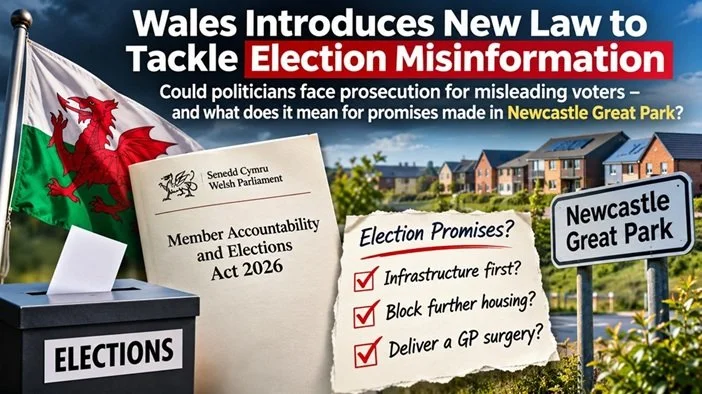
Wales has introduced new legislation aimed at tackling false and misleading factual claims during Senedd election campaigns, raising questions about political accountability and election promises in England. The reforms have renewed debate over commitments made to Newcastle Great Park residents concerning housing development and infrastructure. Illustration: Great Park Gazette
Politicians who make false or misleading factual claims during election campaigns could face criminal penalties under future rules in Wales, following the introduction of landmark legislation intended to strengthen political accountability and protect voters from deliberate deception.
The new legislation, passed by the Welsh Parliament earlier this year, represents a significant development in the debate over whether politicians should face legal consequences for misleading the public.
However, the changes also raise an important distinction between deliberately making false statements of fact and failing to deliver promises made during an election campaign.
For residents of Newcastle Great Park, the issue has particular relevance following renewed scrutiny of commitments made by Castle Ward's Green Party representatives before the May 2026 local elections.
Great Park Gazette recently examined those commitments after plans for 155 additional homes received Newcastle City Council Planning Committee backing and a further 320 homes were proposed for the former Sage headquarters.
The developments have raised questions about the difference between what candidates promise voters and what elected representatives subsequently deliver.
Now, Wales is taking legislative steps towards addressing a wider issue: should politicians face legal consequences when they knowingly mislead the public to influence an election?
What New Law Has Wales Introduced?
On 17 March 2026, the Welsh Parliament, known as the Senedd, passed the Senedd Cymru (Member Accountability and Elections) Bill.
The legislation received Royal Assent on 27 April 2026, becoming the Senedd Cymru (Member Accountability and Elections) Act 2026.
The Act introduces several reforms intended to strengthen democratic accountability, including changes to the standards system for Members of the Senedd and provisions for recalling elected representatives in certain circumstances.
One of its most significant elements concerns false or misleading statements made during election campaigns.
Under Section 24, Welsh ministers are legally required to introduce provisions prohibiting certain false or misleading statements of fact made or published before or during Senedd elections for the purpose of influencing the election of candidates.
The legislation also allows the Welsh Government to create criminal offences through future regulations.
This means that, once the relevant rules are introduced, certain dishonest factual claims made during election campaigns could potentially lead to criminal prosecution.
However, the Act does not itself create an immediately enforceable criminal offence of lying during an election campaign.
The detailed prohibitions, enforcement arrangements and any penalties still need to be established.
Could Politicians Really Be Prosecuted for Lying?
Potentially, yes.
Section 24 expressly allows future regulations to create criminal offences relating to prohibited election statements.
However, whether a particular statement could lead to prosecution would depend on the final wording of those regulations.
The legislation provides scope for ministers to determine several important matters, including:
What constitutes a factual statement rather than an opinion.
Whether the rules cover false statements, misleading statements or both.
Whether a person must have acted knowingly or recklessly.
Which individuals or organisations are covered.
How long before an election the restrictions apply.
What exemptions or safeguards should be included.
These details are particularly important because political campaigns frequently involve predictions, disputed interpretations, opinions and promises about future events.
A politician making a deliberately false claim about an existing fact is not necessarily in the same legal position as someone making a genuine promise that subsequently proves impossible to fulfil.
The legislation is intended to provide a framework for tackling misleading factual claims while leaving those difficult distinctions to be addressed through further rules.
When Will the New Rules Come Into Force?
The election-conduct provisions of the 2026 Act came into force on 27 June 2026.
However, this does not mean politicians can already be prosecuted under a new offence created by those provisions.
Welsh ministers must first introduce the detailed regulations required by the legislation.
During the Senedd's consideration of the Bill, the Welsh Government indicated that the next scheduled Senedd election in 2030 was the anticipated point at which the new rules would become relevant.
No fixed two-year deadline for introducing the detailed prohibition was included in the final Act.
The Government has argued that careful consultation and legal scrutiny are necessary before establishing rules capable of restricting political campaign statements.
The timetable therefore remains dependent on the development and approval of further legislation.
Would the New Law Make Broken Election Promises Illegal?
This is perhaps the most important distinction for voters.
The Welsh legislation does not automatically make it illegal for politicians to break election promises.
Consider two hypothetical examples.
A candidate publicly claims that a council has already approved funding for a new hospital, despite knowing that no such funding exists.
That is a claim about an existing fact.
Depending on the future rules and the evidence available, a knowingly false statement of that kind could potentially fall within a prohibition on election misinformation.
Now consider a candidate who promises to oppose a housing development but, after being elected, changes their position or fails to prevent the scheme from progressing.
That is a statement about intended future action.
The eventual failure to deliver the promise does not, by itself, establish that the candidate was dishonest when making it.
Circumstances might have changed, legal restrictions may have prevented the promised action, or the candidate may have genuinely attempted to fulfil their commitment without success.
To establish deliberate deception, stronger evidence would generally be required concerning what the politician knew and intended at the time.
The distinction is particularly important when considering promises relating to planning applications, which are governed by statutory requirements and cannot simply be refused because of a political pledge.
What Does the Law Currently Say in England?
At present, there is no general criminal offence in England covering every false or misleading political campaign claim.
The Electoral Commission explains that relatively few restrictions apply to what political parties, candidates and campaigners say in election materials.
One important restriction is contained in Section 106 of the Representation of the People Act 1983.
This makes it an illegal practice to publish certain false statements of fact about a candidate's personal character or conduct for the purpose of influencing an election, subject to the statutory conditions and defences.
For example, deliberately making a false factual allegation about an opposing candidate's personal conduct could fall within the legislation.
However, false claims about political policies or proposals generally do not fall within that specific offence.
The Electoral Commission also confirms that it does not regulate the general truthfulness of political campaign material.
Similarly, the Advertising Standards Authority does not ordinarily regulate advertisements whose principal purpose is to influence voters during elections.
This leaves an important distinction between political conduct that may be considered misleading or unacceptable and conduct that actually breaches election law.
In England, a politician failing to deliver an election promise does not automatically mean they have committed a criminal offence.
Why Is This Relevant to Newcastle Great Park?
The issue of election promises has become particularly topical in Newcastle Great Park following recent developments involving major housing applications.
Great Park Gazette has reported extensively on longstanding concerns about unfinished roads, delayed infrastructure adoption, healthcare provision, schools and the financial obligations associated with private estate management.
These issues featured prominently in campaigning before the May 2026 local elections.
In April, a Green Party candidate subsequently elected in Castle Ward made a firm public commitment to an infrastructure-first approach to further housing.
One statement declared:
"Infrastructure must come before more housing."
Another comment linked support for additional development directly to the delivery of healthcare infrastructure:
"No surgery, no sign-off on the next 100 houses."
These statements formed part of a wider campaign calling for developers to fulfil outstanding commitments before further residential expansion.
For residents concerned about the continued growth of Newcastle Great Park, they represented significant political assurances.
However, subsequent planning developments have brought those commitments back into focus.
Another 155 Homes Receive Planning Committee Backing
On 2 October 2026, Newcastle City Council's Planning Committee supported proposals for 155 additional homes on land north of Brunton Lane, adjoining Newcastle Great Park.
The committee resolved that it was minded to grant permission, subject to the completion of a Section 106 legal agreement and relevant conditions.
The scheme had previously attracted opposition from residents, including public protests against plans for approximately 160 homes on land associated with the development's intended town centre facilities.
Among those who publicly challenged the original proposals in June 2025 was Jamie Robinson, then Chair of the Great Park Neighbourhood Association.
Robinson was subsequently elected as a Green Party councillor and appointed Vice-Chair of Newcastle City Council's Planning Committee.
However, published committee attendance records show that he was absent from the 2 October meeting, with apologies recorded.
He therefore did not participate in the committee's vote on the 155-home application.
That does not establish whether he submitted separate representations or undertook other work concerning the application.
Nor does it demonstrate that his attendance would have changed the decision.
Nevertheless, the circumstances raise legitimate questions about how earlier political commitments have been pursued through the formal planning process.
A Further 320 Homes Proposed at Former Sage Headquarters
A separate outline planning application has also been submitted seeking permission to redevelop the former Sage headquarters at Newcastle Great Park.
Application 2026/1424/01/OUT proposes demolishing the vacant office building and constructing up to 320 homes.
Together, the two schemes involve proposals for up to 475 additional properties, although the 320-home application remains undecided and the 155-home scheme was subject to outstanding legal requirements when reported.
Castle Ward Green Party Councillor Imran Mohammed recently confirmed that he had reviewed the Sage application and written to planning officers seeking additional information.
His enquiries concern matters including traffic, employment land, biodiversity, drainage, healthcare, schools and outstanding road adoption responsibilities.
However, Councillor Mohammed also stated that he had not yet reached a final view on the application.
That position does not establish dishonesty or a breach of any election commitment.
Councillors are entitled, and in relevant planning decision-making roles may be required, to examine evidence before reaching conclusions.
It does, however, leave residents entitled to ask how the Green Party's previous infrastructure-first campaigning will be applied to the current proposals.
Read our full investigation:
Would the Welsh Law Apply to These Councillors?
No.
There are two fundamental reasons.
Firstly, the Welsh legislation concerns elections to the Senedd, not elections to Newcastle City Council.
It does not automatically extend to local council elections in England or introduce new criminal liabilities for Castle Ward councillors.
Secondly, the matters examined by Great Park Gazette concern political commitments about future planning decisions.
The progression of a development contrary to a campaign commitment does not, on its own, establish that a knowingly false statement of fact was made during an election.
There is also a distinction between an individual councillor voting for a development and a Planning Committee supporting an application while that councillor is absent.
The Welsh reforms therefore provide a useful comparison for the wider debate about political accountability, rather than a legal basis for accusing any Newcastle councillor of committing an offence.
What About Removing Politicians From Office?
The Welsh legislation also contains provisions for a recall system covering Members of the Senedd.
Under that system, eligible voters could be asked whether a representative should remain in office following specified serious misconduct or a relevant criminal conviction.
The process is subject to legal conditions and, in some circumstances, recommendations from the Senedd's Standards of Conduct Committee.
It is not a system allowing voters to remove a politician simply because they disagree with a policy decision or believe an election promise has been broken.
The recall provisions are also distinct from the proposed restrictions on misleading election statements.
For Newcastle City Council residents, the Welsh recall arrangements do not create any equivalent power to remove local councillors from office.
Could Similar Legislation Be Introduced in England?
In principle, Parliament could consider legislation addressing deliberately false factual claims during election campaigns.
However, any such proposal would raise substantial legal and constitutional questions.
Supporters of stronger restrictions argue that knowingly false factual claims can undermine voters' ability to make informed decisions and damage public confidence in democracy.
They believe there should be meaningful consequences where deliberate deception can be demonstrated.
Critics raise concerns about freedom of expression and the possibility of political speech becoming subject to legal challenges during election campaigns.
There is also the question of who decides whether a particular statement is false, particularly when political disputes involve competing interpretations of evidence.
The Welsh reforms have attracted scrutiny over precisely these issues.
Legal and parliamentary commentators have questioned whether criminal offences affecting political expression should be established through secondary legislation rather than being fully defined in an Act of Parliament.
Any comparable change in England would need to balance the protection of voters with freedom of political debate and safeguards against misuse.
How Can Great Park Residents Hold Councillors Accountable Now?
Regardless of whether England introduces new election honesty legislation, residents already have several ways to scrutinise the conduct and commitments of elected representatives.
They can examine published council meeting agendas and minutes, review Planning Committee attendance records, submit questions through council procedures and request explanations about decisions affecting their neighbourhoods.
Residents can also compare election statements with subsequent public actions and ask councillors to explain any changes in position.
Where there is evidence of a potential breach of a councillor's code of conduct, complaints may be made through the council's standards procedures.
However, a disagreement over policy or an unfulfilled election promise does not automatically amount to misconduct.
In planning matters, it is especially important to distinguish between councillors expressing views, submitting representations, participating in committee decisions and exercising powers that are legally available to them.
For Newcastle Great Park, this means asking representatives for specific information about the work they have undertaken on road adoption, infrastructure, healthcare and proposed housing developments.
Transparency over those actions can help residents assess how effectively election commitments are being pursued.
Should Election Promises Carry Greater Accountability?
The Welsh legislation demonstrates that political misinformation and accountability are now subjects of significant legislative attention.
Although the proposed restrictions will not automatically criminalise broken promises, they represent an attempt to establish clearer boundaries around false factual statements made to influence elections.
The wider debate is relevant far beyond Wales.
Residents elect representatives based partly on the policies, priorities and commitments presented during campaigns.
When circumstances change or commitments are not fulfilled, voters have a legitimate interest in understanding why.
That does not mean every unsuccessful promise should be treated as deliberate deception.
It does mean that clear explanations, accurate public records and consistent scrutiny are important to maintaining public trust.
For Newcastle Great Park, where development and infrastructure have been prominent election issues, the distinction between campaign commitments and subsequent actions is particularly relevant.
The central question is not simply whether politicians should face criminal penalties for knowingly misleading voters, but how the democratic system can ensure that election commitments are transparent, meaningful and subject to effective public scrutiny.
Have Your Say
Do you think England should consider laws similar to those being developed in Wales to tackle deliberately false election claims?
Should politicians face legal consequences for knowingly misleading voters, or should accountability remain primarily a matter for the electorate?
And when councillors make firm commitments during an election campaign, what evidence should residents expect to see of the work undertaken to fulfil them?
We would welcome your thoughts.
Join the conversation in the Great Park Residents Group on Facebook and share your views with fellow residents.
Great Park Gazette will continue to examine matters affecting democratic accountability, local representation and the commitments made to residents across Newcastle Great Park.
Further Information and Official Sources

