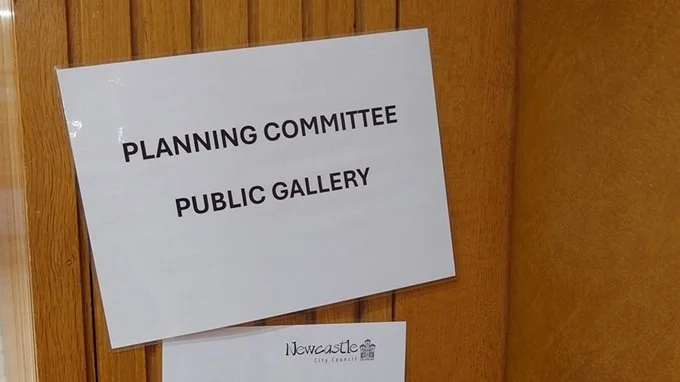
Sign directing members of the public to the Planning Committee gallery at Newcastle Civic Centre on 2 October 2026, when councillors considered proposals for 155 new homes north of Newcastle Great Park. The committee supported the application, subject to completion of a Section 106 agreement, while Castle Ward Green Party Councillor Jamie Robinson was recorded as absent with apologies. Photo: Great Park Gazette
Castle Ward's Green Party councillors are facing questions over their pre-election commitments to challenge further housing development at Newcastle Great Park, after plans for 155 additional homes received Planning Committee backing and Councillor Imran Mohammed confirmed he has not yet decided whether to support or oppose a separate proposal for up to 320 homes at the former Sage headquarters.
The developments have brought renewed attention to promises made ahead of the May 2026 local elections, when residents were assured that essential infrastructure should come before further housing.
In a strongly worded campaign statement published on 9 April 2026, a Green Party candidate who was subsequently elected promised continued opposition to further development until developers fulfilled outstanding commitments to the community.
That position was particularly significant for Newcastle Great Park, where residents have spent years raising concerns about road adoption, healthcare provision, schools, estate management charges and the continued expansion of the development.
Yet just five months after the local elections, Newcastle City Council's Planning Committee supported proposals for another 155 homes north of Brunton Lane.
Now, a further 320 properties could potentially be built on the former Sage headquarters site, bringing the combined number of homes involved in the two schemes to 475.
The 155-home development has received a committee resolution in favour of granting permission, subject to outstanding legal requirements, while the 320-home scheme remains under consideration.
For residents who took the election promises seriously, this raises an important question.
What has happened to the commitment that infrastructure must come before more housing?
What Did the Green Party Promise Before the Elections?
Great Park Gazette previously examined the election commitments made by Castle Ward's Green Party representatives in our investigation into councillor attendance and the challenges of balancing elected office with other employment.
The article revisited a Facebook statement published on 9 April 2026, ahead of the local elections held on 7 May.
The statement was particularly uncompromising about allowing further housing development while longstanding infrastructure problems remained unresolved.
In a direct challenge to the then Labour-led council administration, the Green Party candidate declared:
"Labour can keep counting, but we’ll keep holding developers to account."
The post went on to make an even firmer commitment to Great Park residents:
"Infrastructure must come before more housing. We will continue to block development until the companies involved deliver on the promises they made to this community."
This was more than a general expression of concern about development.
The language explicitly promised to continue blocking further housing until developers fulfilled their outstanding commitments to the community.
The candidate also emphasised the importance of ensuring that essential public services and infrastructure were delivered before further residential expansion.
He stated:
"Whether it’s schools, roads, or healthcare, we are putting local people before corporate profit. It’s time developers lived up to their end of the bargain."
These statements presented a clear political position, contrasting the Green Party's proposed approach with that of Labour and promising a more determined challenge to developers over outstanding infrastructure.
Further public comments outlined specific measures that could be used to challenge planning variations, pursue the enforcement of Section 106 agreements and use the planning process to apply pressure over unfinished infrastructure.
The candidate also connected his position on further housing directly to the delivery of a long-awaited doctors' surgery at Newcastle Great Park.
In one particularly direct statement, he declared:
"No surgery, no sign-off on the next 100 houses."
This was a significant assurance for residents who had already experienced years of frustration over the lack of promised healthcare facilities, unfinished roads, delayed infrastructure adoption and continued residential development.
The wording appeared to establish a clear condition: further housing should not be supported until essential healthcare provision had been delivered.
For residents already concerned that the growth of Great Park was outpacing the infrastructure needed to support its expanding population, these were substantial election commitments.
Taken together, the statements established a clear expectation that, if elected, the Green Party representatives would take a firm and determined approach towards further housing development until outstanding infrastructure concerns were properly addressed.
They also raised expectations that the councillors would actively challenge developers, scrutinise planning applications and use the powers available to them to pursue the delivery of long-promised facilities.
However, an election commitment to oppose development does not give an individual councillor the legal power to veto a planning application.
Planning decisions must be considered within the relevant legal and policy framework, and councillors cannot guarantee that an application will be refused simply because they previously campaigned against further development.
Nevertheless, there is an important distinction between being unable to prevent a development and demonstrating that every reasonable opportunity was taken to challenge it in accordance with the commitments made to voters.
With the Planning Committee having subsequently supported proposals for 155 additional homes north of Great Park, and another 320 homes now proposed at the former Sage headquarters, those earlier statements have renewed significance.
The question is therefore not simply whether further development has progressed, but what practical actions the Green Party councillors have taken to honour their election commitments, whether their original position remains unchanged, and what evidence they can provide of their efforts to hold developers accountable.
For residents who placed their trust in those promises, these are reasonable questions that deserve clear public answers.
Read our previous investigation:
Can Councillors Balance Paid Employment With the Demands of Representing Residents?
The First Major Test: Another 155 Homes North of Brunton Lane
On 2 October 2026, Newcastle City Council's Planning Committee considered an application by Taylor Wimpey and Persimmon Homes for another 155 residential properties on land north of Brunton Lane, immediately adjoining Newcastle Great Park.
The application, reference 2025/1264/01/DET, included:
36 two-bedroom flats.
14 two-bedroom houses.
86 three-bedroom houses.
19 four-bedroom houses.
The scheme also included proposals for affordable housing, landscaping, parking and associated infrastructure.
Developers were expected to provide more than £1.7 million in contributions towards local facilities and services, including education and healthcare.
Five objections were submitted by nearby Great Park residents, raising concerns including school capacity, loss of green space and the absence of bungalows within the development.
Castle Ward Liberal Democrat Councillor David Down raised questions about housing suitable for older residents wishing to downsize while remaining in their community.
Despite the objections, the Planning Committee supported the scheme unanimously among those present.
The committee resolved that it was minded to grant planning permission, subject to completion of a Section 106 legal agreement and planning conditions.
The formal decision notice had not been issued when the latest planning records were checked, meaning the committee's support should not be confused with unconditional final permission.
Nevertheless, the decision marked a significant step towards the construction of another 155 homes.
For residents who had heard promises about preventing further development until infrastructure was delivered, the decision represented an important test of those election commitments.
The question now is what action the Green Party councillors took to challenge the proposal, what improvements they sought and whether they believe the necessary infrastructure requirements have been satisfied.
Read our previous report:
155 New Homes Approved North of Great Park
Where Was Green Party Councillor Jamie Robinson?
The October Planning Committee decision is particularly significant when considered alongside Great Park Gazette's earlier investigation into committee attendance.
Councillor Jamie Robinson, who represents Castle Ward for the Green Party, was appointed a Vice-Chair of Newcastle City Council's Planning Committee following the local elections.
The role places him in a position to participate in the formal scrutiny of major planning applications, including developments affecting the community he represents.
However, the attendance records examined by Great Park Gazette in October showed that Councillor Robinson had attended just one of five Planning Committee meetings during the period reviewed.
He attended the meeting held on 19 June 2026.
Apologies were recorded for four subsequent meetings:
10 July 2026.
4 September 2026.
18 September 2026.
2 October 2026.
The meeting on 2 October was the one at which the committee supported the application for 155 additional homes north of Great Park.
This means Councillor Robinson was not present to participate in the committee's consideration and vote on that application.
It would be incorrect to suggest that he voted in favour of the scheme, and there is no evidence that his absence changed the outcome.
Nevertheless, his absence raises a legitimate question about the practical delivery of the infrastructure-first approach promoted during the election campaign.
Planning Committee meetings provide an opportunity to examine officers' recommendations, question applicants, scrutinise infrastructure arrangements and participate directly in planning decisions.
For an elected councillor who has accepted additional planning responsibilities, participation in those meetings is an important element of public accountability.
It is equally important to acknowledge that apologies were submitted for the absences, and the records do not establish why Councillor Robinson was unable to attend.
Committee attendance is not the only measure of a councillor's effectiveness. Work can also take place through correspondence, discussions with planning officers and direct representations on behalf of residents.
However, the available records leave a reasonable question for the councillor to answer.
How has he used his position to deliver the infrastructure commitments made during the election campaign, particularly when a major housing application affecting his own ward was being decided?
Jamie Robinson Previously Led Protests Against the Very Housing Development That Later Received Planning Backing
Perhaps one of the most significant aspects of the controversy is that Councillor Jamie Robinson was previously one of the most vocal opponents of the housing proposals north of Great Park town centre, before becoming an elected Green Party councillor.
On 4 June 2025, almost a year before the local elections, dozens of Great Park residents gathered outside the community centre on Roseden Way to protest against plans by Taylor Wimpey and Persimmon Homes to build approximately 160 homes on land originally intended for community and town centre facilities.
Among those leading the opposition was Jamie Robinson, who was then speaking in his capacity as Chair of the Great Park Neighbourhood Association (GPNA).
In comments reported on 6 June 2025, Robinson strongly criticised the developers' plans to replace land previously earmarked for community facilities, potentially including leisure, hotel and healthcare uses, with additional housing.
He argued that the land should have been developed for the benefit of the existing community rather than providing more homes and further revenue for developers.
His frustration was unmistakable.
"We are cash cows for these people. It is not fair."
Robinson also called for Newcastle City Council to take stronger action against developers to ensure that longstanding promises concerning roads, footpaths and other infrastructure were fulfilled.
He drew comparisons with action taken by Northumberland County Council to hold developers accountable for unfinished infrastructure elsewhere in the region.
These were strong public statements from someone representing residents through the neighbourhood association.
They reflected widespread frustration over the pace of development and the failure to deliver facilities that many homeowners believed would accompany the original Great Park masterplan.
The GPNA also highlighted the financial burden of private estate management charges and concerns about the condition of unfinished roads and pathways.
A residents' poll conducted by the association reportedly found that 630 respondents, representing 97% of those who participated, wanted developers to complete outstanding commitments before building more homes.
Although the poll was not necessarily representative of every Great Park household, it demonstrated strong opposition among those who took part.
From Approximately 160 Homes to 155 Homes
There is an important connection between that June 2025 protest and the more recent Planning Committee decision.
The original consultation materials identified proposals by Taylor Wimpey and Persimmon Homes for approximately 160 properties on land adjoining Brunton Lane.
The subsequent formal planning application, reference 2025/1264/01/DET, proposed 155 homes on land north of Brunton Lane.
It was this application that received the Planning Committee's support on 2 October 2026, subject to completion of the necessary legal agreement and conditions.
In other words, the development that residents protested against in June 2025 had progressed to a major planning decision by October 2026.
By that point, Jamie Robinson was no longer simply a neighbourhood association campaigner.
He had been elected as a Green Party councillor for Castle Ward and appointed Vice-Chair of the council's Planning Committee.
Yet, as previously established, Councillor Robinson was absent from the Planning Committee meeting at which the 155-home development was considered, with apologies recorded.
He therefore did not participate in the committee vote on the application.
This does not establish that he had abandoned his earlier opposition, nor does it mean his attendance would necessarily have changed the outcome.
However, it creates a striking contrast between his prominent public campaigning against the original proposals and his absence from the formal decision-making meeting once he held elected office.
What Happened to the Opposition?
The issue for residents is not simply whether Councillor Robinson attended one particular meeting.
It is whether the determination he demonstrated as a neighbourhood campaigner has translated into effective action as an elected representative.
In June 2025, Robinson was publicly challenging developers, demanding outstanding infrastructure and urging the council to take a firmer approach.
By October 2026, the development he had opposed had received Planning Committee backing.
The public record examined by Great Park Gazette establishes his absence from that meeting but does not, by itself, establish what written objections, representations or other interventions he may have made.
That leaves several important questions.
Did Councillor Robinson submit a formal objection to the 155-home application?
Did he make representations to planning officers or seek stronger conditions and infrastructure commitments?
Did he continue advocating the position expressed during the June 2025 protests?
And what explanation can he provide to residents who remember his previous campaign against development on this particular site?
The comparison between his statements as a community campaigner in June 2025 and his responsibilities as a councillor in October 2026 is a legitimate matter of public accountability.
Residents are entitled to understand what actions were taken, what outcomes were achieved and whether the positions expressed before entering elected office have been maintained.
With another 320 homes now proposed at the former Sage headquarters, the same questions about infrastructure, consistency and political accountability are becoming even more important.
Now Another 320 Homes Are Proposed for the Former Sage Headquarters
Attention has now turned to a separate major planning application involving the former Sage headquarters on North Park Avenue.
Developer Avant Homes (England) Limited has applied for outline planning permission to demolish the vacant office complex, its car park and associated structures and construct up to 320 residential properties.
The application, reference 2026/1424/01/OUT, proposes a residential development that could include family houses, apartments, landscaping, pedestrian and cycling connections and associated infrastructure.
The proposals would involve the loss of an existing major office site, raising questions about employment land, the balance between housing and business development, and the wider economic future of Great Park.
A planning notice displayed on 5 November 2026 confirmed that the proposed development does not accord with the provisions of the approved development plan.
That is a significant consideration.
It does not automatically require the application to be refused, but it means the departure from the adopted planning framework must be properly assessed.
The application is currently seeking outline permission, with access arrangements to be determined at this stage and other detailed matters reserved.
Importantly, no planning permission has yet been granted for the 320 homes.
Residents have until Thursday 26 November 2026 to submit comments on the current application.
Read our previous coverage:
Planning Notice Appears at Former Sage Headquarters as Residents Given Until 26 November to Comment
Councillor Imran Mohammed Says He Has Not Reached a Decision
Against this background, Green Party Councillor Imran Mohammed has published a statement on the Castle Ward Councillors Facebook page confirming that he has received a formal planning consultation concerning the former Sage headquarters.
The councillor says he has completed an initial review of the extensive planning documents and has contacted Newcastle City Council's planning officers seeking additional information.
His enquiries cover numerous issues relevant to residents.
These include the proposed loss of allocated employment land, increased traffic, reliance on a single vehicle access, tree protection, biodiversity, drainage, affordable housing and pressure on healthcare and education.
He has also asked whether another major housing development could affect outstanding road adoption and estate maintenance issues.
These are all substantial planning considerations.
The statement demonstrates that Councillor Mohammed is seeking clarification about several important aspects of the application.
However, he also makes clear that he has not yet decided whether he supports or opposes the proposals.
In his statement, Councillor Mohammed says:
"At this stage, I have not reached a final view on the application."
He adds that his priority is ensuring residents' concerns are heard and that any decision is based on robust evidence.
There is nothing inherently improper about a councillor reviewing an application before deciding their position.
Indeed, councillors are expected to consider relevant planning evidence carefully.
However, the distinction between this cautious position and the much firmer pre-election commitment to block further development until infrastructure was delivered is difficult to overlook.
The question is whether the earlier commitment remains the Green representatives' position, and if so, how they intend to apply it to this development.
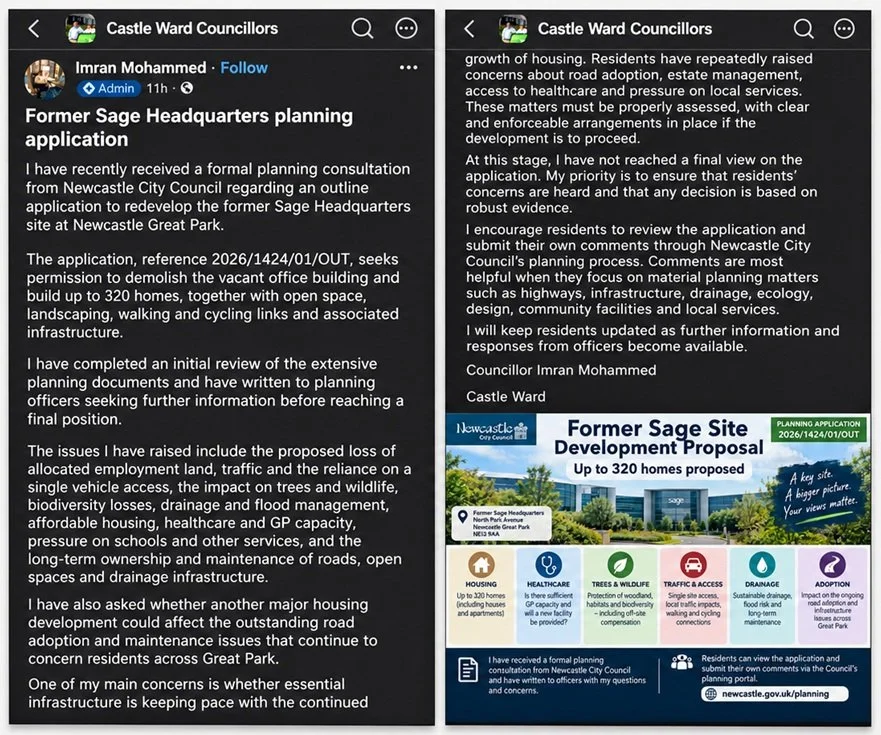
Screenshots of Green Party Councillor Imran Mohammed's statement on the Castle Ward Councillors Facebook page, in which he confirms he has not yet reached a final position on plans for up to 320 homes at the former Sage headquarters in Newcastle Great Park. The statement has raised questions about the Green Party's previous election commitments to oppose further housing until outstanding infrastructure is delivered. Image: Great Park Gazette / Facebook screenshots
Has the Green Party's Position on Further Housing Changed?
The language used during the election campaign created a clear impression that further development would be resisted until outstanding infrastructure obligations had been met.
Yet the latest public statement made on 10 November 2026 adopts a more conditional approach.
Councillor Mohammed is seeking information before reaching a conclusion.
These positions are not necessarily legally or logically incompatible.
The earlier campaign comments came from a Green Party candidate, while the latest statement comes from another councillor. The evidence does not establish that both made identical personal promises.
It is also possible to maintain an infrastructure-first policy while examining whether a particular application contains sufficient safeguards, contributions or legally enforceable commitments.
Nevertheless, residents are entitled to ask whether the Green Party's approach in Castle Ward has changed since the election.
If the previous position was that further housing should not proceed until outstanding infrastructure had been delivered, what would now justify supporting another 320 homes while those longstanding issues remain unresolved?
Have circumstances changed?
Have developers provided new commitments?
Has the council identified solutions to the outstanding road adoption and healthcare problems?
Or is the Green Party now interpreting its original election commitments differently?
These questions deserve clear public answers.
What About Great Park's Outstanding Infrastructure?
One reason the election commitments resonated with residents was the long-running frustration surrounding incomplete infrastructure.
Development at Newcastle Great Park began approximately 25 years ago, yet significant concerns remain about the adoption of roads, estate maintenance responsibilities and long-promised community facilities.
Great Park Gazette has previously reported on efforts by Newcastle North MP Catherine McKinnell to progress outstanding road adoption matters, including the Spine Road and Roseden Way.
Although progress has been reported on certain legal and maintenance arrangements, firm completion dates remain an important concern for residents.
The possible loss of employment land at the Sage site also raises questions about whether Great Park is becoming increasingly residential without a comparable expansion in local jobs and services.
For households already paying full council tax alongside private estate management charges, further development may also raise concerns about the long-term responsibility for new roads, landscaped spaces and drainage systems.
These were precisely the types of issues that featured in political campaigning before the local elections.
Read our previous investigation:
Great Park Road Adoption: After 25 Years, Residents Still Waiting as MP Announces Further Progress
Can Councillors Simply Block a Planning Application?
There is an important legal distinction between campaigning against development and possessing the authority to prevent it.
Under England's planning system, decisions must generally be made in accordance with the adopted development plan unless material planning considerations indicate otherwise.
Councillors involved in planning decisions must consider the relevant evidence, applicable policies, representations and legal obligations.
They cannot lawfully refuse an application solely because they made an election pledge to oppose further housing.
Equally, a councillor is not automatically disqualified from participating simply because they previously expressed strong views on development.
Section 25 of the Localism Act 2011 makes clear that an earlier expression of opinion does not, by itself, establish that a decision-maker has a closed mind.
Councillors may therefore campaign on planning issues, express concerns and advocate particular outcomes, provided they fulfil their legal responsibilities when making decisions.
An individual ward councillor also cannot personally veto an application.
Decisions may be taken by the Planning Committee or, in other circumstances, by authorised planning officers.
This means a candidate promising to block further housing is making a political commitment about the approach they intend to pursue, not necessarily guaranteeing an outcome they have the power to deliver.
However, that distinction cuts both ways.
If a councillor makes a firm commitment to residents during an election campaign, the public is entitled to ask what practical steps were subsequently taken to fulfil it.
Those steps could include submitting objections based on material planning grounds, seeking stronger legal agreements, questioning officers, participating in committee proceedings and pressing developers to deliver outstanding obligations.
The absence of a particular outcome does not automatically demonstrate that an election commitment was dishonest.
But residents should reasonably expect evidence of what was attempted.
Is It Illegal for Politicians to Make False Election Promises?
The controversy also raises a wider question about the legal consequences of misleading voters.
Can a politician be prosecuted for making an election promise that is subsequently broken?
In most circumstances, the answer is no.
UK electoral law places relatively few restrictions on what political candidates and parties can say about their policies, priorities and future intentions.
One important exception is contained in Section 106 of the Representation of the People Act 1983.
This makes it an illegal practice to make or publish certain false statements of fact about a candidate's personal character or conduct for the purpose of influencing an election, subject to the statutory conditions and defences.
However, the provision does not generally criminalise political promises that are subsequently abandoned or cannot be fulfilled.
For example, a candidate promising to oppose a housing development, then later failing to prevent it, would not automatically have committed an electoral offence.
There is also an important difference between a promise that proves impossible to deliver and a statement made with a deliberately dishonest intention.
Establishing the latter would require evidence about what the politician knew or intended when making the statement.
The available information does not establish that Councillors Robinson or Mohammed knowingly made false promises to secure votes.
It does, however, provide grounds for examining whether the commitments made during the campaign are being honoured in practice.
This exposes a broader weakness in political accountability.
Voters may attach considerable importance to pledges made during elections, yet the primary consequences when those pledges are not delivered are often political rather than criminal.
Residents can question their representatives, scrutinise public records, raise complaints about identifiable misconduct where appropriate, and ultimately hold councillors accountable through the democratic process.
The law does not, however, guarantee that every campaign promise will be fulfilled.
Residents Deserve Answers, Not Simply More Assurances
There is a difference between investigating planning applications carefully and moving away from a clear election commitment.
Councillor Mohammed's statement contains relevant questions about infrastructure, access, biodiversity, employment land and public services.
Those enquiries are welcome as part of proper planning scrutiny.
But residents should not have to guess whether the Green Party's original position remains intact.
Similarly, Councillor Robinson's attendance record raises legitimate questions about how effectively the commitments made during the election have been pursued through the Planning Committee.
The fact that another 155 homes received committee support does not prove the councillors supported that outcome.
Nor does the existence of the Sage application mean that another 320 homes will necessarily be built.
Nevertheless, the developments represent important tests of the promises made to voters.
The central question is not whether every planning application can be defeated.
It is whether elected representatives are taking consistent, demonstrable action to deliver the policies on which they campaigned.
Six Questions for Castle Ward's Green Party Councillors
In the interests of transparency, the following questions deserve public answers from Councillors Jamie Robinson and Imran Mohammed.
1. Does the original infrastructure-first election commitment still stand?
Will both councillors publicly confirm whether they remain committed to opposing further major housing development until outstanding infrastructure obligations are met?
2. What action was taken over the 155-home development?
What representations, objections or requests for improvements did either councillor make before the Planning Committee supported the Brunton Lane application?
3. How does Councillor Robinson explain his Planning Committee attendance record?
Without requiring disclosure of private personal circumstances, what assurance can he provide that his additional committee responsibilities can be fulfilled consistently?
4. Under what circumstances could the Sage development be supported?
What specific improvements, planning conditions or legally enforceable agreements would Councillor Mohammed need to see before deciding whether to support the proposed 320 homes?
5. What progress has been achieved on outstanding infrastructure?
Can the councillors identify concrete progress on road adoption, healthcare, school capacity and other facilities since their election?
6. What should residents understand by the original promise to block development?
Was this an unconditional commitment to oppose further housing until existing obligations were completed, or an intention to challenge applications unless adequate infrastructure measures were secured?
Clear answers would help residents understand the relationship between the election commitments and the councillors' current approach.
How Can Residents Object to or Comment on the Sage Proposals?
Residents who wish to comment on the proposed redevelopment of the former Sage headquarters can do so through Newcastle City Council's official planning process.
Planning application: 2026/1424/01/OUT
Applicant: Avant Homes (England) Limited
Location: Former Sage Headquarters, North Park Avenue, Newcastle Great Park, NE13 9AA
Proposal: Demolition of existing buildings and outline permission for up to 320 homes.
Deadline for comments: Thursday 26 November 2026.
Comments should focus on material planning considerations.
These can include transport and highways, employment land, biodiversity, drainage, flood risk, healthcare capacity, school provision, landscaping and relevant planning policies.
Residents can also examine the implications of the proposal for existing infrastructure and whether adequate arrangements are being made for long-term maintenance.
The council must assess relevant planning representations as part of its determination of the application.
Search and Comment on Planning Applications – Newcastle City Council
A Test of Political Accountability at Newcastle Great Park
The coming months will provide an opportunity to establish how the Green Party's infrastructure-first election commitments translate into practical action.
The Planning Committee's support for 155 additional homes has already prompted legitimate questions.
The former Sage headquarters application provides another opportunity for Castle Ward's representatives to demonstrate how they intend to address longstanding concerns about the pace of development.
There are substantial issues to consider, including affordable housing, the future of employment land, environmental protection and the continuing need for homes across Newcastle.
But those considerations must be weighed alongside the expectations created by election promises and the concerns of existing residents.
Great Park residents were given clear assurances about the importance of delivering infrastructure before further housing. They are entitled to know what those assurances mean now that their councillors hold elected office.
Whether the Green Party's position has changed, been misunderstood or is being applied through a more detailed approach to planning scrutiny, an explanation would help residents judge the record for themselves.
The question is no longer simply what was promised before the election.
It is what has been done since.
Have Your Say
Do you believe Castle Ward's Green Party councillors are delivering on their election commitments concerning housing and infrastructure?
Are you satisfied with the Planning Committee's decision to support another 155 homes north of Great Park?
Should the former Sage headquarters be redeveloped for housing, or should greater priority be given to retaining employment opportunities and delivering outstanding infrastructure?
And do you think politicians should face greater accountability when election promises are not fulfilled?
Join the conversation in the Great Park Residents Group on Facebook and share your views.
Great Park Gazette will continue to monitor the planning application, the council's decision-making process and the responses of Castle Ward's elected representatives.
Further Information and Sources

