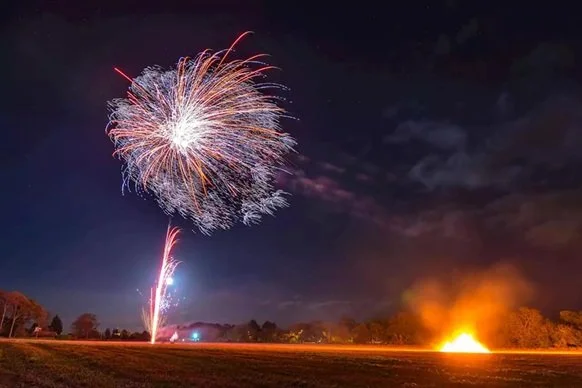
The impact of fireworks on pets, wildlife and residents' wellbeing is once again under discussion ahead of Bonfire Night. Photograph: Jeremy Bolwell / Geograph
As fireworks begin to be heard across Newcastle Great Park ahead of Bonfire Night, concerns are growing about their impact on household pets, local wildlife and residents' wellbeing. Meanwhile, the Government is reviewing potential changes to fireworks legislation following a major public consultation.
With Bonfire Night approaching on Thursday 5 November, the familiar sound of fireworks is beginning to return to Newcastle Great Park.
For many people, fireworks are a much-loved part of seasonal celebrations, providing colourful displays for families and communities to enjoy.
However, for others, the sudden explosions can bring considerable anxiety, distress and disruption.
Newcastle Great Park is home to thousands of residents, including families with young children, elderly people and those with additional sensory needs. The area is also home to numerous dogs, cats and a variety of wildlife, including deer living in and around its green spaces.
With fireworks often being set off unexpectedly in the days and weeks surrounding Bonfire Night, questions are being raised nationally about whether the current rules strike the right balance between celebration and protecting people and animals.
The impact of fireworks on household pets
For many pet owners, the arrival of fireworks season brings an annual challenge.
Dogs and cats have significantly more sensitive hearing than humans, meaning that loud bangs can be particularly frightening.
The RSPCA warns that fireworks can trigger fear, anxiety, increased stress and, in some cases, injuries when frightened animals attempt to escape.
Some dogs may tremble, pant excessively, bark, pace around the house or seek somewhere to hide.
Cats may retreat into small spaces, refuse food or attempt to escape when startled.
For owners of particularly frightened animals, even a short fireworks display can turn an otherwise peaceful evening into a stressful experience.
The difficulty is often made worse when fireworks are set off without warning.
Unlike organised displays, where residents may know the date and approximate time in advance, private fireworks can begin suddenly, leaving pet owners little opportunity to prepare.
The RSPCA provides extensive advice for protecting pets during the fireworks season, including creating safe spaces, closing curtains, keeping cats indoors after dark and speaking to a vet where animals experience severe anxiety.
Read the RSPCA's advice on protecting animals from fireworks.
What about Great Park's deer and other wildlife?
The impact of fireworks extends beyond household pets.
Newcastle Great Park benefits from extensive green spaces, woodland, grassland and wildlife habitats, with deer among the animals found in the surrounding area.
Unlike household pets, wild animals do not have owners who can prepare safe indoor spaces or reassure them when fireworks begin.
The RSPCA identifies deer, birds, rabbits, squirrels, foxes, badgers and hedgehogs among the wildlife potentially affected by fireworks.
Sudden explosions and bright flashes can cause animals to panic and flee.
Birds may be startled from their resting places, while mammals can become disorientated or run into dangerous situations.
For deer, an unexpected loud explosion could trigger a flight response, potentially creating danger if an animal runs towards nearby roads.
There are also concerns about firework debris falling into green spaces, where discarded materials may pose risks to wildlife.
This is particularly relevant in areas such as Great Park, where residential development sits alongside natural habitats.
The RSPCA advises people organising fireworks displays to avoid known wildlife habitats, including woodland areas, lakes and locations where animals may be sheltering.
Read the RSPCA's advice on fireworks and wildlife.
The wider impact on residents' quality of life
Although fireworks are traditionally associated with Bonfire Night itself, their use often extends across several evenings before and after 5 November.
For some residents, this can mean repeated interruptions to their evenings and sleep.
Sudden loud noises may be particularly distressing for people with autism, sensory sensitivities, post-traumatic stress disorder (PTSD) and certain other health conditions.
Young children and vulnerable residents may also find unexpected explosions frightening.
In the Government's 2025 public attitudes research, 71% of respondents who disliked fireworks noise cited disruption to the peace and quiet of their community, while 68% cited the impact on vulnerable people.
The research also found substantial concern about the effects on animals.
The issue is not necessarily whether people should be allowed to celebrate, but how celebrations can take place without causing unnecessary distress to neighbours and wildlife.
For residents of a large community such as Newcastle Great Park, where thousands of households live alongside one another, consideration for others can make a considerable difference.
Government reviewing fireworks laws following consultation
The UK Government has been examining whether existing fireworks legislation should be strengthened.
On 16 July 2026, the Government launched a major consultation titled Fireworks and pyrotechnics in the UK.
The consultation sought views on several proposals, including:
Restricting the loudest consumer fireworks so that they would only be available to professional users.
Reviewing whether certain fireworks and pyrotechnic products should be added to the existing list of prohibited products.
Reconsidering the regulation of some lower-risk fireworks and pyrotechnics.
Reducing the maximum permitted noise level for consumer fireworks.
Under the current regulations, the maximum permitted noise level for consumer fireworks is generally 120 decibels, measured using a specified test method at the relevant safety distance.
The Government's main proposal is to reduce this to 110 decibels, which it estimates would approximately halve the perceived loudness.
The consultation also requested evidence about further reductions to 100 or 90 decibels.
The public consultation closed on Wednesday 7 October 2026.
In a parliamentary response published on 22 October, the Government confirmed that it had received more than 140,000 submissions.
Ministers said the responses were being reviewed before decisions were made on whether legislative changes would be required.
No final decision on changing the noise limits has yet been announced.
Read the Government's fireworks consultation.
Parliamentary petitions attract hundreds of thousands of signatures
Public concern about fireworks has also been reflected in several petitions submitted to the UK Parliament.
Three petitions have attracted particularly significant support.
Petition 732559 – Restrict fireworks sales to approved events
This petition called for the sale of fireworks to be limited to those organising local council-approved events.
It attracted 195,930 signatures and was debated in Parliament on 19 January 2026.
Petition 738192 – Reduce consumer firework noise to 90 decibels
This petition called for the maximum permitted noise level of consumer fireworks to be reduced from 120 to 90 decibels.
Campaigners argued that lower noise limits could reduce distress experienced by animals and people sensitive to loud noise.
The petition attracted 184,376 signatures and was also debated on 19 January 2026.
Petition 700013 – Limit fireworks sales and use to licence holders
A further petition called for the sale and use of fireworks to be restricted to licence holders.
It attracted 87,527 signatures and was debated in Parliament in December 2024.
All three petitions have now closed, meaning they can no longer receive signatures.
The debates demonstrate the extent of public interest in the issue, although parliamentary debates on petitions do not automatically result in changes to legislation.
Could quieter fireworks offer a solution?
One option attracting increasing attention is the use of quieter fireworks.
Products marketed as silent fireworks or low-noise fireworks are already available.
Despite the name, silent fireworks are not completely silent.
They are designed to produce colourful visual effects while reducing some of the loud explosive bangs associated with traditional fireworks.
The RSPCA acknowledges that no fireworks are truly silent, but suggests that lower-noise alternatives can help reduce their impact on animals and people.
Other options include drone light shows and laser displays, which can provide visual entertainment without the same explosive noise.
These alternatives may also need careful planning to avoid disturbing nearby wildlife, particularly in sensitive habitats.
For communities such as Newcastle Great Park, quieter displays could offer a way for people to enjoy celebrations while reducing disruption to neighbours and animals.
Find out more about quieter fireworks and alternative displays.
What are the current laws on fireworks?
Despite the Government's review, the existing laws remain in place.
In England, the general rules include:
Fireworks cannot normally be set off between 11pm and 7am.
On Bonfire Night, 5 November, the permitted cut-off is extended to midnight.
On New Year's Eve, Diwali and Chinese New Year, the cut-off is extended to 1am the following morning.
It is illegal to set off or throw fireworks in streets and other public places.
People must be aged 18 or over to purchase adult fireworks.
Category F4 fireworks are restricted to professional users.
The rules mean that fireworks set off before 11pm are not automatically illegal simply because they are loud.
However, fireworks used dangerously, unlawfully or in a manner amounting to antisocial behaviour may require police attention.
Residents can read the official guidance at GOV.UK – Fireworks: the law.
A little consideration can make a difference
As Bonfire Night approaches, residents planning celebrations can take practical steps to minimise disruption.
Choosing lower-noise fireworks, giving neighbours advance notice, keeping displays to reasonable hours and avoiding wildlife habitats can all help.
For pet owners, knowing when fireworks are likely to take place can make it easier to prepare their animals.
Even a brief warning to neighbouring households can help families with frightened pets, young children or vulnerable relatives plan ahead.
Responsible celebrations and consideration for neighbours do not have to be mutually exclusive.
What do Great Park residents think?
The fireworks debate raises important questions about how communities balance traditional celebrations with the wellbeing of residents, pets and wildlife.
Should private fireworks continue to be available under the current rules?
Would lower-noise fireworks provide a reasonable compromise?
Or should fireworks be limited to organised displays where residents can receive advance notice?
With the Government considering possible changes to the law, these questions are likely to remain part of the national conversation.
Great Park Gazette would like to hear residents' experiences and views.
Have fireworks already begun in your part of Newcastle Great Park? Have your pets been affected, or have you noticed any impact on local wildlife?
Do you support quieter fireworks, additional restrictions or keeping the existing arrangements?
Residents can join the discussion in the Great Park Residents Group on Facebook.
Great Park Gazette will continue to follow developments surrounding the Government's fireworks review and report on any proposed changes to the law.

