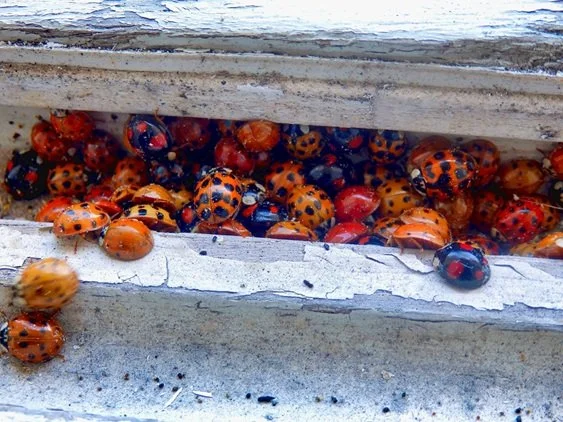
Harlequin ladybirds can gather in large numbers around windows and buildings as they search for sheltered places to spend the winter. The non-native species has been reported among ladybird swarms across Newcastle and the North East. Despite headlines about a sexually transmitted fungus affecting some ladybirds, experts confirm it cannot infect humans. Illustrative image
Thousands of ladybirds have reportedly been gathering on homes, windows and outdoor surfaces across the North East, including Newcastle and Tyneside. Some are the invasive harlequin ladybird, which has attracted alarming headlines about a sexually transmitted fungus. But experts say there is no danger of people catching the infection.
Residents across Newcastle and the North East are being warned to expect an unusual sight this autumn, as large numbers of ladybirds gather around homes and buildings in search of somewhere to spend the winter.
Reports published on Friday 30 October 2026 describe thousands of ladybirds appearing across Newcastle, Durham, Teesside, Tyneside and Cumbria, with some residents finding their window frames, fences and outdoor surfaces covered in the colourful insects.
Among them are believed to be harlequin ladybirds, a non-native species that has become well established across Britain.
The insects have attracted attention because some can carry a fungus described in media reports as a sexually transmitted disease.
However, despite the alarming headlines, experts at London's Natural History Museum have confirmed that the infection cannot be transmitted to humans.
For households in Newcastle Great Park, the sudden appearance of ladybirds may be surprising, particularly if large clusters begin gathering around windows and doors.
But there is a straightforward explanation for why they are appearing now.
Why are so many ladybirds appearing?
Late October is an important time of year for ladybirds.
As temperatures fall and their usual food supplies become less available, the insects begin searching for sheltered places to survive the winter.
This seasonal process is known as diapause, a state of dormancy during which their metabolism slows and they conserve energy.
Some species spend winter beneath tree bark, among fallen leaves or in other natural hiding places.
Others, particularly harlequin ladybirds, are known to gather together in large groups.
Homes can provide attractive shelter, especially around window frames, roof spaces, exterior walls and small gaps in buildings.
Warm sunshine can also encourage ladybirds to gather on the sunny sides of houses before temperatures drop again.
This is why residents may suddenly notice dozens or even hundreds of insects gathering in one place.
Despite the dramatic appearance, this is a natural seasonal behaviour rather than evidence of a new disease outbreak.
Could Great Park homes be affected?
Newcastle Great Park has a mixture of modern houses, apartments, gardens, landscaped areas and green spaces.
These provide habitats for many insects, including ladybirds.
Properties with sunny exterior walls, windowsills and sheltered gaps could attract ladybirds looking for winter accommodation.
The insects may gather around:
Window frames and windowsills.
Door frames and external walls.
Rooflines, vents and sheltered corners.
Conservatories and garages.
Garden furniture, fences and sheds.
Harlequin ladybirds have been recorded in the North East for many years, so their presence in the Newcastle area is not new.
The Natural History Society of Northumbria says the species was first reported in the region in 2010 and has since become one of the most frequently recorded ladybirds locally.
There have been widespread reports across the North East, Great Park Gazette has independently one large-scale swarm specifically within Newcastle Great Park so far.
Residents who have noticed unusually large numbers around their properties are welcome to share their sightings and photographs.
What are harlequin ladybirds?
The harlequin ladybird, scientifically known as Harmonia axyridis, originates from Asia.
It became established in Britain in 2004 and has since spread across much of the country.
Harlequins were introduced into several other countries to help control agricultural pests, particularly aphids.
However, the species spread rapidly and is now considered invasive in Britain.
Unlike the familiar red ladybird with seven black spots, harlequins can appear in many different colours and patterns.
Some are orange with numerous black spots, while others are almost entirely black with two or four red markings.
This unusual appearance has led some people to describe them as 'fake ladybirds'.
In reality, they are genuine ladybirds, just a different species from those many people are used to seeing.
How can you identify a harlequin ladybird?
The harlequin is one of the larger ladybird species commonly encountered in Britain.
Typical identifying features include:
Size: Usually around 7–8mm long, although individuals vary.
Colour: Red, orange, yellowish or black.
Spots: Some have many spots, while others have very few or none.
Markings: Some have a distinctive black M-shaped or W-shaped marking on the pale area immediately behind the head.
Legs: Often orange or brown rather than black.
Not every harlequin looks the same, which can make identification difficult.
Some native British ladybirds also have unusual colouring, so residents should avoid assuming that every orange or black ladybird is an invasive species.
The UK Ladybird Survey provides identification information to help distinguish harlequins from native species.
Are the ladybirds really carrying an STD?
One of the more unusual aspects of the recent reports is the claim that harlequin ladybirds are infected with a sexually transmitted disease.
There is some scientific truth behind this, but the headlines require important clarification.
Harlequin ladybirds can carry a fungus belonging to a group known as Laboulbeniales.
The infection is sometimes referred to as laboulbenia and can spread between ladybirds through close contact, including mating.
The fungus grows on the insect's outer surface and may appear as tiny scales or pale crust-like patches.
It can affect native ladybirds as well as harlequins.
However, the infection is specific to insects and cannot infect humans.
It is not related to human sexually transmitted infections, and there is no evidence that touching a ladybird could give someone a human STD.
The Natural History Museum has specifically addressed this misconception, reassuring the public that the fungus poses no risk to people.
It is also important to remember that not every harlequin ladybird carries the fungus.
Can harlequin ladybirds bite?
Harlequin ladybirds are not generally dangerous to people.
However, like some other ladybirds, they can occasionally nip if handled or disturbed.
A bite is usually no more than a minor irritation.
The insects also have a defensive mechanism that can make them unpleasant to handle.
When threatened, they may release a yellow fluid from their leg joints.
This fluid can smell unpleasant and may stain clothing, furnishings or other surfaces.
It is one reason experts recommend avoiding squashing ladybirds indoors.
The British Pest Control Association confirms that ladybirds do not normally cause structural damage to buildings.
They may nevertheless become a nuisance when large numbers gather inside a property.
What should you do if ladybirds enter your home?
If you discover a cluster of ladybirds around a window or inside your house, there is usually no need to panic.
The Royal Horticultural Society and Natural History Museum recommend tolerating them where possible or carefully removing them.
For Great Park residents, the following steps may help:
1. Avoid squashing them
Crushing ladybirds can release the yellow defensive fluid, potentially leaving unpleasant odours or stains.
2. Gently collect and remove them
Use a soft brush, dustpan or container to collect the insects and move them outdoors.
3. Check windows and doors
Make sure window seals and door frames are in good condition.
Small gaps can provide entry points for insects seeking shelter.
4. Check vents and other openings
Look for obvious gaps around window frames and other areas where insects could enter. Avoid blocking essential ventilation.
5. Avoid unnecessary insecticide use
Chemical treatments may also harm native ladybirds and other beneficial insects.
The Royal Horticultural Society advises against widespread attempts to destroy harlequin populations, as the species is already established and such measures can harm other wildlife.
6. Seek professional advice if necessary
If unusually large numbers repeatedly enter your property and become difficult to manage, a qualified pest-control professional can advise on suitable measures.
For most households, however, simple prevention and careful removal should be sufficient.
Are harlequin ladybirds bad for the environment?
Although harmless to people, harlequin ladybirds can cause problems for Britain's native wildlife.
They are highly effective predators and feed on aphids and other small insects.
However, they also compete with native ladybirds for food and can consume the eggs and larvae of other ladybird species.
Because they reproduce quickly and can survive in a range of environments, they have spread successfully across Britain.
Conservation organisations continue monitoring their impact on native wildlife.
The Royal Horticultural Society notes that the species is now so widespread that killing small numbers is unlikely to make any meaningful difference to its overall population.
For gardeners, identifying and protecting native insects remains an important part of supporting local biodiversity.
Great Park's green spaces and wildlife
Newcastle Great Park is home to a variety of habitats, including residential gardens, trees, grassland and green corridors.
These support insects that play important roles in the local environment.
Ladybirds are particularly useful predators of aphids, helping to control pests that feed on plants and flowers.
Native ladybirds can also be found sheltering in fallen leaves, vegetation and small gaps in natural materials over winter.
Residents who enjoy gardening can support beneficial insects by avoiding unnecessary pesticide use and retaining some sheltered areas of natural vegetation.
As winter approaches, these small habitats become increasingly important.
The appearance of large numbers of ladybirds is also a reminder of how closely wildlife responds to seasonal changes in temperature and daylight.
North East residents can help scientists monitor ladybirds
There is an opportunity for people in Great Park to turn these unusual sightings into something useful.
The Natural History Society of Northumbria runs the North East Ladybird Spot project, encouraging residents to record the ladybirds they discover.
The project has already received more than 10,000 records, helping researchers understand where different ladybird species occur across the region.
Residents can contribute by taking photographs and recording where and when an insect was spotted.
Sightings can be shared through iRecord, iNaturalist or directly with the Society.
North East Ladybird Spot:
https://www.nhsn.org.uk/the-north-east-ladybird-spot/
Email: nhsn@ncl.ac.uk
Photographs are particularly useful when identifying harlequins because of their unusually varied colours and markings.
Have you spotted ladybird swarms in Great Park?
With reports of large gatherings across Newcastle and the wider North East, Great Park Gazette would like to hear from residents who have noticed unusually high numbers of ladybirds.
Have they been collecting around your windows?
Have you spotted them on fences, cars or garden furniture?
Or have you found clusters inside your home?
Photographs and sightings from around Newcastle Great Park could help build a picture of whether the latest regional activity is being noticed locally.
Despite the attention surrounding the so-called STD-infected ladybirds, there is no reason for residents to be alarmed.
The fungal infection cannot affect humans, the insects do not normally damage buildings, and their autumn gatherings are part of a familiar seasonal cycle.
For Great Park households, the message is simple: Don't panic, avoid squashing them, and carefully remove any insects that find their way indoors.
Published Friday 30 October 2026.
Further information and sources
Natural History Museum – Why harlequin ladybirds are invading our homes
Durham Wildlife Trust – Harlequin ladybird
Royal Horticultural Society – Harlequin ladybird advice
British Pest Control Association – Ladybird advice
Natural History Society of Northumbria – North East Ladybird Spot

