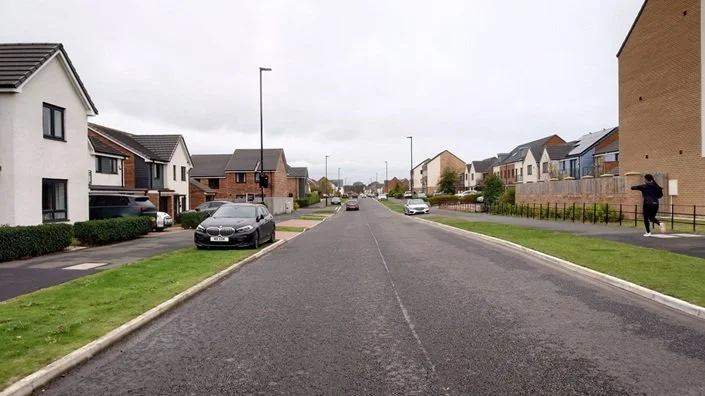
Roseden Way - Great Park
Newcastle North MP Catherine McKinnell says “progress is being made” towards the adoption of roads in Newcastle Great Park, including an agreement over future maintenance funding for a bridge on the estate's Spine Road. But with the development now 25 years old, significant stretches of road still awaiting adoption and no firm completion dates announced, the Great Park Gazette asks whether residents are finally getting answers — or simply another update without a timetable.
Residents of Newcastle Great Park have been given another update on the long-running issue of road adoption, with Labour MP Catherine McKinnell announcing progress in discussions between Newcastle City Council and the Great Park Consortium.
In a statement published on 23 October 2026, the Newcastle North MP said funding had been approved for the long-term maintenance of the bridge on the estate's Spine Road.
She also confirmed that council officers are reviewing proposed safety improvements to Roseden Way, another road whose adoption remains outstanding.
Both developments could help move the adoption process forward.
However, neither announcement includes a firm date for when Newcastle City Council will take responsibility for the affected roads.
For residents who have spent years waiting for the roads surrounding their homes to be brought under local authority control, that remains the central issue.
And the history of Great Park makes the wait particularly striking.
Newcastle Great Park is now 25 years old
Newcastle Great Park is sometimes described as a relatively new housing development.
However, records published by the Great Park Consortium confirm that construction began in 2001.
The earliest homes at Warkworth Woods were built between 2001 and 2005, while Melbury was developed between 2002 and 2010.
That means Great Park has been under development for approximately 25 years.
Of course, not every road on the estate is 25 years old. The development has been delivered in phases, with newer neighbourhoods and infrastructure constructed much more recently.
But the age of the overall development raises an important question about how long residents should reasonably expect to wait for roads intended for adoption to meet the necessary standards.
The issue is not simply that some newly constructed roads are still awaiting their final inspections.
Several roads have been in everyday use for years, and residents have repeatedly raised concerns about their condition, maintenance and the lack of clarity over responsibility.
Against that background, an announcement that technical assessments and legal agreements are still being progressed will understandably prompt questions about how much longer the process might take.
What has Catherine McKinnell announced?
In her latest statement, Catherine McKinnell says Newcastle City Council has informed her that the Great Park Consortium has approved funding for a commuted sum relating to the bridge on the Spine Road.
A commuted sum is a payment or financial provision intended to cover specified future maintenance liabilities.
In this case, it is intended to give the Council assurance that funding will be available for the bridge's long-term upkeep.
The MP says this agreement allows further work to proceed on the Dedication Agreement, a legal arrangement needed before the Council can formally take responsibility for the relevant roads.
However, there is more work to complete.
Council officers still need to carry out a technical assessment of the Spine Road before the local authority can take control.
McKinnell says she expects to meet council officials shortly to discuss progress.
That is a development worth reporting.
But it is important to distinguish between approval of maintenance funding and the legal completion of road adoption.
The former may help make the latter possible.
It does not mean the Spine Road has already been adopted, nor does it establish when adoption will take place.
Progress on paper — but when will residents see a result?
The Great Park Gazette recognises that road adoption can involve complicated legal, financial and engineering requirements.
Bridges, drainage infrastructure, road construction standards and future maintenance obligations can all require scrutiny before a council agrees to take responsibility.
However, those practical considerations do not remove the need for clear public accountability.
In her update, McKinnell refers to her longstanding efforts to secure clearer timescales.
Yet the statement does not provide:
A target date for completion of the Spine Road's technical assessment.
A deadline for finalising the Dedication Agreement.
The amount of the approved bridge maintenance funding.
A proposed date for formal adoption of the Spine Road.
A target date for resolving the outstanding issues on Roseden Way.
An explanation of what happens if further deadlines are missed.
These are not minor details.
They are the information residents need to understand whether the latest announcement represents the final stages of a process or whether further months — potentially longer — of negotiation remain.
If stricter timetables have been requested, residents should be able to see what those timetables are.
Roseden Way: Another update, but still no adoption date
Roseden Way remains a particularly important part of the story.
McKinnell says Newcastle City Council is reviewing proposals from the Great Park Consortium intended to improve safety along the road.
Progress on those measures is expected to help the Council move towards adoption.
However, the latest statement does not identify the precise outstanding works or say when the Council expects to make a decision.
This is especially noteworthy because improvement works were already announced for Roseden Way in October 2025.
At that time, the Consortium said work was due to begin during October, with completion expected by January 2026.
The planned work included kerb repairs, adjustments to road ironwork and resurfacing.
The Consortium described the improvements as part of the process of bringing the road up to the standards required for formal adoption.
Now, in October 2026, the MP's latest statement indicates that further safety proposals remain under review.
That does not establish that the previously announced works were never carried out. Nor does it mean the Council's additional safety requirements are unnecessary.
But it does create an obvious question:
What was completed under the earlier programme, what remains outstanding, and why has adoption still not followed?
A detailed public update explaining the remaining obstacles would be considerably more useful than another general assurance that progress is being made.
Has any road adoption actually been achieved?
Yes — and this is an important distinction.
In a previous update published on 9 March 2026, Catherine McKinnell reported that Melbury had been adopted by Newcastle City Council in September 2025.
She welcomed that development and said she had been pressing for adoption for years.
It would therefore be inaccurate to suggest that no road adoption has taken place anywhere in Great Park.
Melbury's adoption is a tangible outcome.
However, it does not resolve the continuing problems elsewhere on the estate.
Nor does the existence of that outcome, on its own, establish which individual or organisation should receive the credit for securing it.
The adoption process involves the developer, the Council and relevant technical and legal procedures. An MP can make representations and apply pressure but does not personally grant highway adoption.
The fairer measure of McKinnell's campaigning is therefore not whether she can point to meetings or correspondence alone.
It is whether those efforts are helping deliver completed adoption, clear accountability and reliable timescales for residents.
Sixteen years as MP — what has the campaigning delivered?
Catherine McKinnell has represented Newcastle upon Tyne North in Parliament since May 2010.
That is more than 16 years.
Her latest statement says she has campaigned on Great Park road adoption for a long period and has repeatedly pressed the developers and Council for action.
Previous public updates provide evidence of that engagement.
In March 2026, for example, she described meetings with both the developers and Newcastle City Council and acknowledged that adoption progress had been too slow.
That record means it would be unfair to claim there is no evidence she has pursued the issue.
But residents are entitled to ask a different question.
After years of campaigning, why do major outstanding roads still lack firm adoption dates?
The answer cannot be established simply from the MP's statements.
There may be technical or legal obstacles outside her direct control.
Nevertheless, a long record of representations should invite scrutiny of the results achieved, particularly when the same unresolved issues continue to appear in successive updates.
The distinction is straightforward:
Campaigning is an activity. Adoption is an outcome.
Residents deserve to know how and when one will lead to the other.
What did the 2026 council elections tell us?
The latest update also comes against a changed political backdrop in Newcastle.
At the local elections held on 7 May 2026, Labour suffered a major loss of representation on Newcastle City Council.
Only two Labour councillors were elected across the city's 78 seats.
The Liberal Democrats won 25 seats, the Green Party 24, Reform UK 24 and independent candidates three.
In Parklands and North Gosforth, all three seats were won by Liberal Democrat candidates.
In neighbouring Castle ward, two Green Party candidates and one Liberal Democrat were elected.
Those results are significant for the local political landscape.
They also mean the responsibility for scrutinising and progressing road adoption at council level now falls to an authority with very different political representation from previous years.
However, election results alone cannot establish why individual residents voted as they did.
It would be wrong to claim that Great Park's road adoption problems caused Labour's electoral losses without specific supporting evidence.
Voters may have considered numerous local and national issues.
What can be said is that residents now have a different group of local councillors to question about outstanding adoption agreements, highway standards and deadlines.
And those councillors, regardless of party, should be expected to seek clear answers.
The bigger issue: Council tax and private estate charges
Road adoption is not the only long-running concern for Great Park residents.
Many households also face compulsory private estate management charges in addition to their ordinary council tax bills.
Depending on the arrangements affecting their property, these charges may contribute to the maintenance of landscaped areas, drainage systems, communal spaces and other infrastructure.
The exact responsibilities vary, and road adoption does not automatically remove every private management charge.
Nevertheless, the relationship between public services, privately maintained infrastructure and household costs is an issue the Great Park Gazette has already raised.
Earlier this month, we published:
‘Make your voice heard’ – Great Park residents seek answers over council tax and private estate charges
https://www.greatparkgazette.co.uk/news/newcastle-council-tax-private-estates
The article examined concerns raised by the Great Park Residents Group during Newcastle City Council's budget consultation.
Residents questioned whether it was fair for households on privately managed estates to pay full council tax while also facing compulsory charges for aspects of their immediate surroundings.
The Gazette acknowledged that council tax funds a broad range of public services and is not simply a payment for maintaining the roads and green spaces outside an individual home.
However, the additional financial burden remains a legitimate issue for public debate.
Our earlier reporting also called for greater transparency over road adoption and a clear account of what remains to be completed on each affected estate.
McKinnell's latest update reinforces why that information matters.
Correspondence with Andy Burnham also went unanswered
The Great Park Gazette has previously reported that the Great Park Residents Group wrote to senior politicians about the treatment of homeowners on privately managed estates.
An email sent to Andy Burnham on 14 July 2026 raised concerns about compulsory estate charges, council tax fairness and the need for stronger regulation.
Burnham became Prime Minister on 20 July 2026, six days after that correspondence was sent.
According to the Gazette's earlier reporting, no response was received.
A separate approach to Conservative leader Kemi Badenoch's office did receive a reply acknowledging the concerns and directing the proposals towards the party's policy development process.
That difference in responses is a matter of record in our earlier article.
It does not demonstrate that one political party has solved the problem while another has refused to consider it.
Nor does an unanswered letter establish that Burnham personally read and deliberately disregarded the concerns.
However, residents are entitled to expect serious consideration of an issue affecting households across the country.
Burnham and McKinnell are both Labour politicians, with McKinnell also serving as a government minister.
The national Government therefore has a role in considering whether the current rules provide sufficient protection for homeowners.
But the responsibility for individual road adoption decisions remains with the relevant local authority and developers.
Both levels of government have questions to answer — and neither should be allowed to substitute statements of concern for measurable action.
Are stronger protections for homeowners on the way?
McKinnell's latest statement also highlights government proposals to improve protections for homeowners on privately managed freehold estates.
These include stronger regulation of estate managers and proposals that could give residents greater control over the management of communal areas.
There has been progress at national level.
In a parliamentary answer published on 1 October 2026, the Government confirmed its intention to legislate for an independent statutory regulator covering property agents, including estate managers on freehold estates.
That is a more concrete policy commitment than an initial consultation alone.
However, the legislation has not yet been implemented, and important details of the proposed regulatory system remain to be published.
There is also a separate review being undertaken by the Law Commission.
At present, qualifying leaseholders in blocks of flats can exercise a Right to Manage, allowing them to take over certain management responsibilities without having to prove fault.
Freeholders living on privately managed housing estates do not have an equivalent general right.
The Law Commission is examining whether a similar approach could be introduced for those homeowners.
Its first consultation paper is expected in the first half of 2027.
These developments could eventually improve the position of residents across Newcastle Great Park and similar estates.
But proposed national reforms should not be confused with solutions already delivered locally.
A future regulatory framework does not tell residents when Roseden Way will be adopted.
Nor does it confirm whether any individual household's management charges will change.
Could road adoption reduce residents' estate charges?
Potentially, but not necessarily.
Where a road is formally adopted, the local highway authority generally takes responsibility for maintaining it as a public highway.
However, estate management arrangements may continue to cover other infrastructure, such as private landscaped areas, communal facilities or land outside the adopted highway boundary.
The effect on a particular household's bill will depend on its legal arrangements and what the estate management company currently charges for.
Residents should therefore not assume that adoption of the Spine Road or Roseden Way would automatically eliminate their management charges.
A useful part of any future adoption announcement would be an explanation of precisely which assets will transfer to the Council and which costs, if any, will remain with residents or their management company.
Greater transparency over that distinction would help households understand what adoption means in practical and financial terms.
The questions Catherine McKinnell, the Council and developers should answer
The Great Park Gazette believes residents deserve more than general statements about progress.
The latest announcement provides an opportunity for Catherine McKinnell, Newcastle City Council and the Great Park Consortium to publish a straightforward account of what remains to be done.
The most pressing questions are:
When will the Spine Road be adopted? Can the Council publish a target date or a clearly defined timetable for completing the remaining work?
How much has been approved for the bridge's future maintenance? Has the commuted sum been formally secured, and are there any remaining financial conditions?
When will the technical assessment be completed? What does it involve, and what happens if further remedial work is identified?
What is the status of the Dedication Agreement? Which provisions remain to be agreed, and who is responsible for completing them?
What remains outstanding on Roseden Way? Which works announced in October 2025 were completed, and what additional measures are now under consideration?
When will the Council decide whether the proposed Roseden Way safety improvements are acceptable? Can residents be given a date for that decision?
Will there be a publicly accessible road-by-road adoption schedule? This could identify each outstanding section, its current status, the responsible organisation and the anticipated completion date.
What will adoption mean for maintenance responsibilities and private charges? Which costs currently met through private arrangements, if any, will transfer to the Council?
What specific results can the MP identify from her representations? Beyond meetings and requests for updates, which decisions or deadlines have been secured as a direct result?
These questions are not an accusation that any individual is deliberately delaying adoption.
They are a request for measurable information about a process that has taken far longer than many residents would reasonably have expected.
What should happen next?
McKinnell has said she will meet council officials and continue updating residents.
That commitment is welcome.
But the next update should ideally contain more than news of another meeting.
It should explain whether the Spine Road assessment has been completed, when the legal agreement is expected to be finalised and what remains to be done on Roseden Way.
If dates cannot yet be provided, residents should be told why.
If further works are required, the organisations responsible should identify what they are and when they are expected to finish.
And if outstanding negotiations are preventing adoption, the Council and Consortium should explain the nature of those obstacles as far as they reasonably can.
After 25 years of Great Park development, the issue deserves a transparent, road-by-road timetable.
Great Park residents deserve outcomes, not just updates
There is no reason to dismiss the latest announcement outright.
Securing agreement over future bridge maintenance funding could represent a meaningful step towards adoption.
The adoption of Melbury in September 2025 also demonstrates that progress is possible.
But the wider issue remains unresolved.
Residents continue to hear about technical assessments, legal agreements, safety proposals and discussions between organisations.
What many still lack is a date when the roads concerned will finally become the Council's responsibility.
Catherine McKinnell is entitled to explain the work she has undertaken on residents' behalf.
Newcastle City Council is entitled to insist that roads meet appropriate safety and engineering standards before accepting them.
And the Great Park Consortium must be given the opportunity to complete and explain its obligations.
But residents are equally entitled to ask how long this process will continue — and when the assurances will translate into completed adoption.
Twenty-five years after development began, that is a reasonable question.
And it deserves a specific answer.
Have your say
Are you still waiting for your road to be adopted in Newcastle Great Park?
Have you experienced problems with the condition of Roseden Way, the Spine Road or another part of the estate?
Do you believe residents are receiving enough information about the remaining work and expected timescales?
The Great Park Gazette welcomes residents' experiences and views through the Great Park Residents Group.
We also welcome factual clarification from Catherine McKinnell, Newcastle City Council and the Great Park Consortium, particularly any confirmed dates or documents setting out the remaining steps towards adoption.
Sources and further reading
Catherine McKinnell MP – Great Park Update, 23 October 2026
https://www.catherinemckinnellmp.co.uk/great-park-update-3/
Catherine McKinnell MP – Great Park Update, 9 March 2026
https://www.catherinemckinnellmp.co.uk/great-park-march/
Newcastle Great Park Consortium – Development timeline
https://www.newcastlegreatpark.com/a-timeline-of-development/
Newcastle Great Park Consortium – Roseden Way improvement works
https://www.newcastlegreatpark.com/road-upgrade-works-on-roseden-way/
Newcastle City Council – May 2026 election results
https://new.newcastle.gov.uk/election/newcastle-city-council-election-7-may-2026
Great Park Gazette – Council tax and private estate charges
https://www.greatparkgazette.co.uk/news/newcastle-council-tax-private-estates
Law Commission – Management of housing estates
https://lawcom.gov.uk/project/management-of-housing-estates/
UK Parliament – Government response on property agent regulation, 1 October 2026
https://questions-statements.parliament.uk/written-questions/detail/2026-09-17/HL3692
Editor's note: This article examines public statements and published records available as of 24 October 2026. The reported status of the outstanding legal and technical work is based on the MP's account of information received from the Council, rather than independent access to the Council's adoption files. The Great Park Gazette welcomes corrections and further documentation from the organisations concerned.

