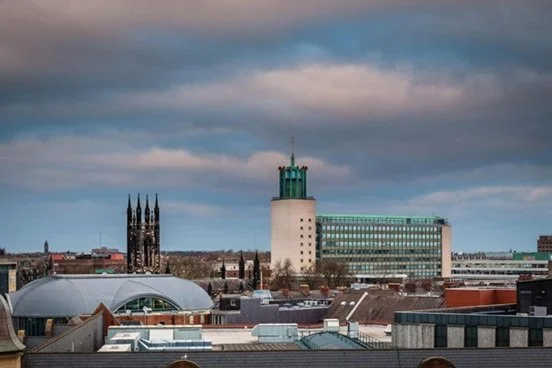
Newcastle Civic Centre, headquarters of Newcastle City Council. The authority has proposed a 4.99% council tax increase from April 2027, prompting fresh questions about value for money for Newcastle Great Park households already paying private estate management charges. Archive photo: Voello / Wikimedia Commons
Households across Newcastle Great Park could face another significant increase in council tax from April 2027, after Newcastle City Council unveiled proposals for a 4.99% rise alongside major spending cuts and plans to reduce its workforce by the equivalent of more than 300 full-time positions.
The proposals, announced on 10 November 2026, come as the council attempts to address severe financial pressures over the next three years, with a projected budget shortfall exceeding £47 million.
Council leaders say the increase is necessary to protect essential services, maintain financial stability and avoid even more damaging cuts.
However, for residents of Newcastle Great Park, the announcement raises a particularly uncomfortable question.
Why should households already paying full council tax alongside compulsory private estate management charges be expected to pay even more, when longstanding concerns about local infrastructure, estate maintenance and accountability remain unresolved?
The issue is especially relevant to residents living on privately managed and unadopted parts of Great Park, where homeowners can face additional charges for maintaining communal spaces and infrastructure that would ordinarily fall under public management elsewhere.
With councillors also promising investment in neighbourhood maintenance, roads and green spaces, residents may reasonably ask how those commitments will benefit households already contributing towards the upkeep of their own estates.
Council Tax Could Increase by 4.99% From April 2027
Newcastle City Council's proposed budget for 2027/28 includes an increase in council tax of 4.99%, representing the highest rise ordinarily permitted under the relevant referendum rules without seeking approval through a local referendum.
The proposed increase would take effect from April 2027, subject to the budget receiving formal approval.
Council leader Colin Ferguson, who heads the city's minority Liberal Democrat administration, has argued that the financial pressures facing Newcastle leave the authority with limited alternatives.
The council says inflation, increasing operating costs and growing demand for statutory services are placing considerable strain on its finances.
Adult social care is a particular concern, with an ageing population and increasing numbers of residents requiring complex support.
The authority has warned that failing to introduce the proposed council tax increase would add substantially to its financial difficulties.
According to the budget figures outlined, not implementing the maximum increase could create an additional £26.7 million funding pressure over the following three years.
For households already struggling with rising living costs, however, another increase represents an unwelcome addition to their annual expenses.
Although the exact impact will depend on each property's council tax band and the final charges agreed, most households would see their Newcastle City Council element increase if the proposals are approved.
Any changes to separately determined police and fire precepts would also need to be considered when calculating final household bills.
More Than 300 Council Jobs Could Be Lost Under Savings Plans
Alongside the proposed council tax rise, the authority is preparing significant changes to its workforce and operating arrangements.
Draft financial plans indicate that the equivalent of approximately 307.6 full-time council positions could be removed by the end of the 2027/28 financial year.
This includes approximately 113 posts identified for removal during the current financial year.
Importantly, a reduction in full-time equivalent posts does not necessarily mean the same number of employees will be made compulsorily redundant.
The council says it intends to minimise compulsory redundancies wherever possible by removing vacant positions and offering voluntary severance arrangements.
The reductions form part of what the council calls its Change and Innovation Programme.
The initiative is intended to modernise operations, reduce duplication, improve efficiency and make greater use of technology, including artificial intelligence.
Council leaders argue that the changes are necessary to ensure public money is used effectively while maintaining frontline services.
Nevertheless, the scale of the planned workforce reduction raises questions about whether residents could experience longer waiting times, reduced capacity or changes to service delivery.
The practical impact will depend on which roles are affected, how services are reorganised and whether the efficiency improvements deliver the expected savings.
Council Faces Financial Pressures Exceeding £47 Million
The council's medium-term financial planning identifies major funding pressures across the next three financial years.
The figures outlined include:
2027/28: £12.7 million
2028/29: £13.5 million
2029/30: £21.2 million
Together, these amount to £47.4 million.
In its public announcement, Newcastle City Council has described its programme as delivering approximately £45 million in savings over three years.
The difference reflects figures presented in the developing financial plans, with the final detailed budget documents expected to clarify the precise savings requirements and assumptions.
The council also plans to use approximately £4 million from its financial reserves to help balance the budget for the coming year.
However, finance officials have warned that repeatedly relying on reserves is not a sustainable long-term solution.
Reserves provide a financial safety net but cannot indefinitely cover recurring spending commitments.
This leaves the council attempting to balance competing priorities: maintaining essential public services, reducing expenditure, protecting vulnerable residents and limiting the financial burden placed on taxpayers.
Why Great Park Residents Face a Different Financial Reality
For many residents of Newcastle Great Park, the proposed council tax increase cannot be considered in isolation.
Unlike households living on fully adopted estates, some Great Park homeowners are required to pay compulsory private estate management charges in addition to their ordinary council tax bills.
These charges can contribute towards maintaining communal facilities and infrastructure, including landscaping, green spaces, drainage systems, shared areas and, depending on the development, other estate assets.
The precise arrangements vary between properties and different parts of Great Park.
However, the central issue remains the same.
Residents can be required to pay full council tax while also paying a separate compulsory charge for maintaining parts of the environment surrounding their homes.
This does not mean homeowners are paying twice for every council service.
Council tax contributes towards a much wider range of responsibilities, including adult social care, children's services, waste collection and other functions that benefit residents across Newcastle.
The Great Park Residents Group has previously acknowledged this distinction.
Nevertheless, the fact that these charges fund different responsibilities does not remove the additional financial burden.
For affected households, both bills are compulsory.
And unlike council tax, private estate management charges may be subject to different contractual arrangements, charging structures and accountability mechanisms.
Adding a further 4.99% council tax increase to this situation understandably raises questions about fairness and value for money.
Great Park Gazette Has Already Raised Concerns About Double Financial Burdens
This is not the first time Great Park Gazette has questioned the relationship between council tax and private estate charges.
On 10 October 2026, we published an article examining concerns raised by the Great Park Residents Group during Newcastle City Council's earlier People's Budget engagement exercise.
In that article, we highlighted how residents had asked the council to consider whether households required to pay compulsory private estate management charges should receive some form of financial recognition.
The group also called for stronger regulation of management companies, greater transparency over charges and clearer information about the adoption of roads and infrastructure.
At the time, the group reported that its detailed questions had not received a public response from the council through the relevant social media discussion.
That does not establish that the council had deliberately ignored the concerns, nor that a formal response would not be provided through another channel.
However, the absence of a public answer to questions raised during an exercise specifically inviting residents to discuss council tax and value for money remained a concern.
Read our previous investigation:
Now that a further council tax increase has been formally proposed, those questions have become even more pressing.
Residents are entitled to ask whether the council has considered the financial circumstances of households living on privately managed estates when developing its budget proposals.
They are also entitled to know what practical steps the authority is taking to address the long-running infrastructure and adoption issues affecting their communities.
Council Promises More Spending on Green Spaces and Neighbourhood Maintenance
Despite the financial pressures, Newcastle City Council says its proposed budget will include additional investment in services that residents experience within their neighbourhoods.
These commitments include establishing a new Neighbourhood Task Force to tackle issues such as weed killing, grass cutting and street cleaning.
The council has outlined £1 million for the initiative.
It has also reaffirmed plans for £50 million of investment in pothole repairs over a ten-year period.
Councillors are additionally expected to have access to £50,000 per neighbourhood to support local priorities.
The council says these measures demonstrate its intention to protect visible frontline services rather than simply reducing spending across the board.
For residents of Newcastle Great Park, however, the commitments raise another important question.
How will these additional neighbourhood investments benefit residents who already pay private companies to maintain communal areas around their homes?
It would be incorrect to assume that all private estate management responsibilities overlap with council services.
There are important differences between council-maintained highways and privately managed spaces, and between statutory services and contractual estate obligations.
Nevertheless, residents should be able to understand which improvements they can expect from public investment and which remain the responsibility of private management arrangements.
That distinction is particularly important on estates where infrastructure has remained unadopted for many years.
The Unresolved Issue of Estate Adoption
For Newcastle Great Park, the question of value for money extends beyond estate management charges.
Residents have repeatedly raised concerns about unfinished roads, delayed infrastructure, outstanding facilities and the responsibilities of developers.
Some parts of the development have remained subject to complex adoption arrangements for many years.
Where roads, drainage systems or other infrastructure have not been formally adopted, responsibility for their maintenance may remain with developers, management companies or other parties, depending on the legal arrangements.
This can create confusion over who is accountable when problems arise.
While adoption does not automatically eliminate every estate management charge, it can clarify responsibility for certain public infrastructure.
For residents facing another council tax increase, progress on these longstanding issues would be a tangible demonstration that their concerns are being taken seriously.
The question is not simply how much households are being asked to contribute.
It is also what progress is being made on the issues that affect their everyday lives.
Twenty-Five Years On, Great Park Residents Are Still Waiting for Roads to Be Adopted
The question of whether Great Park residents are receiving fair value for their council tax becomes even more significant when considering the estate's longstanding road adoption problems.
In October 2026, Great Park Gazette reported that 25 years after construction first began at Newcastle Great Park, significant stretches of road were still awaiting formal adoption by Newcastle City Council.
The investigation followed an update from Newcastle North MP Catherine McKinnell, who announced progress in discussions between the council and the Great Park Consortium.
According to the MP, funding had been approved for the future maintenance of a bridge on the estate's Spine Road, allowing further work to proceed on the legal agreement required for adoption.
Meanwhile, proposals to improve safety along Roseden Way were still being reviewed by council officers.
Although these developments represent potential steps forward, neither announcement provided a firm date for when the outstanding roads would finally be adopted.
There has been some progress. Melbury was formally adopted by Newcastle City Council in September 2025, demonstrating that adoption is achievable.
However, significant questions remain about other roads, including the Spine Road and Roseden Way.
This creates a particularly frustrating situation for residents who pay full council tax, contribute towards private estate maintenance arrangements where applicable, and continue waiting for infrastructure to be brought under council responsibility.
The announcement that Newcastle City Council intends to invest £50 million in pothole repairs over the next decade also raises questions about how that funding will benefit Great Park.
Will any of this investment improve roads that remain unadopted, or will those roads continue to fall outside the council's normal highway maintenance responsibilities until the outstanding agreements are completed?
It is important to recognise that road adoption involves technical assessments, safety requirements, legal agreements and financial obligations. The council cannot simply accept responsibility for infrastructure that has not met the necessary standards.
Equally, 25 years after development began, residents are entitled to expect clearer answers, realistic timescales and greater accountability from everyone involved.
Formal adoption would not necessarily eliminate private estate management charges, as these may continue to cover landscaped areas, communal facilities and other infrastructure. Nevertheless, it could clarify maintenance responsibilities and potentially affect some costs, depending on the arrangements.
With another council tax increase now being proposed, Great Park Gazette believes residents should be given a clear, publicly accessible timetable explaining which roads remain unadopted, what work is outstanding and when Newcastle City Council expects to take responsibility.
Read our previous investigation:
Great Park Road Adoption: After 25 Years, Residents Still Waiting as MP Announces 'Further Progress'
Are Great Park Residents Getting the Representation They Deserve?
The latest budget proposals also bring renewed attention to the role of elected councillors.
Newcastle Great Park falls within Castle Ward, which is represented by three councillors following the May 2026 local elections:
Councillor David Down – Liberal Democrats
Councillor Jamie Robinson – Green Party
Councillor Imran Mohammed – Green Party
Residents may have different experiences of how effectively their councillors respond to enquiries, pursue local concerns and communicate the progress being made.
The effectiveness of local representation is an important issue for Newcastle Great Park residents, particularly as households face the prospect of higher council tax bills alongside existing private estate management charges.
All three Castle Ward councillors, regardless of political affiliation, should be able to demonstrate how they are representing residents' interests, addressing longstanding infrastructure concerns and holding the council accountable for its decisions.
Great Park Gazette has previously raised questions about councillor attendance, engagement and the progress being made on local issues. These are legitimate matters for public scrutiny, and residents deserve clear answers from their elected representatives.
Such assessments are matters of experience and opinion rather than definitive measures of a councillor's work.
It is also important to recognise that councillors undertake work outside public meetings, including correspondence, casework and discussions with council officers.
However, residents are entitled to expect transparency about the actions their representatives are taking, regardless of political party.
With households potentially facing higher bills, questions about how councillors represent their interests are particularly relevant.
This should not be about political allegiance.
It should be about accountability, communication and demonstrable progress.
Previous Gazette Investigation Raised Questions About Councillor Attendance
On 17 October 2026, Great Park Gazette examined whether local councillors can realistically balance paid employment with the demands of representing residents.
Our article drew on Local Government Association research and Newcastle City Council's published attendance records.
It highlighted concerns about participation in Planning Committee meetings following election commitments to challenge further housing development and prioritise essential infrastructure.
The investigation found that a Castle Ward councillor serving as Vice-Chair of the Planning Committee had attended one of five recorded meetings during the period examined, with apologies submitted for the remaining four.
Those figures raised questions about participation in decisions affecting Great Park, particularly where planning and infrastructure had featured prominently in election campaigning.
However, the article also made clear that the publicly available information did not establish the reasons for those absences or demonstrate that employment commitments were responsible.
Nor did it establish that the attendance record had changed the outcome of any planning decision.
The broader question remains relevant today.
If councillors are asking residents to accept higher council tax bills while the authority reduces its workforce, what assurance can they provide that local concerns are receiving effective scrutiny?
Read our previous article:
Can Councillors Balance Paid Employment With the Demands of Representing Residents?
What Has Newcastle City Council Said?
Council leader Colin Ferguson has defended the proposals, arguing that Newcastle must modernise its services while dealing with substantial financial pressures.
He has stated that the administration wants to protect essential services and avoid making short-term cuts that could create greater difficulties in future years.
The council says its priorities include protecting vulnerable residents, improving neighbourhoods and maintaining financial sustainability.
The proposed budget will also retain the Council Tax Support scheme, which provides help to eligible households experiencing financial hardship.
These commitments are important.
The rising cost of adult social care, increasing demand for children's services and wider pressures on local authority finances are genuine challenges.
However, acknowledging those challenges does not mean residents should be discouraged from questioning the fairness of proposed increases or examining how effectively public money is spent.
For households in Great Park, the council's explanation of its financial position should form part of a wider discussion about what residents are receiving in return for their contributions.
What Questions Should Great Park's Councillors Be Answering?
With the budget consultation approaching, there are several issues on which greater clarity would be valuable.
1. Council tax and estate management charges
Will the council acknowledge the additional compulsory financial burden faced by some residents of privately managed and unadopted estates?
Would it support national consideration of a council tax allowance, rebate or other form of financial recognition for affected households?
2. Estate adoption
What progress is being made towards resolving outstanding infrastructure and adoption issues across Newcastle Great Park?
Can residents receive clearer information showing which assets remain unadopted, why adoption has not happened and who is responsible for resolving the outstanding work?
3. Neighbourhood investment
How will the proposed Neighbourhood Task Force and additional green-space investment benefit areas where significant maintenance responsibilities are privately funded?
4. Workforce reductions
What safeguards will be introduced to ensure that reducing council staffing does not result in unacceptable delays or deterioration in services?
5. Local representation
How will all three Castle Ward councillors demonstrate that they are actively representing residents' concerns during the budget consultation?
Will they publicly explain their positions on the proposed council tax increase and the additional financial pressures faced by households paying estate management charges?
These are reasonable questions that should be addressed through a transparent public discussion.
They do not require councillors to agree with every proposal put forward by residents.
They require clear explanations, evidence of action and accountability for decisions affecting the community.
When Will the Council Tax Increase Be Decided?
The proposed budget is expected to be considered by Newcastle City Council's Cabinet on Monday 16 November 2026.
A formal public consultation is scheduled to begin on Tuesday 17 November, giving residents an opportunity to express their views before the final budget is agreed.
The consultation is expected to continue until 29 December 2026, although residents should check the council's published consultation information for the confirmed closing date.
Following consideration of the consultation responses and any revisions to the proposals, the budget will be submitted to a meeting of the full council for a final decision in the new year.
The proposed 4.99% rise is therefore not yet a formally approved council tax increase.
Residents still have an opportunity to make representations before the final decision.
Information about the budget and consultation process can be found through Newcastle City Council:
Newcastle City Council – Budget and Consultation Information
Residents can also visit the council's public engagement website:
Let's Talk Newcastle – Budget Consultation
Great Park Residents Should Make Their Voices Heard
The coming consultation provides an important opportunity for residents of Newcastle Great Park to raise concerns about the combined financial impact of council tax and private estate management charges.
It is entirely reasonable for the council to explain that rising demand for statutory services requires additional funding.
It is equally reasonable for residents to ask whether the current arrangements provide fair value for money.
A household paying full council tax and an additional compulsory management charge is facing a different set of financial obligations from a household without those private charges.
That does not automatically create a legal entitlement to a council tax discount.
It does, however, raise a legitimate question about whether the present system is equitable and whether national or local reforms are needed.
The council's proposals to improve neighbourhood maintenance and roads are welcome in principle, but residents should be able to identify how those investments will affect their own communities.
Similarly, promises to improve efficiency must eventually be measured against actual service standards.
For Great Park households, the issue is not simply whether council tax increases by 4.99%. It is whether residents can see meaningful improvements, fair treatment and effective representation in return for the money they are required to pay.
Have Your Say
Do you think Newcastle City Council is justified in proposing a 4.99% council tax increase for 2027/28?
Are households on Newcastle Great Park getting fair value for money when many already pay compulsory estate management charges?
Do you believe our three Castle Ward councillors are doing enough to represent local concerns, or would you like to see greater communication and accountability?
And what improvements would you expect to see if the council tax increase goes ahead?
We would like to hear your experiences and opinions.
Join the discussion in the Great Park Residents Group on Facebook and let us know what you think.
Great Park Gazette will continue to follow the budget proposals, the public consultation and their implications for residents as the decision-making process progresses.
Further Information and Sources

