Five-year concern over A1 boundary fencing behind Barmoor Drive remains unresolved
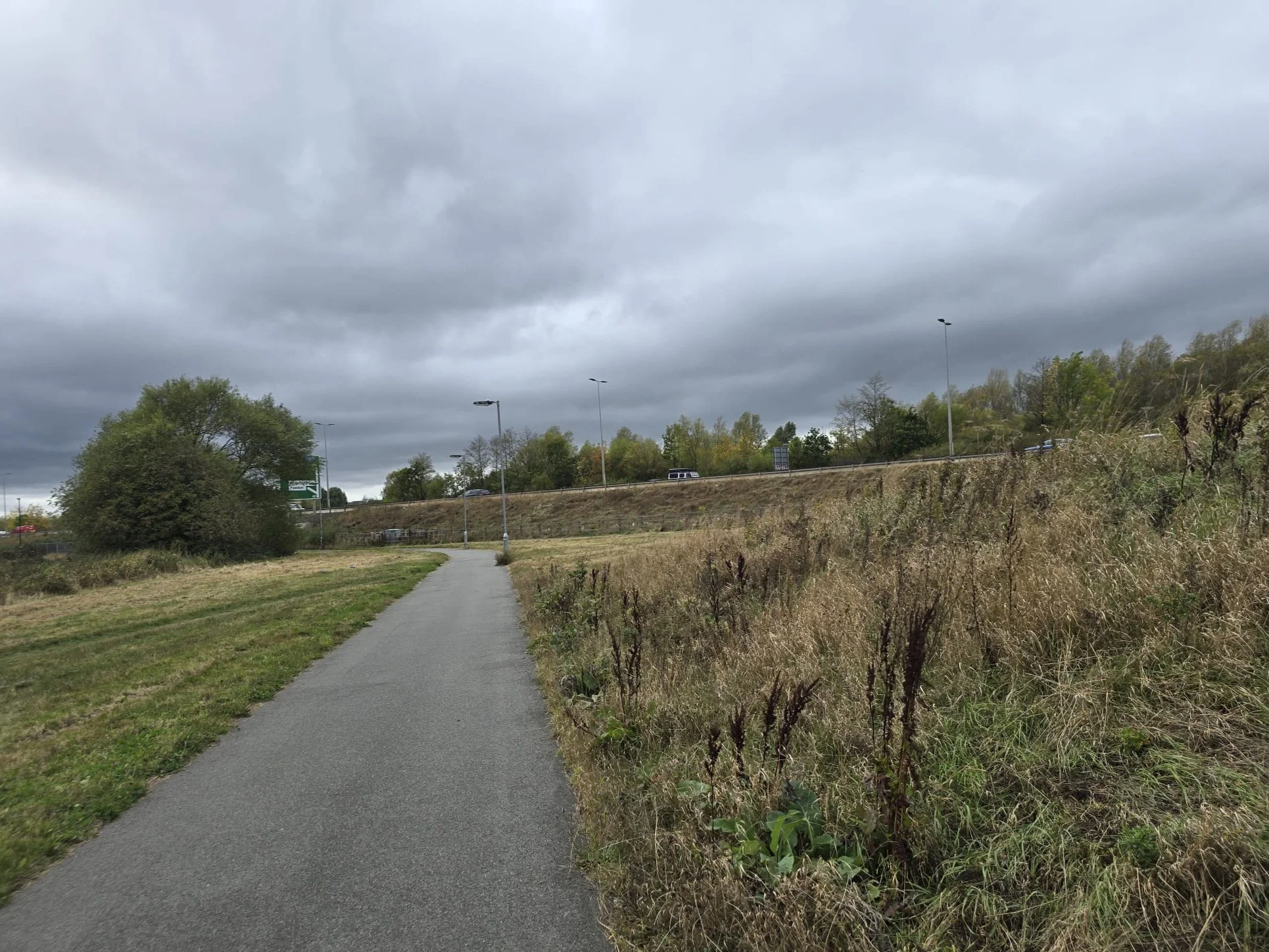
A1 motorway
A Great Park resident has renewed a long-running call for improved fencing between the residential area around Barmoor Drive and the A1, after raising concerns about the condition and effectiveness of the boundary for more than five years.
Correspondence supplied to Great Park Gazette shows that concerns about the land, vegetation and fencing alongside the A1 have been raised repeatedly since 2021.
The resident believes the existing fencing does not provide an adequate barrier between the Great Park open space and one of the busiest roads in the area, particularly for wildlife and domestic animals.
The issue has previously been raised with the office of Catherine McKinnell, the Great Park developers and, more recently according to the resident, through the Kingston Open Spaces reporting system.
However, the resident says the underlying concern remains unresolved.
CONCERNS DATE BACK TO 2021
The earliest correspondence supplied to Great Park Gazette dates from 24 March 2021.
At that time, the resident contacted Catherine McKinnell raising concerns about works taking place alongside the A1 behind Barmoor Drive.
The resident said trees and vegetation that had previously provided a substantial buffer between homes and the A1 had been removed during works in the area.
Her concerns included the impact on wildlife, the loss of screening between residential properties and the road, traffic noise, air pollution and the absence of what she considered adequate fencing.
She asked whether there were plans to provide additional fencing between Great Park and the A1 and whether trees removed during the works would be replaced.
The resident also argued that the vegetation had previously provided some protection for wildlife and created a physical and visual barrier between homes and the road.
These statements represent the resident’s account of the works and their impact.
SPECIFIC FENCING CONCERNS RAISED IN SEPTEMBER 2021
The fencing itself was raised directly again in correspondence dated 21 September 2021.
In that email, the resident specifically referred to the fencing at the rear of Barmoor Drive alongside the A1.
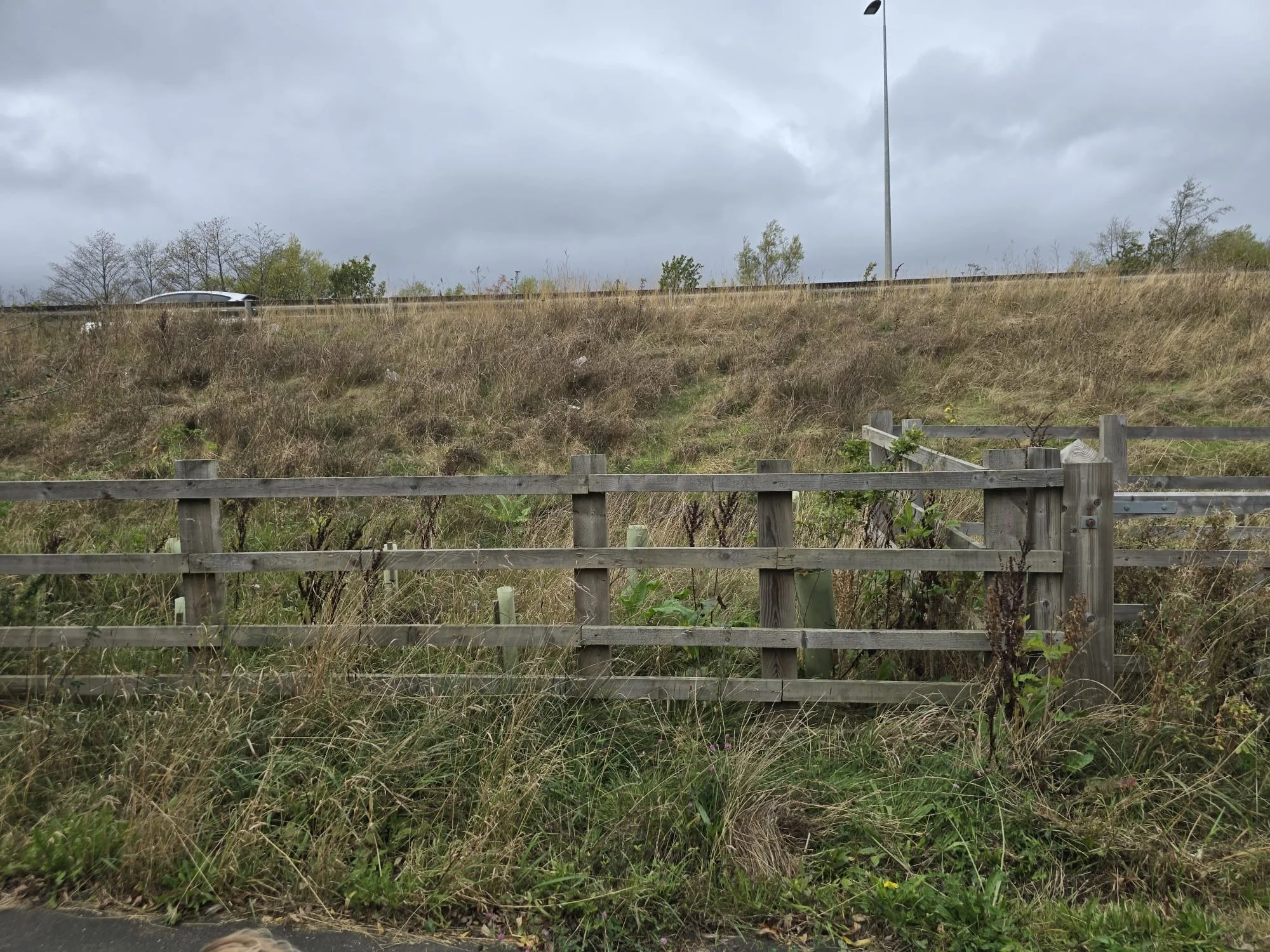
She said there were large gaps and asked whether a more permanent and secure form of fencing could be installed.
One suggestion was for mesh to be added to reduce the possibility of animals passing through the boundary and entering the road.
Her concern was that an animal gaining access to the A1 could create a danger both to the animal and to motorists.
The correspondence shows that this was therefore not simply a recent complaint about a damaged section of fencing, but part of a wider safety concern that had already been raised several years ago.
PHOTOGRAPH SHOWED DAMAGED FENCING IN 2023
Further correspondence from February 2023 included a photograph of the fencing close to the A1.
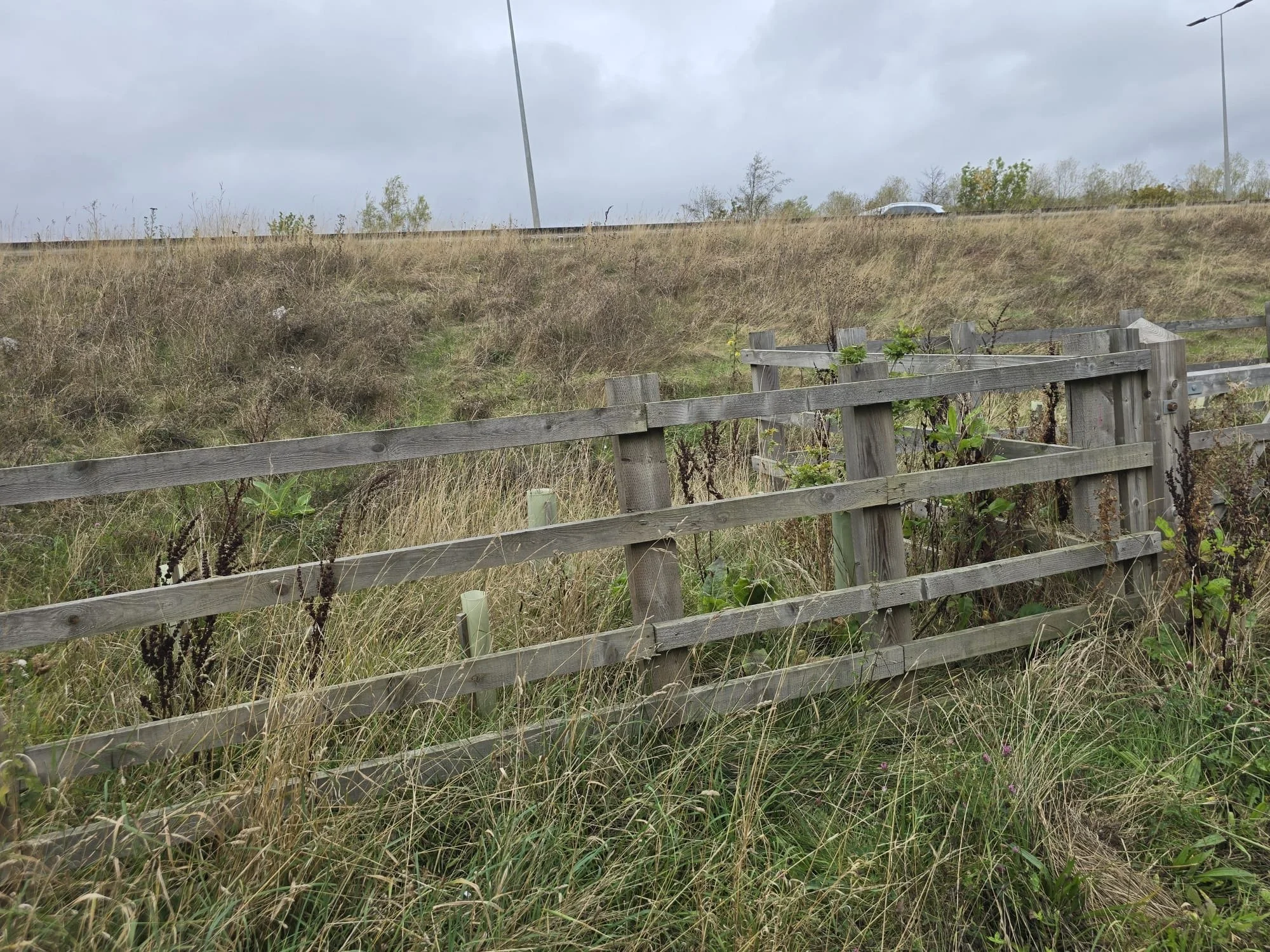
The image supplied to Great Park Gazette shows a section of timber and wire fencing beside the embankment, with part of the structure appearing damaged or displaced.
Traffic can clearly be seen travelling on the A1 immediately beyond the embankment.
Alongside the photograph, the resident again called for more substantial fencing and suggested that a fence approximately six feet high should be provided.
It is important to make clear that this is the resident’s preferred solution.
The material supplied to Great Park Gazette does not establish that a six-foot fence is a legal or technical requirement for this particular location.
RESIDENT SAYS FENCE WAS REPAIRED RATHER THAN REPLACED
In her latest correspondence with Great Park Gazette, the resident said repairs were subsequently carried out to damaged fencing.
However, she believes the fencing should have been replaced rather than repaired.
She told Great Park Gazette that she has now been raising the wider issue for approximately five years.
She also said she submitted the issue through the Kingston Open Spaces website several months ago but no longer has evidence of the submission or a reporting reference.
She says she received no response.
Because no acknowledgement or reference number has been supplied, Great Park Gazette has not been able to independently verify that particular report to Kingston Open Spaces.
Residents reporting estate maintenance issues are therefore encouraged to retain confirmation emails, screenshots and reference numbers wherever possible.
WILDLIFE AND ROAD SAFETY CONCERNS
A central part of the resident’s concern throughout the correspondence has been the possibility of animals gaining access to the A1.
She says both domestic animals and wildlife are able to move through or around inadequate sections of fencing and believes this creates a potential collision risk.
The resident has told Great Park Gazette that dogs and deer have previously been killed after reaching the motorway or road.
Great Park Gazette has not independently verified individual incidents involving animals at this particular section of fencing, and we therefore present this as the resident’s account.
There is, however, separate correspondence concerning wildlife and road safety elsewhere at Great Park.
In correspondence supplied by the resident from 2026, Newcastle City Council responded to an enquiry regarding a traffic collision involving a deer at Great Park.
That correspondence concerned requests for wildlife warning signage rather than the Barmoor Drive fencing itself.
The council explained at the time that roads in Great Park west of the A1 had not yet been adopted as public highway and were being managed by the Great Park Consortium while highway infrastructure was being prepared for adoption.
The council said warning signage would need to satisfy Department for Transport guidance as part of that process and that the matter would be raised with the Great Park Consortium.
That correspondence does not establish responsibility for the particular boundary fence behind Barmoor Drive, but it demonstrates that wildlife and road-safety concerns have separately been raised with the authorities.
WHAT HAPPENED TO THE VEGETATION?
The resident has consistently linked the fencing concern with the loss of trees and shrubbery alongside the A1.
Her 2021 correspondence describes the vegetation as having previously provided a substantial buffer between homes, wildlife and the road.
She believes the removal of this vegetation made the condition and effectiveness of the fencing more important.
The correspondence supplied does not contain an official response confirming precisely what vegetation was removed, why each section was removed or what replacement planting was required.
This remains one of the areas where further clarification would be useful.
PREVIOUS RESPONSE ABOUT LAND BEHIND BARMOOR DRIVE
Separate correspondence subsequently obtained through Catherine McKinnell’s office provides some additional information about the open land behind Barmoor Drive.
A response relayed from the developers said their landscaper had visited the area following contact from a resident and had inspected the site after a period of heavy rainfall.
That response focused primarily on the drainage ditch running through the area and on questions surrounding an informal walking route.
The developer said the ditch ran for much of the length of the development and was intended to collect rainfall from the bund and intercept overland flow towards properties.
The site inspection reportedly found only minor obstructions and concluded that the drainage feature appeared to be functioning.
The response also said there were no drawings showing a formally designated “welly walk” behind Barmoor Drive.
According to the developer, some pathways in the area had instead developed informally through residents walking through open space and woodland.
The land was described as having an ecological mitigation purpose.
While this correspondence provides useful background about the land between the properties and the A1, it did not appear to resolve the separate concern about the adequacy of the boundary fencing.
WHO IS RESPONSIBLE FOR THE FENCE?
One of the most important unanswered questions is who is responsible for inspecting, maintaining and, if necessary, replacing the particular section of fencing behind Barmoor Drive.
The correspondence supplied to Great Park Gazette does not provide a definitive answer.
The A1 through Newcastle forms part of England’s strategic road network, which is managed by National Highways.
National Highways guidance recognises boundary fencing as a road-safety measure that can be used where there is a risk of animals straying into the carriageway.
It also stresses the importance of maintaining fencing where a need has been identified.
However, responsibility for an individual fence can depend on precisely where the legal highway boundary lies, who owns the adjoining land, why the fence was originally installed and any agreements associated with the development or highway works.
The fact that a fence is immediately beside the A1 therefore does not by itself establish who is responsible for it.
Clarification is needed over whether this particular boundary belongs to National Highways, the Great Park Consortium, the estate management arrangements or another landowner.
WHAT NEEDS TO BE ESTABLISHED NOW?
After five years of correspondence, there are several straightforward questions that could help establish what action, if any, is required:
• Who owns and is responsible for the fencing behind Barmoor Drive alongside the A1?
• When was the fencing last formally inspected?
• What repairs have previously been undertaken?
• Was the fencing installed as part of the original Great Park development, the A1 improvement works or for another purpose?
• Is the existing fencing considered suitable for preventing dogs and wildlife from reaching the A1?
• Are there any recognised gaps or damaged sections requiring further repair?
• Is replacement fencing planned?
• Is additional mesh or wildlife fencing considered necessary?
• Were trees or shrubs removed as part of previous highway works, and was replacement planting required?
• Is there any documented record of animal collisions associated with this section of the boundary?
• Which organisation should residents contact when there is damage to this particular fence?
REPORTING THE ISSUE
Great Park Gazette does not replace the official estate maintenance reporting process.
Residents who identify damaged fencing, paths, communal infrastructure, landscaping or other maintenance issues should first report them through the appropriate official channel.
Estate maintenance issues can be reported to Kingston Open Spaces at:
https://kingstonopenspaces.co.uk/report-a-repair/
Residents are advised to retain any reference number, acknowledgement email or screenshot showing when the report was submitted.
Where an issue has already been reported but remains unresolved, residents can then contact Great Park Gazette through the Contact page and ask us to consider documenting it within our Estate Management section.
GREAT PARK GAZETTE POSITION
Great Park Gazette has published this issue because the correspondence supplied shows that concerns regarding the A1 boundary behind Barmoor Drive have been raised repeatedly over a number of years.
Publication should not be interpreted as concluding that the existing fencing is legally inadequate, that a particular organisation has failed in a statutory duty, or that a six-foot replacement fence is required.
Those matters would require confirmation from the organisations responsible for the land and highway boundary.
What the correspondence does demonstrate is a long-running resident concern which has not, from the resident’s perspective, been satisfactorily resolved.
Great Park Gazette would welcome clarification from Kingston Open Spaces, the Great Park Consortium, Newcastle City Council, National Highways or any other organisation responsible for the land or fencing.
If further information or an official response is received, this article can be updated.
A1 motorway fencing
A1 motorway fencing
